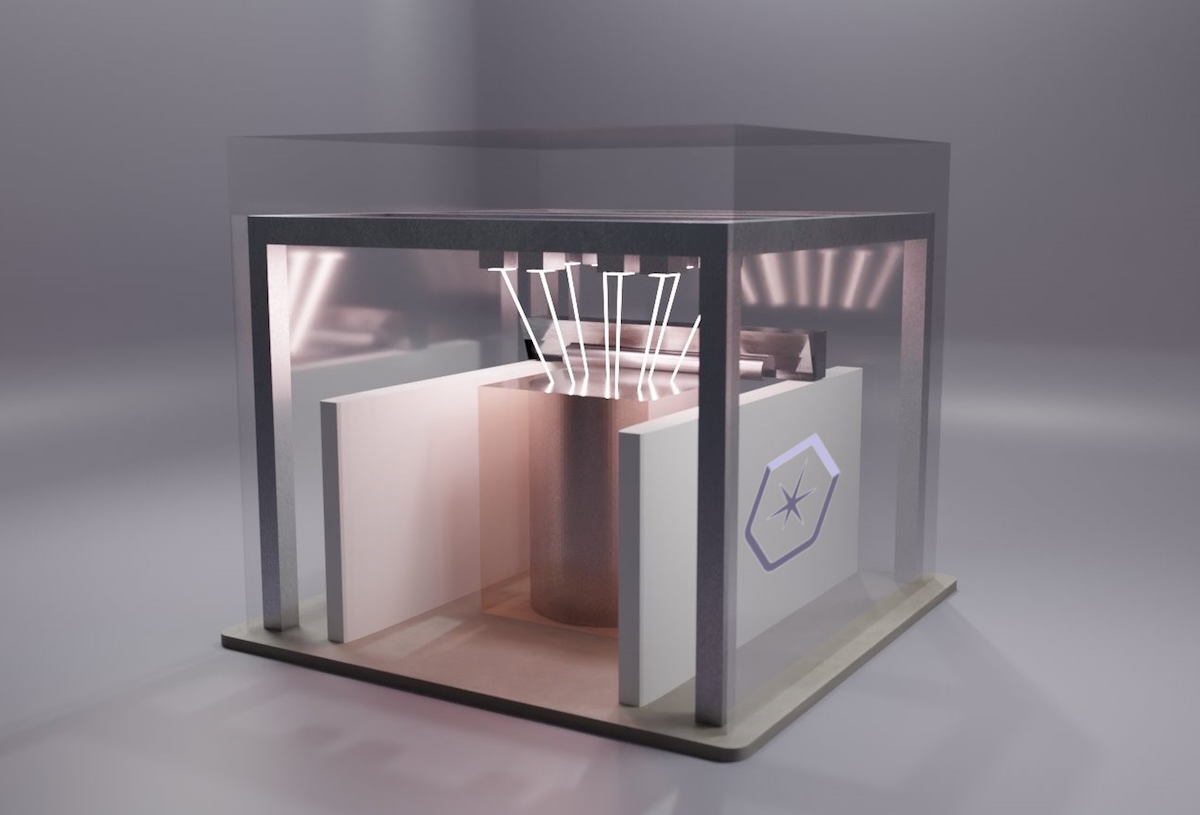

AddUp is introducing a new 3D printer aimed at producing large metal parts with dimensions of up to 1.5m x 1.5m x 2m. The project, called MASSIF (Metal Additive System, Sustainable, Industrial, Eco-Friendly), uses Powder Bed Fusion (PBF) additive manufacturing. With it, AddUp aims to increase productivity, reduce costs and respond to sustainability requirements.
AddUp is a player in the field of metal additive manufacturing. It specialises in developing technologies for the production of complex metal parts. The company is a joint venture between industrial group Fives and French Michelin. AddUp focuses on improving productivity and efficiency in the metal processing industry using additive manufacturing.
The first PBF machine developed by AddUp has a print volume of 750 mm x 750 mm and a height of 1 m. The new machine uses AddUp's FormUp 350, a platform designed for demanding industrial environments. The FormUp 350 has long been used for series production. Customers use the technology to supply critical components, such as medical implants and aerospace parts, among others.
Productivity and cost benefits
MASSIF offers several productivity and cost advantages. According to AddUp, the technology can increase productivity by 300%, while simultaneously reducing the cost per part by 50-70%. It also reduces wastage of the powder material it uses. This leads to cost savings and also improves the sustainability of the system.
3D printer also minimises the need for post-processing. AddUp reports that the machine can deliver high-quality parts directly from the printer, which are finished immediately. In-process monitoring is also available, increasing the accuracy of the production process. This reduces the amount of quality control required after the printing process.
Various partners involved
Several partners are involved in the MASSIF project. These include Cailabs, CETIM, Dassault Systèmes, ISP Systems and Vistory. The consortium receives support from the #France2030 programme for "Robots and Intelligent Machines of Excellence". The aim of the project is to create an automated industrial ecosystem by 2030, contributing to both economic growth and sustainability.
Within the consortium, AddUp is responsible for designing the new machine and building a prototype that integrates the technological foundations of the production process and quality control. Cailabs is focusing on developing laser beam shaping solutions to increase print speed and thus improve the machine's productivity. ISP Systems is working on a dynamic beam forming solution to optimise laser beam focus quality.
Virtual models and prototype testing
Dassault Systèmes deploys its 3DEXPERIENCE platform to use realistic data to create virtual models, which can simulate products, processes and factory operations in a virtual environment. This supports the efficient manufacture of certified critical parts. Vistory develops solutions that ensure the confidentiality and integrity of manufacturing data, protecting makers' industrial property rights and ensuring traceability of operations.
CETIM is testing MASSIF's prototype in its own facilities. CETIM is also integrating the final machine into its new Printing Bourges centre. Here it will validate the manufacturing parameters for different materials and also produce the first demonstration parts for various target markets.
Author: Wouter Hoeffnagel









