

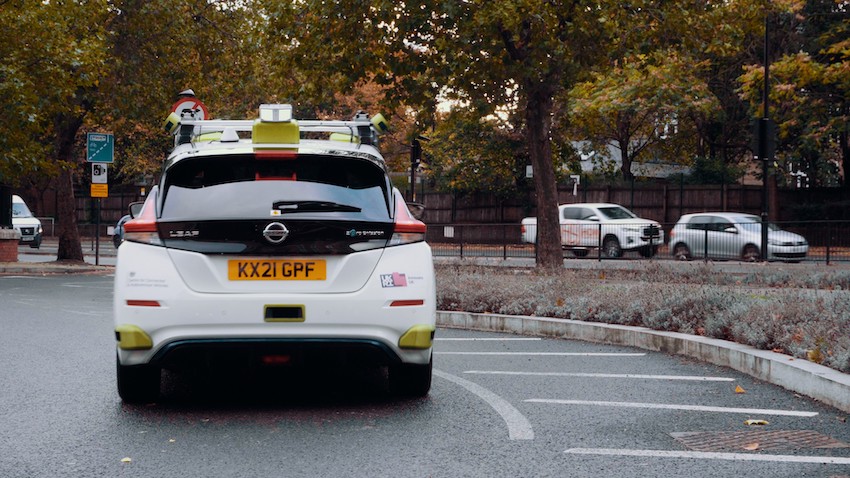
Nissan is sending an autonomous Leaf onto London's roads. The tests are part of ServCity, a project centred on autonomous mobility services. And should demonstrate how cities can use the latest autonomous vehicle technologies and integrate them into urban environments.
ServCity is a £100 million mobility fund from the UK government. It is managed by the Centre for Connected and Autonomous Vehicles (CCAV). Some six partners are involved in the project: Nissan, Connected Places Catapult, TRL, Hitachi Europe, the University of Nottingham and SBD Automotive. The parties are working together to develop a blueprint that removes barriers to the deployment of autonomous vehicles in UK cities.
Smart Mobility Living Lab
The project has been running for some time. Until now, simulations and tests were mainly carried out on private test tracks. From 21 October 2022, however, the parties will start testing on public roads for the first time. The tests will take place at the Smart Mobility Living Lab (SMLL) in Greenwich, London. This will use public and private roads in London to develop and validate new mobility and transport technologies in a connected environment.
Over time, this living lab should lead to safer, cleaner, more sustainable, more accessible, more intelligent and better aligned transport systems. The focus here is on innovative ideas and their commercialisation. ServCity argues that rolling out new mobility services makes no sense if they operate in silos. "There are too many dependencies and factors outside the view of service providers to work independently," ServCity says on its website.
Integration of mobility services
The project therefore focuses on integrating autonomous mobility services. Using a practical and pragmatic approach, ServCity aims to help policymakers and authorities shape their mobility strategies for the future.
The test will make use of the capabilities offered by the SMLL. These include roadside sensors, as well as data processing capabilities. The parties want to set up an infrastructure environment that contributes to the self-learning capability of connected autonomous vehicles.
Enhancing usability
Specifically, the parties involved want to make autonomous vehicles more user-friendly. In addition, ServCity should give users the confidence that they can react quickly and safely to any situations they may face on the road. Bob Bateman, Project Manager at Nissan: "We are immensely proud to be part of the ServCity project and delighted to be able to use our 100% electric Nissan LEAF as a test vehicle in this. Our Nissan Intelligent Mobility strategy strives for a mobility future that is more electric, autonomous and connected. We look forward to making this possible with the project's other partners."
Lucien Linders, general manager of SMLL, added: "As a world leader, TRL is committed to developing safe mobility systems that are accessible to all. TRL's Smart Mobility Living Lab is a true urban test site whose roadside sensor infrastructure and facilities support the development process for CAVs. As the calling card of CAM Testbed UK's urban test facilities, we are uniquely placed to test future mobility services in preparation for commercial deployment. We are very proud to offer our expertise and work with the other project partners."
Addressing complex technical challenges
Nick Blake, Chief Innovation Strategist at Hitachi Europe, says: "Hitachi's European Research & Development Group team is focused on tackling the complex technical challenges involved in autonomous driving in crowded urban environments. Our role in the project is to develop the technology behind predicting - and safely responding to - other moving road users and other cars and providing accurate and robust localisation solutions."
Chair of Transport Human Factors at the Human Factors Research Group at the University of Nottingham Gary Burnett reports, "Our team has considerable expertise in conducting and analysing user studies and in evaluating human-computer interactions. We are excited about our role in generating theories, models and methods behind the user experience of the occupants of autonomous vehicles. Therefore, we will ensure that the design and development of the autonomous vehicle service is user-centric and truly aligned with consumer needs."
User experience is central
Andrew Hart, Director SBD Automotive, added: "Autonomous vehicles such as taxis have the potential to fundamentally change mobility for both consumers and cities involved. The user experience is most important here. Customer expectations must be carefully balanced against the technological constraints of the real world. SBD is proud to be part of the project, where we can leverage our decades of hands-on experience with car manufacturers to ensure a seamless driving experience that way."
Author: Wouter Hoeffnagel








