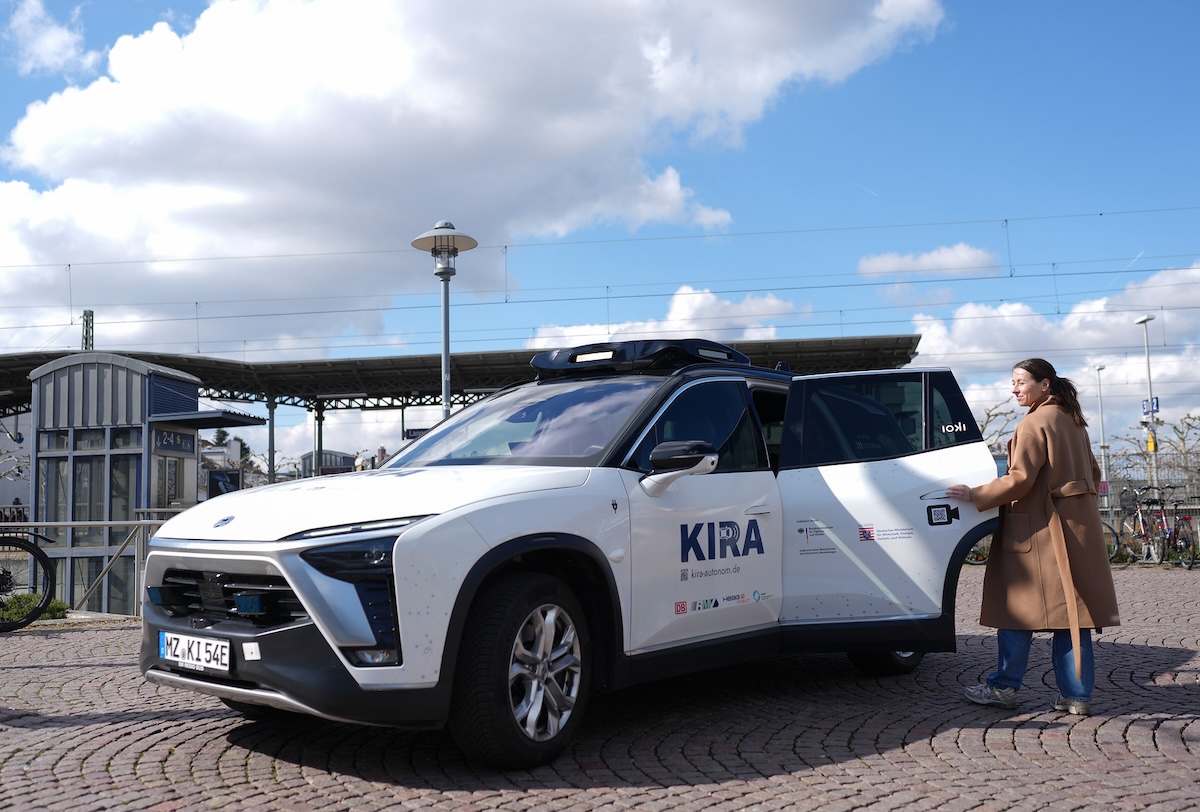

Passengers can be transported by autonomous taxi in the German cities of Langen and Egelsbach, near Frankfurt. The shuttles navigate fully autonomously, determining their own route. However, for safety reasons, there is a human behind the wheel who can intervene if necessary.
This is a project by Deutsche Bahn (DB) in collaboration with the Rhein-Main-Verkehrsverbund (RMV). The parties are thus introducing the first robotic taxi service on European soil. The initiative is called KIRA, which stands for 'Künstliche Intelligenz-basierter Regelbetrieb von autonomem On-Demand-Verkehr'.
Level 4 autonomy
The shuttles operating as part of the project in Langen and Egelsbach are autonomous vehicles with automation level Level 4, meaning that the vehicles can move autonomously within a predefined area, without the need for driver input.
The vehicles operate in areas normally served by regional public transport companies and project partners HEAG mobilo and Kreisverkehrsgesellschaft Offenbach (kvgOF). In doing so, the shuttles drive between regular traffic, reaching speeds of up to 130 kilometres per hour. The parties involved stress that the autonomous vehicle determines all the vehicle's driving manoeuvres.
Human driver present
For safety reasons, a human driver is present during each ride. In addition, the vehicles' driving manoeuvres are remotely monitored and supervised by staff from a control centre. Passengers can contact the control centre from the vehicle at the touch of a button. A technical team is also on standby, ready to come to the rescue in case of any incidents or unforeseen circumstances.
The shuttles used are NIO ES8 vehicles equipped with an autonomous driving system from Mobileye. The vehicles are electrically powered and offer a range of 400 kilometres. In the configuration deployed during KIRA, the NIO ES8 accommodates three passengers.
Letting people experience autonomous driving
"Autonomous driving is a central key technology for innovative, environmentally friendly and barrier-free mobility. In the long run, this should therefore become mainstream everywhere in Germany. With our support for the KIRA project, we want to enthuse citizens locally for this technology: they can be picked up by autonomous shuttles and taken to their destination easily and comfortably. In this way, we make autonomous driving experienceable and show how this form of mobility can improve the quality of life of people in the region," says Patrick Schnieder, Federal Minister for Transport.
Kaweh Mansoori, Minister for Economy, Energy, Transport, Housing and Rural Areas in Hesse, points out that Hesse is the first German state where passengers can use this form of mobility. Minister Mansoori: "Our goal is to make public transport attractive and accessible to all people - especially also in suburban and rural regions. Autonomous driving in public transport is an important key here to ensure mobility for all and improve quality of life. This is why we are following the KIRA pilot project with great interest - it is a blueprint for the mobility of the future."
'Making public transport available and more attractive to all'
Prof Knut Ringat, Chairman of the Management Board Rhein-Main-Verkehrsverbund, is enthusiastic about the initiative. "With autonomous driving, public transport can be offered anytime and anywhere in the future. This will benefit rural regions in particular. If driverless, flexibly bookable minibuses run 24/7 where today line buses only run a handful of times a day, then public transport will become available to everyone and significantly more attractive," says the professor.
"With the 'lighthouse project' KIRA, we are moving forward and deploying autonomous vehicles with passengers in normal traffic for the first time in Germany during a test. With this, we are on the way to complementing and expanding public transport offers in the 30s with autonomous on-demand shuttles, especially in rural areas." The term lighthouse project is used in Germany for projects that should signal various follow-on projects.
More information on the KIRA project is available here.








