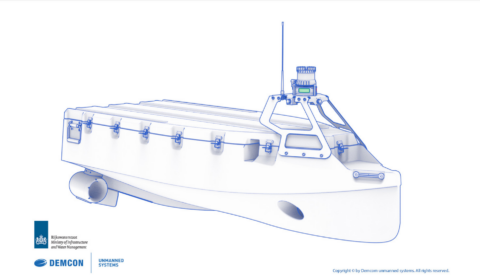
To efficiently monitor offshore installations, such as wind turbines, four Dutch companies developed a concept for an Autonomous Guard Vessel (AGV) in collaboration with a US partner.
The unmanned vessel is electrically powered and returns periodically to an on-site charging station to recharge its batteries. As no crew quarters are required, the AGV is considerably smaller and lighter than existing surveillance vessels. And a smaller, lighter design also means lower energy consumption. The AGV can be fitted with solar panels on deck so that essential functions can be carried out even when the batteries are nearly flat. To ensure non-stop surveillance, several AGVs are deployed simultaneously and assigned to multiple locations. In this way, even when one boat is moored and being recharged, another can go on patrol.
Clean and lean
This clean and lean concept to replace conventional surveillance vessels originated in a project group facilitated by LISA, a community for maritime professionals. The project group resulted in a consortium consisting of C-Job Naval Architects, SeaZip Offshore Service, Sea Machines and, more recently, MARIN and eL-Tec electrical engineering BV. Their combined industry knowledge has led to this viable, innovative and sustainable alternative that benefits both wind turbine owners and operators of guard vessels.
The AGVs detect and identify intruding vessels through a combination of optical cameras, radar and the existing automatic maritime identification system (AIS), an automatic tracking system based on transponders that transmit data such as speed and course of ships. If a vessel gets too close to the offshore installation, the AGV sends a warning via radio, and then comes alongside and physically escorts the vessel out of the area. In this way, collisions with and damage to offshore installations are prevented. Should that vessel fail to comply with the request, the AGV's video system could record the incident for possible later prosecution. Moreover, if necessary, the AGV could alert personnel at a command centre ashore or on the mother ship, who could take over in real time and operate it remotely.
With the development, the group of companies aims to improve the security process of an offshore environment while integrating sustainable solutions and reducing overall costs.