A world first for TU Eindhoven and BAM Infra Nederland. The parties are working together on the world's first 3D printed bicycle bridge. It will be located in the Brabant town of Gemert and is due for completion in September this year.
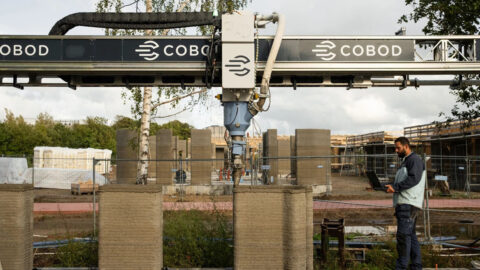
The special printing technique was developed at TU Eindhoven; a 3D concrete printer was commissioned there two years ago. BAM is now applying it for the first time in a concrete project.
Prestressed
The printing process has been developed in such a way that the reinforcement is printed along with it. While laying a concrete strip, the concrete printer immediately inserts a steel cable. With those cables, the bridge is "pre-tensioned", so that no tensile stress can occur in the concrete; concrete cannot withstand that well.
In recent months, the researchers in the group of Theo Salet, professor of concrete structures, first made a scale model (1:2). They tested this in terms of safety, including by placing a load of 2,000 kilos on it. Now that it appears that this can be done safely, they will start printing the concrete elements, which will later be glued to form a bridge.
The bridge will be constructed from eight elements of one metre in length that TU Eindhoven's printer produces vertically. Each print run adds a centimetre of concrete, which then forms one whole with the concrete already there. The concrete has a specific composition that ensures the material retains its shape once printed. After drying, those elements are put together and tie rods are applied. This is then taken to Gemert where it is placed between the two bridge heads and the tie rods are tensioned. The bridge is 8 metres long and 3.5 metres wide. Witteveen + Bos was responsible for designing the bridge.
Less material
The unique production method means less material is needed to make the bridge. "We are connecting for the future," said Marinus Schimmel, director of BAM Infra Netherlands in a press release. "We are constantly looking for a newer, smarter approach to solve infrastructural issues and thus make a significant contribution to improving mobility and making our society more sustainable. Innovation plays a crucial role here. With 3D printing, we do not need auxiliary materials such as formwork. This generates significantly less waste and we need to use fewer scarce raw materials. It also has a positive effect on the amount of CO2 emissions during the bridge production process."

BAM's goal is that 3D printing can eventually be deployed on site. The printer is taken to where a structure needs to be made, prints it and goes to the next workplace. This could bring huge benefits in terms of construction time, environmental impact and costs. Theo Salet, TU/e professor: "Thanks to the use of robots, each design can be realised uniquely each time with the same effort. An important additional advantage is that all information gathered in the design process can now also be passed on directly to the implementation. This is an important development in the field of Building Information Management (BIM), as it brings the parties in the chain closer together. It is ultimately the end user who benefits from this, in the form of higher quality and customisation."
Bridge in Madrid
The Dutch project is not the first 3D-printed bridge. Last year, the Institute for Advanced Architecture of Catalonia (IAAC) 3D-printed a pedestrian bridge in Madrid. This bridge has the same style as Gaudí's architectural designs. There are few details about the 3D printer used. The developers did reveal that it was a powder-based process and that the concrete was reinforced with thermoplastic polypropylene.
By: Kelly Bakker
Source: BAM Infra/TU/e