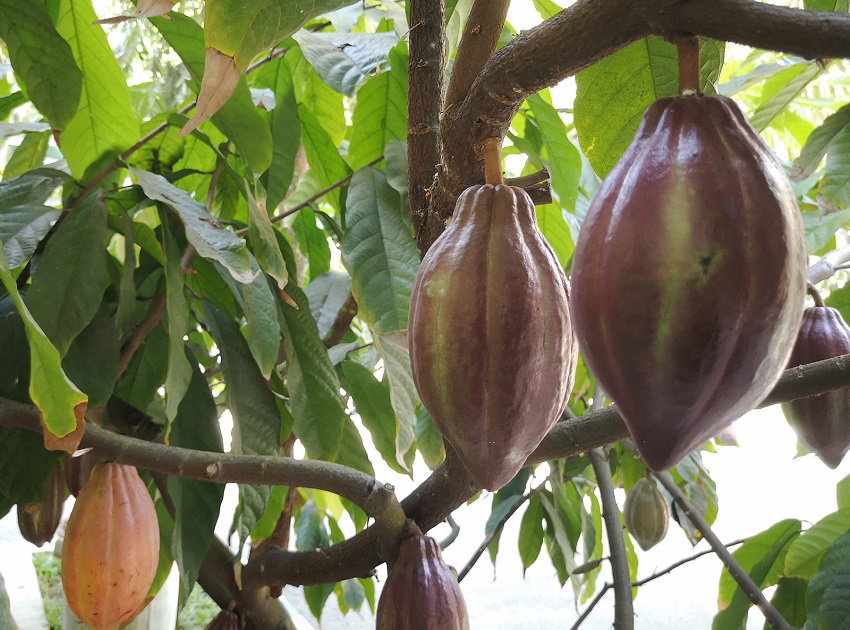

Cocoa is an important part of Brazilian agriculture. However, the cocoa fruit is susceptible to fungal diseases. This is something that the University of Campinas, Brazil, and researchers at the Fraunhofer Institute for Process Technology and Packaging (IVV) want to address together. In the "Damaged Beans" project, they want to find new ways to use the damaged cocoa fruit. Especially for the production of cosmetics, mould-damaged cocoa beans could be a valuable raw material.
Cocoa cultivation is a key pillar of the economy in Central and South America. It is primarily used for the production of chocolate. However, cocoa beans suffer severely from the effects of fungal diseases. An epidemic in the 1990s led to a drastic collapse in cocoa production in Brazil. Despite all efforts, it has still not been possible to combat the diseases. In chocolate production, discarding damaged cocoa pods is the only option.
Damaged beans
This is where the CORNET project "Damaged beans" comes in. It aims to establish recycling routes for diseased cocoa beans. The damaged cocoa fruits can potentially be used to produce cosmetics, lubricants and detergents. In the Damaged Beans project, the Fraunhofer IVV in Freising is therefore collaborating with the University of Campinas. They are working on developing specific methods to detect and classify different fungal infections. Then they want to find new applications for low-quality cocoa beans.
Cocoa value chain
This approach has the potential to optimise the entire cocoa value chain. Farmers will be able to market a larger share of their crop. The Federal Ministry of Economic Affairs and Climate Protection (BMWK) is funding the project. Fraunhofer is providing the coordination while a consortium of 19 industrial partners is supporting the project.
Melting behaviour
"Cocoa powder and cocoa butter are produced from cocoa beans. Cocoa butter has a different melting behaviour due to chemical changes caused by the fungal diseases 'witches' broom' and 'black pod disease'. It is therefore softer at room/body temperature. This can be advantageous for cosmetic applications. Especially for fatty natural cosmetics such as lipsticks, body lotions and creams," explains Dominic Wimmer. He is a research associate and project leader at the Fraunhofer IVV.
Cocoa butter can replace acrylates
An altered composition of amino acids and proteins increases its gelling and thickening properties. This could make ingredients from damaged cocoa beans an ideal substitute for acrylates. Acrylates are used in conventional cosmetics as gelling or thickening agents. However, they can cause allergies on the skin.
Sustainability in the process chain
Researchers want to open up fungus-damaged cocoa beans for use outside the food industry. To this end, the University of Campinas is first developing research methods based on near-infrared spectroscopy (NIR). This will allow researchers to determine the degree of deterioration and the physico-chemical quality of mould-infested cocoa beans.
Cascade extraction process
Next, the Fraunhofer IVV sets up a multi-stage cascade extraction process. This is needed to extract cocoa butter, proteins and secondary plant substances (SPS) such as polyphenols for applications in the cosmetic and chemical industries after fat separation. During this process, proteins and phytochemicals are extracted using a range of solvents. "Fungal diseases cause the composition and properties of proteins and phytochemicals to change. But despite their different structure, they - like cocoa butter - are suitable for technical applications such as bio-based detergents, disinfectants and lubricants. They offer the possibility of replacing mineral oil-based raw materials with natural ingredients, which provide a sustainable alternative," said the researcher.
Complex processes
Obtaining the valuable ingredients from cocoa beans sometimes requires complex processes. Wimmer and his team are therefore investigating to what extent time- and energy-intensive fermentation and drying processes or roasting in the extraction process can be omitted if the final product is not used in foodstuffs.
Organic solvents
Moreover, the research team aims to extract cocoa butter not by pressing it in a fat press, but using organic solvents such as ethanol and supercritical CO2 - a particularly gentle method. To extract proteins and secondary plant substances, the solids are treated with aqueous extractions. By varying the pressure and temperature, the solubility can be adjusted to the desired secondary plant constituents and proteins, achieving a specific extraction.
Small farms
"Our cascade extraction process allows damaged beans to be further processed. New value-added channels with great financial potential open up for the farms involved. Worldwide, 40 to 50 million people are employed in cocoa production, 80 to 90 per cent of whom work on small farms," Wimmer lists. "Moreover, it provides the chocolate industry with more pure raw materials suitable for food."
Photo: New recycling routes should make damaged cocoa fruit usable for the production of cosmetics, as well as lubricants and detergents (photo: Fraunhofer IVV)
Fraunhofer conducts research in various fields. For example, also read the following article: Highly sensitive robotic gripper: pneumatics unnecessary











