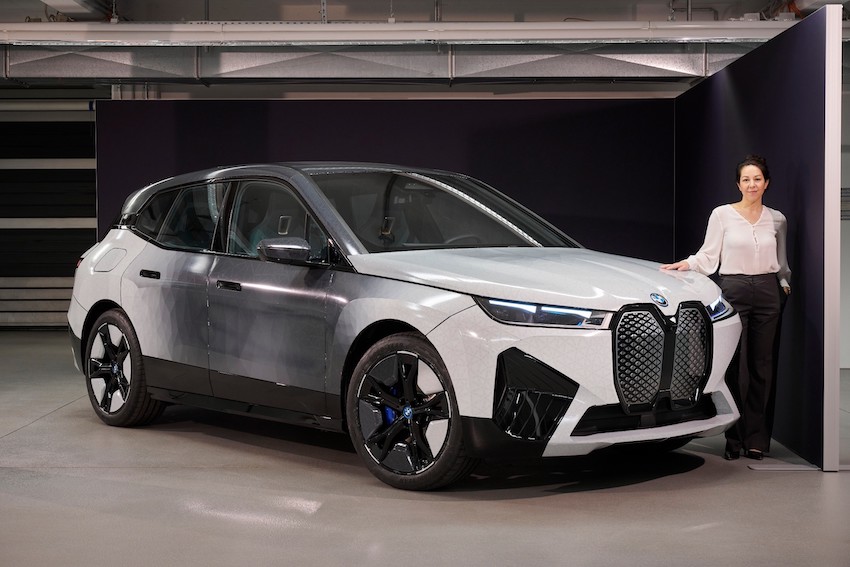

German carmaker BMW is introducing a technology at the Consumer Electronics Show (CES) 2022 that can change the exterior colour of the BMW iX Flow. The technology is called E Ink and is being applied to cars for the first time.
BMW points out that digitalisation has been providing an integrated user experience for some time. This includes a focus on individuality and emotionalisation of the interior of various BMW models. For example, through so-called 'My Modes', customers can customise the driving experience by adjusting the interior atmosphere. With the help of E Ink, BMW now also wants to allow customers to customise the exterior of their vehicle to suit their individual needs and different situations. The E Ink technology was presented at a BWM iX Flow, a research and design project by BMW.
E Ink is, in practice, a special wrap that is applied to a vehicle. Stimulating the ink using electrical signals causes different colour pigments to be brought to the surface. This allows customers to give the wrap the colour they want.
Known for eReaders, among other things
E Ink is not new. The technology from the eponymous company has been in use for eReaders for some time. In the case of the BMW iX Flow, a wrap has been applied with E Ink, which consists of millions of microcapsules. These have the thickness of a human hair. Each microcapsule contains negatively charged white pigments and positively charged black pigments. Based on the chosen setting, stimulation using an electric field causes the white or black pigments to collect on the surface of the microcapsule. This gives the wrap the desired colour.
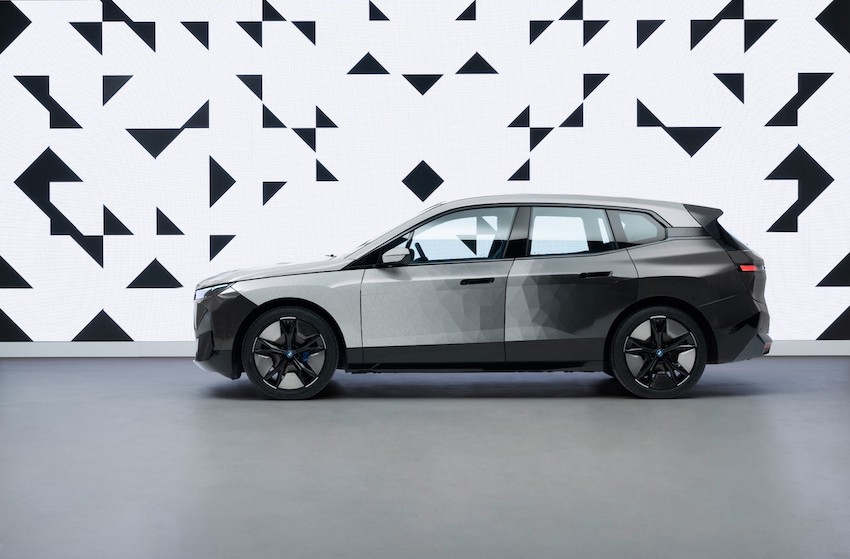
BMW is applying 'generative design processes' that ensure that the different segments of the wrap closely match the contours of the vehicle. This takes into account variations in both light and shade. This process takes place using algorithms.
When creating the various segments of the wrap, BMW applies laser cutting technology. This technology provides the required accuracy in this process. After the segments are applied and the power supply for boosting the pigments is connected, the entire bodywork is heated and sealed. This process ensures optimal and uniform reproduction of colours at every colour change.
Personalisation
The technology could bring about much-needed changes for car owners. It allows them to change the colour of their vehicle to the desired colour at any time. For example, based on their mood or weather conditions. In addition, is someone buying a used car? Then colour is not expected to play a role in this, as it is customisable. BMW talks about an "unprecedented potential for personalisation in terms of exterior design". Eventually, the company wants to market vehicles whose interiors as well as exteriors are customisable.
The benefits of E Ink are not just cosmetic. BMW reports that E Ink also increases a vehicle's efficiency. For example, dark colours are better at absorbing heat. Light colours, on the other hand, reflect more and absorb less heat. Smartly capitalising on these properties leads to higher energy efficiency of cars. For example, choosing a light colour in a hot climate makes for a cooler car. The air conditioning then has to work less hard. In colder climates, on the other hand, a dark colour ensures better heat retention. And the heating needs to be used less. Because a vehicle uses less electricity, fuel efficiency also improves.
'Extremely energy-efficient'
The E Ink technology itself is 'extremely energy-efficient', according to BMW. With a monitor or projector, energy is needed to consistently display a chosen colour. This is not necessary with E Ink; the technology uses no energy at all in the process, according to the manufacturer.
Author: Wouter Hoeffnagel








