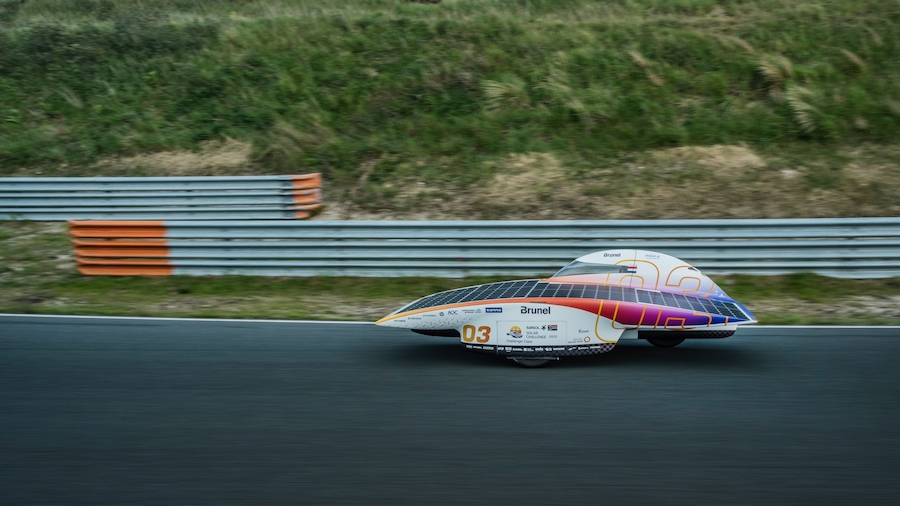

The Brunel Solar Team is presenting their latest solar car ahead of the Sasol Solar Challenge in September. It is the Nuna 11s, which for the first time features a self-designed and built engine. This engine can deliver up to twice as much power as old engines with the same weight.
The Brunel Solar Team consists of 11 students from TU Delft with diverse backgrounds. The team members design and build a solar-powered race car. With this vehicle, they participate in solar races worldwide, aiming to inspire sustainability and innovation. The team was sponsored by Vattenfall for 20 years. Brunel is attached to the team as the main sponsor from 2022. The team is a seven-time world champion.
First self-developed engine
For the first time in its history, the team has developed and built a motor itself. The new motor can deliver up to twice the power whilst weighing the same. This makes the motor more efficient than previous motors used in the team’s solar cars. This is made possible by a new configuration of the coils within the motor. This technology is not yet in use in the automotive industry, but offers great potential. For example, it enables the production of lighter motors that deliver the same power, allowing the car to drive more efficiently.
With the more powerful engine, the Brunel Solar Team hopes to be adequately prepared for the high altitude differences during the eight-day race in South Africa. This altitude difference is something they encountered during the last race in Morocco.
Some specifications of the engine at a glance:
- Direct drive double air gap motor
- 2x more power per kg compared to the previous engine
- Integrated into the wheel
- Built-in brake
The new engine receives energy from a new battery. Weighing 20kg, it is half the weight of previous editions. An important development, as batteries are usually the heaviest part of an electric car. Also, according to the team, the battery is more reliable and safer.
Powered by solar panel
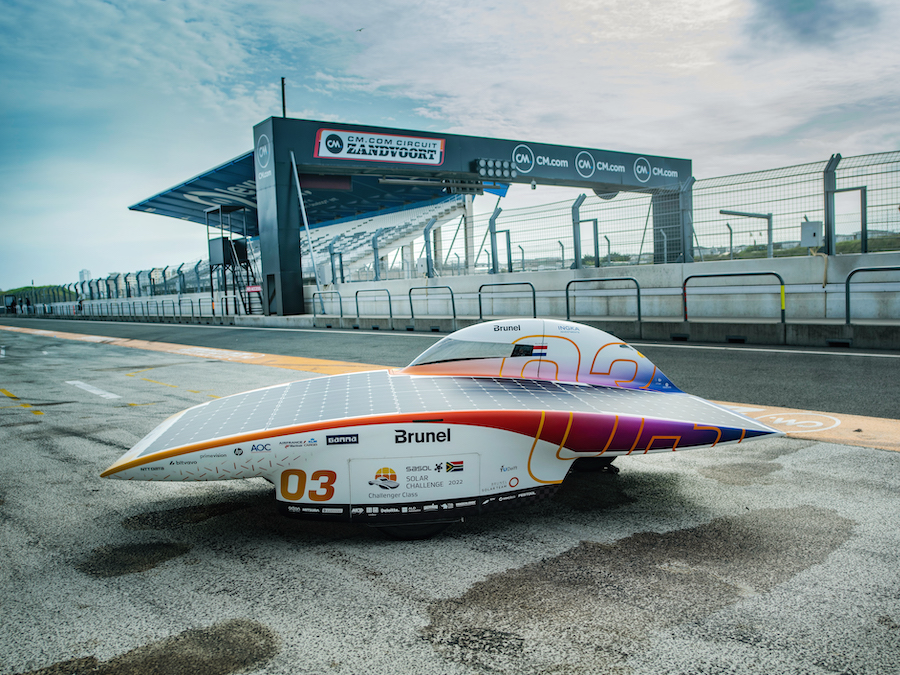
The battery is powered by a solar panel mounted on the car. This has been optimised to work as efficiently as possible in all environments and weather conditions. For example, diodes have been used in the panel, allowing specific solar cells to be bypassed. This allows solar cells in the panel to be switched on or off very precisely. Traditional solar panels automatically switch themselves off completely or switch off in zones when shadowed. The new invention makes it possible to switch off only the shadow-covered part of the panel. This allows the panel to optimally generate energy even if there is shadow.
Some specifications of the battery and solar panel at a glance:
Battery:
- Lithium ion cells
- 20 kilos lighter compared to last year
Solar panel:
- Surface area: 4 m²
- Type: silicon
- Efficiency: 25%
Other specifications of the vehicle:
- Type: Asymmetric tricycle
- Dimensions: 3.5 x 1.8 x 1.05 M
- Weight: Under 150 Kg
'Pushing the boundaries of what is possible'
"We are doing everything we can to win the Sasol Solar Challenge, pushing the limits of what is possible. We are doing this for a greater cause, which is to inspire the world in the field of sustainability and innovation," says Team captain Sanne Vilters. Team strategist Remco Dirks added: "However, the Sasol Solar Challenge requires more than just innovative technology."
The race in South Africa will challenge the team with, among other things, high altitude and all kinds of weather conditions. These include a twisty and steep mountain range and a shaded rain forest. "Normally, we can prepare for this well in advance and optimise our strategy. But to make the race even more exciting this year, a blind stage, a half-blind stage and a marathon stage have been added to the route for the first time. On the evening of the fourth day of racing, we will only hear the route of day five. This requires us to strategically balance our energy consumption and generation in the days before, in order to be prepared for all possible routes. Also a part of the route of day seven (the half-blind stage) will not be known until the evening of day six. During the marathon stage, only three team members are allowed to tinker with the car at night to prepare it for the next day, which is normally allowed to be worked on with the whole team. All in all, the new stages represent a huge challenge for which we have been preparing as a team for months. We have tested our innovations exuberantly, and are confident that we will cross the line as winners in September," Dirks said.
Author: Wouter Hoeffnagel
Photos: Brunel Solar Team








