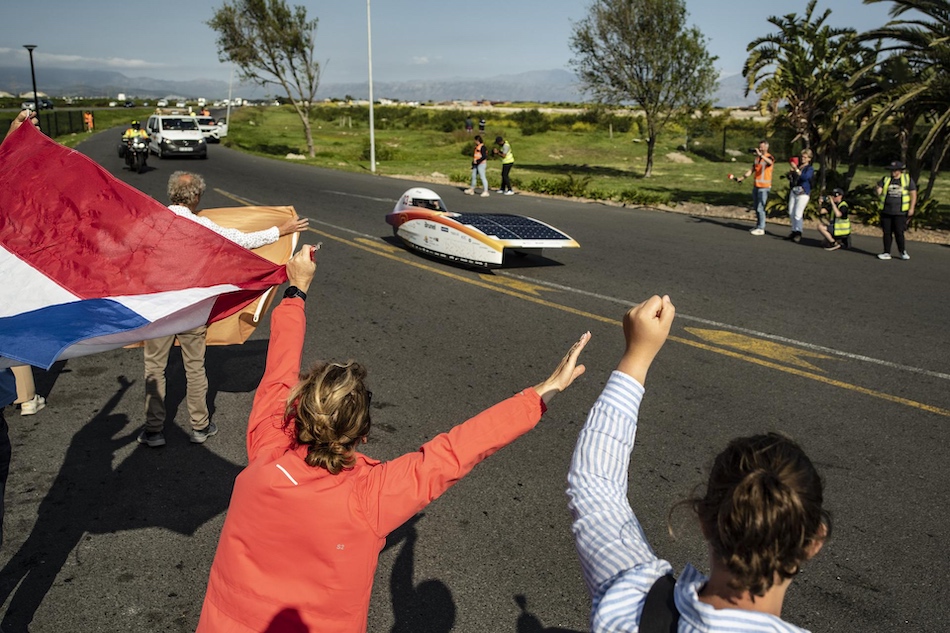

The Brunel Solar Team is the winner of the Sasol Solar Challenge in South Africa. The Dutch team finished with the most kilometres on the counter. It is thus just ahead of the Belgian team, with whom the Brunel Solar Team was continuously battling for the title. The Belgian team stranded in second place with 38 km difference.
It is the first time in three years that the Dutch team has managed to beat the Belgian team again. The Dutch team dragged in another title for the first time since 2018.
Engine not reliable enough
This year would be the first time the team entered the race with a self-built engine. This motor can deliver up to twice as much power with the same weight and is more efficient than previous motors. However, shortly before the start, this electric motor proved not reliable enough for the race. The team therefore used an old engine.
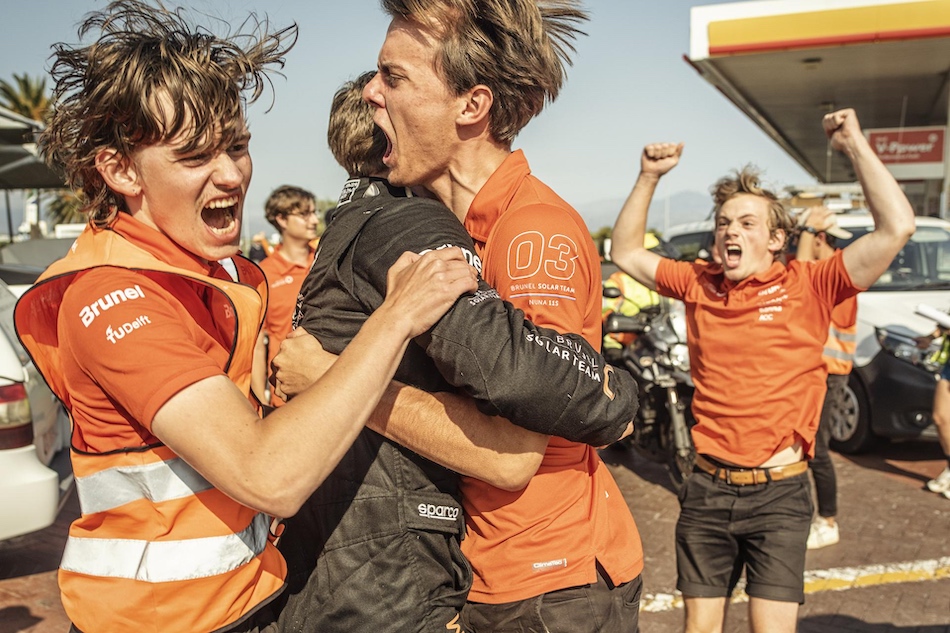
The Brunel Solar Team crossed the line in Cape Town at 3.37pm on Friday, 16 September. The team had a total of 4223 km on the counter, which is 38 km more than the Belgian team. Team captain Sanne Vilters is proud of the team: "The past few days we were really close on each other's heels. However, during every day stop we kept repeating that we had to focus on ourselves and not worry about the other teams. Everyone has their own task within the team and only if everyone performed that task at their best could we win. The fact that we managed to do that now proves that we are a rock-solid team and, of course, that we have a magical car!"
The most kilometres
The Sasol Solar Challenge is an eight-day race from Johannesburg to Cape Town in South Africa. The race is all about total kilometres driven. There is an optional loop on the route every day, which teams try to drive as many times as possible before arriving at the mandatory daily stop at 17:00. The team that finishes in Cape Town with the most kilometres on the counter wins.
That the Dutch and Belgian solar cars are evenly matched is already clear from the start of the challenge in Johannesburg. The Dutch and Belgian teams followed each other closely and alternated the lead. The difference in kilometres on the counter dwindled by the day. The Brunel Solar Team speaks of a strategic cat-and-mouse game between the two countries. By making smart and creative choices, they tried to surprise and outsmart the competition. Before the start of the latter, the Brunel Solar Team had only 10 km more on the counter than the team from Belgium.
The tension was therefore mounting towards the final day. The final day started with a time penalty for both teams. The Dutch team got this because of a (minor) collision that occurred during an overtaking manoeuvre. The Belgian team exceeded the speed limit on African roads. Both teams also arrived too late at the day's stop.
Left on final day ten minutes behind
Due to the time penalty for coming in late yesterday, Nuna 11s left the final day of the race in second last position, ten minutes behind Belgium. The Belgian team was thus in the lead until the running stop. However, the Dutch team did gradually reduce the gap to less than a minute.
Both teams decided to do the control stop immediately at the running stop to do static charging. This is a daily mandatory stop of 30 minutes. After the control stop, the Brunel Solar Team immediately started driving loops. The Belgian team followed, but was hit by a faulty battery just after the loop stop. The repair took 30 minutes, putting the Belgians at a considerable disadvantage. While driving the loops, they were unable to catch up with the distance covered by Nuna in the meantime. At the finish at 15:37, the Brunel Solar Team therefore finished in first place with a 38km lead.
Inspire
The Sasol Solar Challenge has several goals. For instance, the competition stimulates innovation in the field of solar energy. Another important goal is to inspire local people. Thus, the daily location of the running stop mostly takes place on the grounds of a (secondary) school. During the stop, local residents can admire the solar cars.
They were also able to take part in experiments demonstrating how solar energy works. An important topic in a country where, to monitor the stability of the power grid, electricity is cut off several hours a day every day. This is also known as load shedding. An energy transition could provide a solution, something the organisation hopes to accelerate by inspiring the new generation.
Author: Wouter Hoeffnagel
Photos: Hans-Peter van Velthoven











