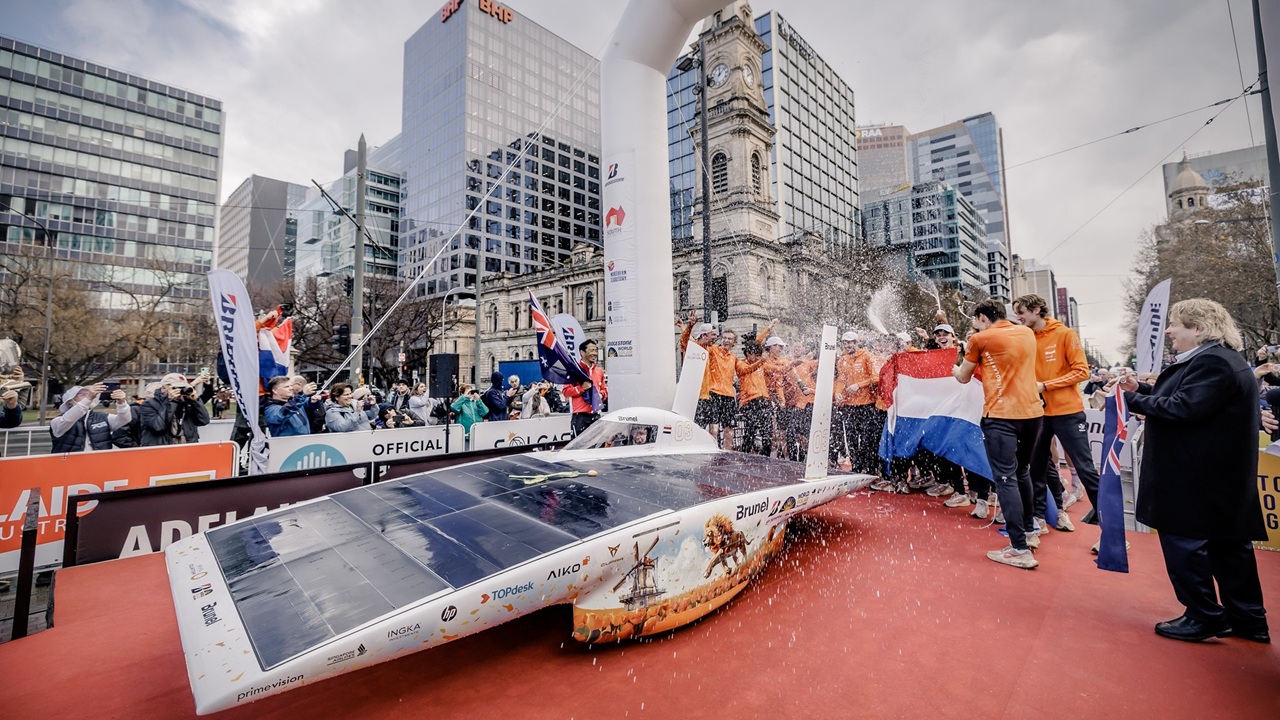

After five days and over 3,000 kilometres across the Australian outback, the Brunel Solar Team crossed the finish line first in Adelaide on 28 August. In a nerve-racking denouement, the Delft student team held off competition from Solar Team Twente and the Belgian Innoptus Solar Team to win the solar racing world championship. The eighth world title makes the anniversary year extra glorious.
How it started
Prior to qualification, all teams went through a dynamic inspection. This involved subjecting the solar cars to three tests: a slalom, an eight and testing the braking distance. Nuna 13 passed the test without any problems. With that, nothing stood in the way of the start: Sunday morning at 08.00 Australian time, the starting gun sounded and the Brunel Solar Team began the 3,000 kilometres from Darwin to Adelaide.
Third position for Brunel Solar team
Brunel Solar Team started the World Solar Racing Championship from third position. Qualifying determined the starting positions of the total of 26 solar cars. Each team got only one chance to set a fast lap. For the Brunel Solar Team, driver Lucas de Jong took a seat behind the wheel. In the run-up to the day, he prepared thoroughly: together with a professional driver he drove the circuit to perfect the ideal lines and cornering technique. He also analysed camera footage of previous laps of the circuit in detail, with the aim of cutting each corner as efficiently as possible. De Jong: "This was my fastest lap ever. It feels good that the preparation paid off. I knew the circuit in detail and was able to get the most out of Nuna. With only two teams ahead of us at the start, we are very happy with our starting position. After all, overtaking costs a lot of energy, which can cause us to lose valuable minutes. This place gave the team confidence for a strong opening day."
Double fin
Nuna 13 not only drove on solar energy, but also harnesses the power of the wind. The team developed a double fin: a collapsible canopy fin and a sword fin that can be deployed strategically when the wind direction is favourable. On the winding Hidden Valley circuit, the fins remained collapsed, where they would actually create more drag. The route from North to South Australia runs along the Stuart Highway, a long straight road on which these innovations provided an advantage.
Final day
The final day started early in the morning with 238 kilometres remaining on the counter and a heavily cloudy sky over southern Australia. While Innoptus Solar Team left later due to a lower battery charge, the team from Twente gave chase. Dozens of kilometres before the finish, the difference was still only two kilometres. By following the best strategy and making clever use of the innovative canopy fin, Nuna 13 managed to increase the gap again and reach the finish line first. "Unbelievable, we just did it, what a battle," said Martijn Boonen, who drove Nuna 13 across the finish line. "These last kilometres were nerve-wracking with downpours, a lot of traffic and the competitor breathing down our necks. We gave everything and now we are world champions. I am super proud of our team."
Jubilee year given a golden edge
The Brunel Solar Team was a seven-time world champion, but its last victory dates back to 2017. The Delft students are therefore euphoric after the hard-fought victory. "We went full out for the win," said Elias Wawoe, team leader of the Brunel Solar Team. "This is really a team performance and the fin on Nuna 13 has proven itself in the wind. Fantastic to bring the eighth title back to the Netherlands and all the more special because it's our anniversary year: a crowning achievement of 25 years of solar racing."
Photo credit: Jorrit Lousberg/Light at Work Photography
Source: Brunel Solar Team
Read also: Over 5.2 million euros funding from SolarNL for circular solar panels











