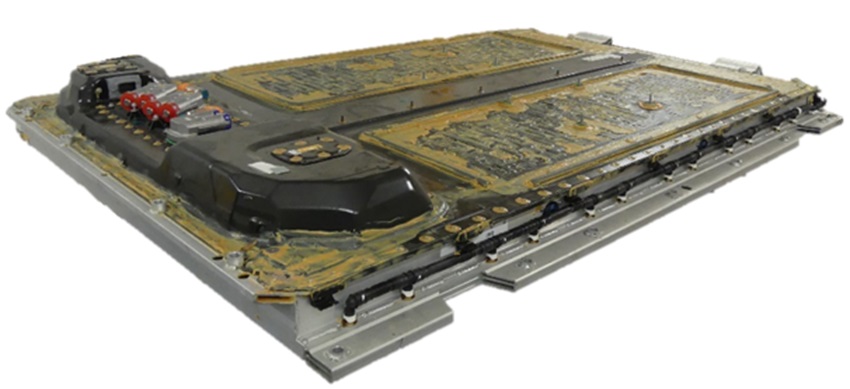

In the research project COOLBat, researchers at the Fraunhofer Institute for Machining and Deformation Technology IWU are working with partners to develop the next generation of battery enclosures for electric vehicles. The aim is to make the enclosures lighter and reduce CO2 emissions during their production by 15%.
Achieving climate-friendly production of battery enclosures for electric vehicles is the goal of industry and research partners working on the COOLBat project. The project focuses on carbon-saving lightweight construction solutions demonstrated by next-generation battery enclosures. This is because current battery enclosures, with their load distribution and temperature control structures, frames, covers and bottom plates, still offer potential for reducing carbon emissions.
Lightweight battery enclosures
In the project, 15 partners are conducting interdisciplinary research into innovative lightweight construction principles to reduce mass. They are also looking for lightweight construction materials and production methods to make the production of battery enclosures more environmentally friendly and improve their properties during use. The partners are taking a broad approach. This focuses on aspects such as circularity and reparability, resource and energy efficiency, safety and fire protection at design and material level. Fraunhofer IWU in Chemnitz is coordinating the project. It is funded by the German Federal Ministry for Economics and Climate Action (BMWK) as part of the Technology Transfer Programme for Lightweight Structures (TTP-LB) and overseen by Project Management Jülich (PTJ).
Simple principle
The principle is simple: the lighter the enclosures, the greater the range of electric cars, as power consumption decreases. "The energy density of current battery systems can still be greatly improved, and battery enclosures are an important aspect of this. Integrating new lightweight construction methods and more functions in a smaller installation space with fewer interfaces makes it possible to reduce weight while lowering CO2 emissions." So says Rico Schmerler, project manager and scientist at Fraunhofer IWU's Battery Systems Department. "By reducing the mass, we can increase the energy density and thus the range, even if the number of battery cells remains the same. By making the housing cover from a fibre composite material, we were able to reduce mass by more than 60 per cent compared to the steel reference."
Cooling and carrying capacity
Another possibility identified by the researchers to save weight is to combine individual systems in the enclosure that previously performed thermal and mechanical functions separately. Cooling channels, for example, cast by the Fraunhofer Institute for Manufacturing Technology and Advanced Materials IFAM, are incorporated directly into load-bearing structures such as cross beams.
Bottom plate
Moreover, the function of the cooling unit is combined with that of underride protection in a single component, the bottom plate. Aluminium foam in the bottom plate absorbs impact energy from stone impact and accidents. Combined with a Phase Change Material (PCM), the aluminium foam also reduces the amount of energy required to cool the electric battery. The bottom plate was developed by Fraunhofer IWU and FES/AES and produced at Fraunhofer IWU, including the foam.
Configuration
This configuration simultaneously protects the battery cells from mechanical stress and overheating. A liquid flows through the channels and cools the cells not only from below but also from the sides. This reduces the electricity required to cool the cells and eliminates the need for cooling elements elsewhere in the vehicle. "We are focusing on functionally integrated structures. Tasks previously performed by different modules in the battery are now integrated into one component - the base plate. In this case to reduce installation space and streamline interfaces," explains Schmerler. "These base plates provide protection against overheating and prevent damage to the battery core in case of an accident." The researchers use the Mercedes EQS battery as a reference and technology demonstration model.
New thermal pads replace pastes
The quality of heat dissipation from batteries to the outside has a significant impact on the performance and lifetime of an electric vehicle. Conductive pastes are commonly used to thermally bond the battery module. One of the aims of this project is to replace these heavy, non-durable pastes with environmentally friendly thermally conductive materials. To achieve this, the Fraunhofer Institute for Surface Engineering and Thin Films IST uses a plasma process. They do this to metallise reusable open-pore foam. It is then placed in the form of a pad in the space between the battery and the casing.
Bio-based fire retardant coatings
A new flame-retardant coating developed by the Fraunhofer Institute for Wood Research, Wilhelm-Klauditz-Institut, WKI, helps improve safety. This coating, applied to the underside of the casing lid, prevents fire from spreading from the battery cells underneath. The coating also contains lignin, a bio-based non-combustible material that replaces petroleum-based materials.
Design for reuse
The previous housing cover, which was made of steel, has been replaced by a new fibre composite cover structure of carbon and resin (known as a towpreg). This has not only significantly reduced the mass of the component. It also makes it possible to reuse the lid. The whole system consists of lid, frame and base plate. It is designed to be disassembled and removed without destruction down to the component level. "We are pursuing the concept of a circular economy and material reduction. We do this through lightweight construction and reusable materials. It results in a smaller carbon footprint and lower repair costs," Schmerler said.
Views on transfer to industry
According to future plans, the various results of the project should be extended to other industries. Think of applications where large batteries are used. Think trains, planes and boats. The cooling systems could also be used to transport food and medicine. Finally, fire protection solutions in buildings are also among possible applications.
Featured image: Reference system prior to dismantling (c) Fraunhofer IWU/AES
See also: A second life for electric motors











