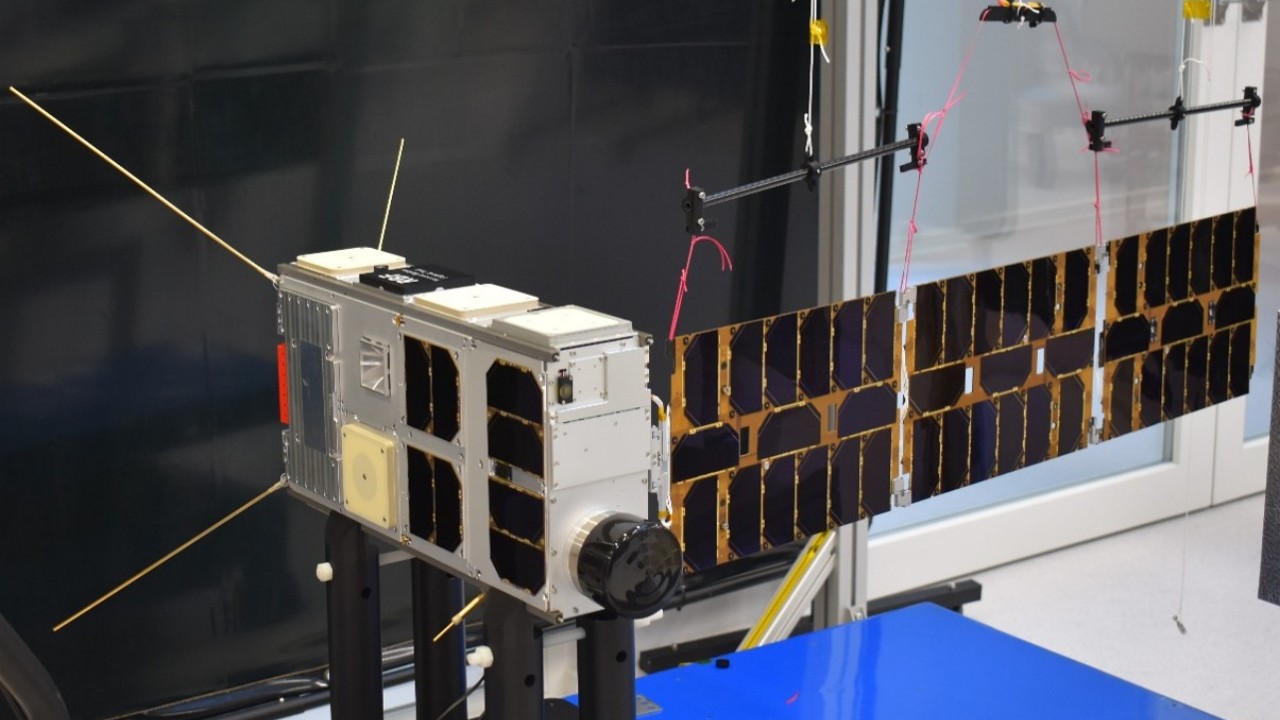

The GOMX-5 CubeSat, built by the Danish satellite manufacturer GomSpace, was launched as part of SpaceX’s Transporter-18 mission. The satellite will demonstrate various new technologies in space. These include an iodine-based electric propulsion system, designed to enable manoeuvring shortly after launch to prevent collisions.
GOMX-5 was developed in collaboration with the European Space Agency (ESA) as part of the General Support Technology Programme (GSTP). The CubeSat has been designed as an in-orbit demonstration mission for technologies intended to make the use of space safer and more sustainable. The mission is therefore closely aligned with ESA’s Zero Debris approach, which aims to limit the amount of new space debris.
Space debris is a problem that is growing as more satellites and other objects orbit the Earth. For example, various decommissioned satellites, rocket parts and debris are orbiting the Earth. They can collide with one another, creating new debris that further increases the risk of collisions. These collisions can also affect operational satellites, which may consequently be damaged or even destroyed.
Propulsion system operational within 48 hours
The propulsion system being tested on the GOMX-5 could help to avoid collisions with, amongst other things, space debris. Activating this system is therefore one of the mission’s key objectives. To this end, GOMX-5 must have its propulsion system ready for use within 48 hours of launch. This would enable the satellite to adjust its orbit considerably faster than with traditional procedures and, if necessary, carry out a manoeuvre to prevent a collision.
By way of comparison, activating and controlling the various satellite systems required for manoeuvring traditionally takes several days. Using an automated platform, GomSpace aims to drastically reduce this time.
The first phase following launch is therefore a crucial part of the demonstration. During this phase, flight control checks, amongst other things, whether the automatic procedures have been carried out correctly. Flight control also checks whether the satellite and the propulsion system are ready for further tests. The experience gained from the demonstration should also provide insight into the practical implications of ESA’s new requirements regarding space debris and how these requirements can be applied to the design and operation of future CubeSats.
Other technologies have also been tested
In addition to the propulsion system, GOMX-5 carries various other technologies that are being tested in space. One of these is a deployable solar panel with a drive system that allows the panel to track the position of the sun. This system enables energy yield to be maximised. A similar technology is already being used on the Juventas CubeSat as part of ESA’s Hera mission to the asteroid Dimorphos.
There is also a payload on board for maritime domain awareness. This technology is designed to detect signals from ships, offshore platforms and other maritime objects. The payload utilises multiple antennas and radios covering a broad frequency range from VHF to L-band.
With this latest payload, GomSpace aims to demonstrate how small satellites can be used to monitor maritime activities, including in areas where conventional tracking systems are less effective. It should be noted, however, that a single satellite cannot provide continuous global coverage. The demonstration is therefore intended to lay the foundations for future satellite constellations.
Reference platform for future missions
For GomSpace, this mission represents a significant step forward. GOMX-5 brings together various subsystems – which were developed separately in previous satellite projects – into a single, integrated, flight-ready platform. The satellite thus demonstrates a new reference architecture for future commercial and government missions.
There is also an experimental computer environment on board, designed to test software in space. The GOMX-5 software is largely configurable and can be adjusted during the mission. This means that, once the formal demonstration has been completed, the satellite can be used as a test platform for software.
The GOMX-5 satellite was developed as part of Element 3 ‘Fly’, a component of ESA’s General Support Technology Programme designed to ensure that new space technologies can actually be tested in space.
The project builds on earlier GOMX missions developed under the same programme with GomSpace, including GOMX-3 and GOMX-4B. GOMX-3 was launched in 2017 to demonstrate, amongst other things, new communication technology. GOMX-4B followed in 2018 and focused on testing technologies for satellite communication and autonomous flight operations.
Image: ©ESA