
Kaspersky reveals in a report that the second quarter of 2023 saw the highest number of cyber threats globally since 2019. One of the findings highlights a trend that shows high-income countries are detecting more cyber threats.
In the first half of 2023, Kaspersky's security solutions blocked 11,727 different malware families in industrial systems. Of all categories, only one showed growth in the first half of 2023: denied Internet sources (11.3%). This is the second consecutive six months of increased cyber threats in this category. Until 2022, denied internet sources were the leading threat category until they were overtaken by malicious scripts and phishing pages. These elements remain the most common threats (12.7%), although their percentages are converging.
Unexpected shifts
The first half of 2023 saw unexpected shifts in traditionally more secure regions. Australia and New Zealand, the United States and Canada, Western Europe and Northern Europe, typically characterised by lower threat levels, saw an increase in the number of ICS computers attacked during this period.
Spyware
Despite these increases, it is crucial to highlight that these regions still have relatively low threat rates compared to other regions. The increase in threats can mainly be attributed to the blocking of internet resources and malicious scripts that are not listed and are often delivered via the internet and email. In addition, spyware detection showed significant growth in these regions.
Percentages of cyber threats
In terms of global figures, threat rates varied significantly by region. In doing so, Africa showed the highest rates at 40.3 per cent, while Northern Europe reported the lowest at 14.7 per cent. Notably, Ethiopia faced the highest threat rate at 53.3 per cent, while Luxembourg reported the lowest at 7.4 per cent.
Building automation
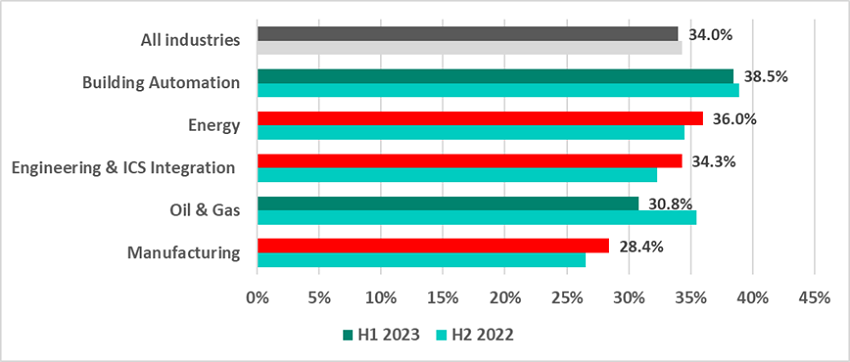
Building automation remained the sector with the most cyber threats, with 38.5 per cent of computers attacked. However, the energy, oil and gas industries saw opposite trends since 2021. Energy saw a 36 per cent increase in threats, while the oil and gas sector showed a decline, accounting for 30.8 per cent.
ICS integration, manufacturing and energy
In addition, the engineering, ICS integration, manufacturing and energy sectors saw an overall increase in the percentage of ICS computers on which malicious objects were blocked in the first half of 2023. “For industrial organisations, cybersecurity is now about safeguarding investments and ensuring the continuity of critical business assets. The findings of our analysis of attacks on the industrial sector reveal crucial insights into the evolving threat landscape across various sectors. By understanding these risks, organisations can make informed decisions, allocate resources wisely and strengthen their defences efficiently. In this way, they not only protect their business results but also contribute to a safer digital ecosystem for everyone,” said Evgeny Goncharov, head of Kaspersky ICS CERT.
Also interesting: Threat of cybercrime among SMEs significantly increased
Image by Pete Linforth via Pixabay











