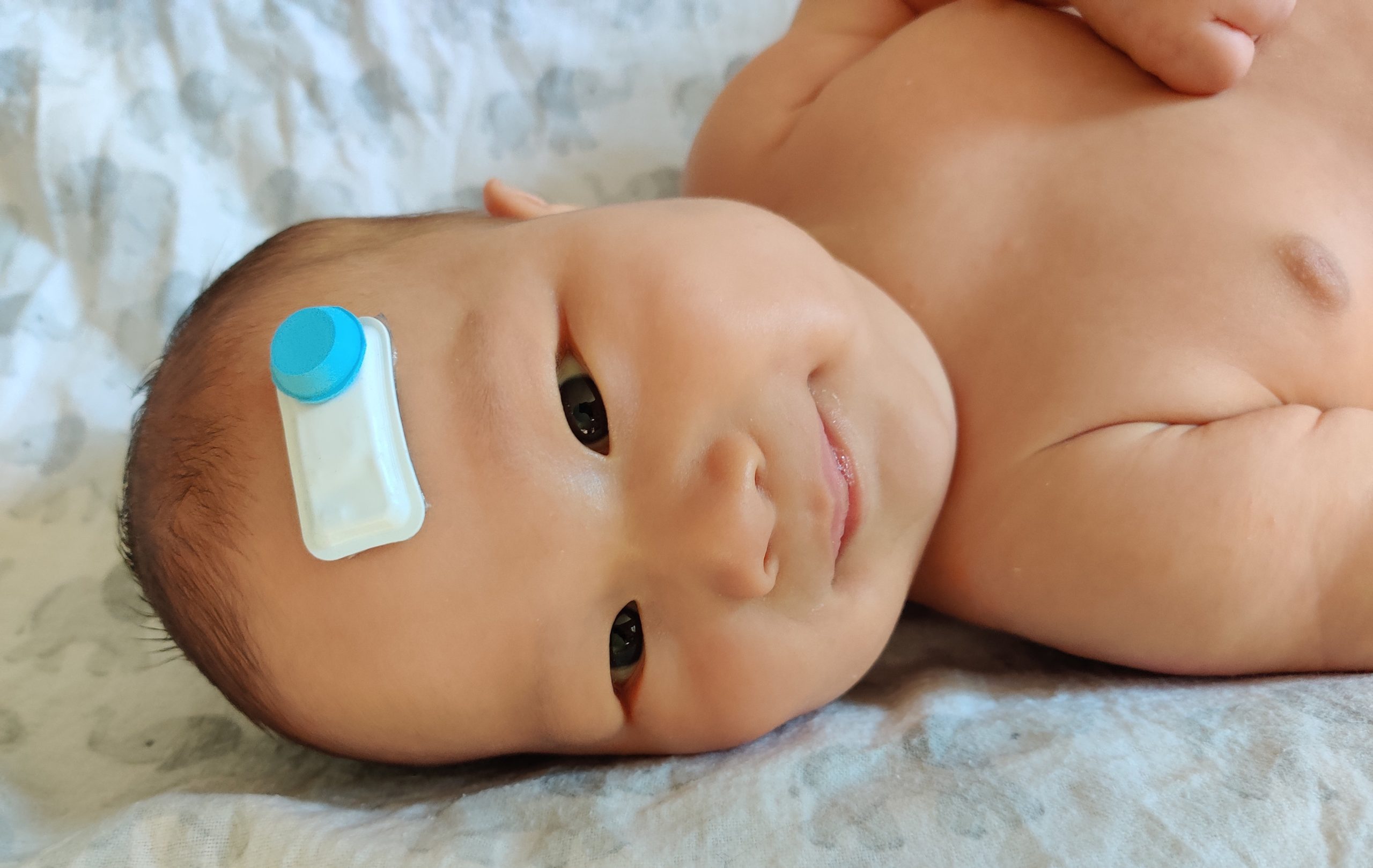
Babies born prematurely are at high risk of suffering brain damage. It is therefore very important for paediatricians to keep a close eye on the oxygen saturation ('oxygenation') of blood in the brain. Researchers at TU Delft have developed a wireless sensor that monitors baby brain health in a simple, inexpensive and comfortable way for the child.
Around 50 per cent of premature babies suffer brain damage, which often causes neurological problems later in life. Oxygen saturation in the brain is an important factor in this and so doctors need to monitor it closely. The devices currently used to do this are large and cumbersome, and include all sorts of cords that babies can get tangled up in. In addition, the machines are enormously expensive, and the attached sensors often damage delicate baby skin when they are pulled off. This prompted researchers at TU Delft to develop a better technique for monitoring oxygen levels in the baby's brain.

Interaction
Together with a doctor and an electrical engineer, the researchers developed a soft, bendable and wireless sensor that can be stuck on a baby's scalp, according to a press release. The sensor sends data wirelessly to an app, which then signals when a doctor or nurse needs to intervene. "The sensors not only monitor regional oxygen levels in the brain, but also measure oxygen levels in arteries throughout the body," says TU Delft researcher Alina Rwei. "In this way, medical personnel not only get information about these two separate systems, but also about the interaction between them."
The sensor consists of four photodiodes, two of which can see deep into the brain and two of which measure more superficially, providing data on blood flow throughout the body. The sensor is flexible and molds to the shape of the skull. After use, the device comes off the skin without any problems. "I tested the sensor on my own baby Philip a few months ago," says Rwei. "It worked exactly as I had hoped. Philip is now also featured in the scientific paper we just published."
Access
Besides the fact that the sensor is more pleasant and easier to use than existing solutions, the device is also many times cheaper. "Where hospitals now spend about 10,000 euros for a large machine that allows you to monitor brain oxygenation, our sensor costs about 25 euros," says Rwei. "Especially in developing countries, this could ensure that more people have access to this kind of technology, which will hopefully prevent many health problems."
The next step is to produce the new device in large numbers. Rwei: "Our team in America has started a startup to bring the sensor to market." Incidentally, not only premature babies will benefit from the new sensors. Adults also need to have their oxygen levels monitored regularly, and the new device can help.
Source + photos: TU Delft










