
Demcon announces it took a majority stake in Orgonex late last year. This spin-off from Utrecht University / the Innovation Center for Advanced Therapies (ICAT) focuses on the development of a bioreactor for cultivating organoids.
Orgonex stems from research into improving the culture process for organoids. These are miniature organs used for fundamental research as well as medical and pharmaceutical applications. Researchers grow organoids from stem cells specific to a particular organ, such as the liver, intestine or pancreas. This leads to complex 3D cell structures, which are representative of the specific organ.
Mimicking components of an organ
Organoids mimic the main functional, structural and biological components of an organ. This makes organoids interesting for research into a wide range of diseases and the underlying physiological processes, or the action of new drugs. Organoids therefore play an important role in accelerating drug development and also help reduce animal testing.
Growing organoids brings challenges. For instance, the traditional, manual culture process is labour-intensive, while automated culture systems generally take up a lot of space in the lab process and involve a high investment.
Efficient and compact bioreactor
Orgonex developed a bioreactor that has a yield five times higher than traditional, manual culture methods for organoids. The system is also more compact than other culture automation solutions, which simplifies integration into the lab process. Thus, the solution can be incorporated into the existing laboratory infrastructure of academic research groups and pharmaceutical companies, among others.
Orgonex is based in Zeist. As part of the Demcon Group, Orgonex will work towards a market launch of its bioreactor, which is scheduled for this year.
Five times higher yield
Orgonex's bioreactor has a yield five times higher than traditional, manual culture methods and is both more compact and simpler than other culture automation solutions. Thus, Orgonex's system offers a low-threshold solution for the efficient culture of sufficient organoids.
Orgonex was founded in 2013 by researchers Kerstin Schneeberger and Bart Spee. They were looking for a way to make the cultivation of the organoids they needed for their research more efficient. To do so, they investigated the specific conditions that promote the growth of organoids in a reactor.
The focus was on the process of stirring the medium in which the organoids grow up, with the aim of understanding the optimal growth conditions in the reactor. Together, the researchers designed a stirrer optimised for organoid culture. In collaboration with TU Eindhoven, they then showed that the design of the stir bar ensures a homogeneous fluid flow in the bioreactor.
Culture protocols
The researchers also developed culture protocols for different types of organoids. The technology ensures the proper mixing of cells and nutrients. It also prevents the cells from being exposed to too much mechanical or thermal stress.
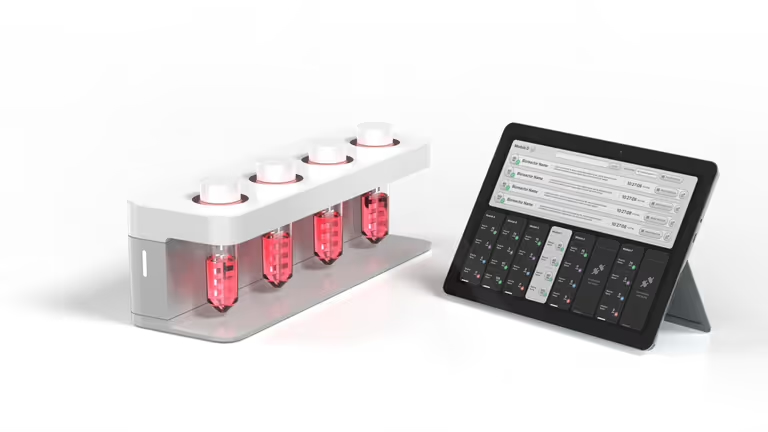
The stirring rod and culture protocols then formed the basis for the development of a simple reactor, in the form of a compact module. This reactor accommodates four standard culture tubes, each with a stir bar that is individually controlled according to the culture protocol used. This module is suitable for placement in an incubator, which is standard in a lab.
Author: Wouter Hoeffnagel
Image: Demcon