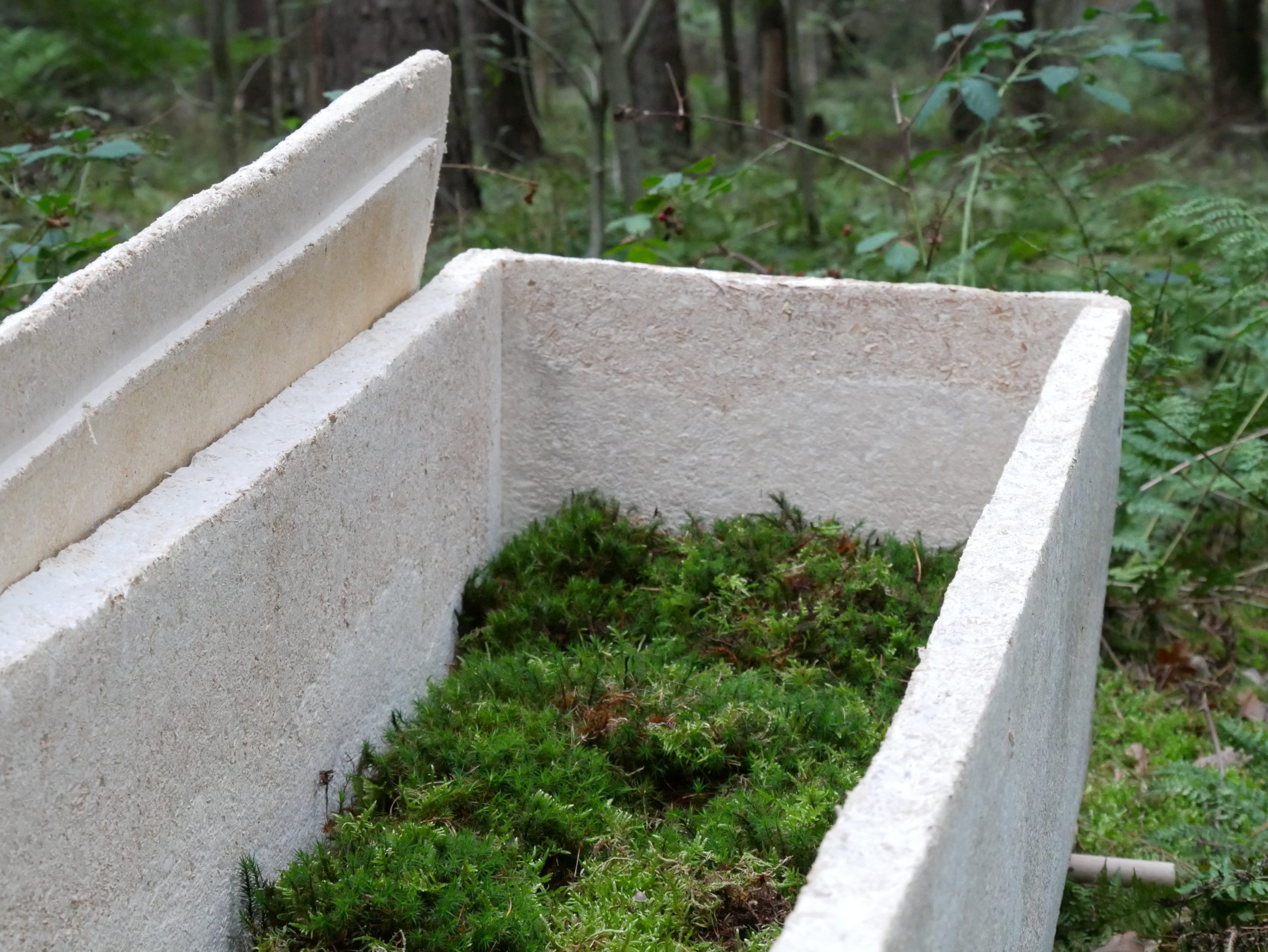
TU Delft students' startup 'Loop' has developed a living coffin from mycelium. This Living Coc oon contributes to efficient 'composting' of the body, clears toxins and thus provides an enriched nutrient soil for (new) trees and plants. After extensive research, including together with two major funeral cooperatives CUVO (The Hague) and De Laatste Eer (Delft), this new form of burial is ready for practical application. In one of the limited first edition of ten 'Living Cocoons', the first person has already been buried recently.
Mycelium
Mycelium normally grows underground in the complex root structure of trees, plants and mushrooms. It is a living organism that can neutralise all kinds of toxins and provides nutrition to everything growing above ground. Bob Hendrikx, founder of Loop, calls mycelium nature's recycler: 'It is constantly looking for waste products to convert into nutrients for the environment. It does the same with toxins, such as oil, plastic and metal. For example, mycelium was used in Chernobyl, is used in Rotterdam for soil decontamination and some farmers also use it to make land healthy (again)'.
Clearing
'The Living Cocoon lets people become one with nature again, enriching the soil instead of polluting it,' says Hendrikx. How fast a body usually composts depends on different circumstances, but experience shows that it can sometimes take more than 10 years. Painted and metal parts of a coffin, like synthetic clothing, remain even longer. Loop's expectation is their coffin can complete this entire process in as little as two to three years, as it actively contributes to composting. In the process, not only the waste products of the human body are converted into nutrients, the surrounding soil quality is also improved, giving new life a chance to flourish.
Follow-up tests with Naturalis
Practical research by Ecovative in the US has already shown that the coffin itself is broken down by nature within 30 to 45 days under normal Dutch conditions. To quantify the positive impact on soil quality, Loop is collaborating with researchers from Naturalis to investigate further the resulting increase in biodiversity resulting from this method of burial. Hendrikx: ‘We want to know exactly what the contribution to the soil is, so that in future we can be even more effective in convincing local authorities to transform contaminated areas into healthy forests, using our bodies as nutrients’.
in practiceThe founders of Loop, based at the YES!Delft Incubator, have held extensive discussions with funeral directors about this new product. Hendrikx: ‘They know how the burial process works in practice, advise families on their choices, manage cemeteries and are also familiar with all the logistical requirements involved in burial. This is valuable knowledge that they contributed to the development.’ Frank Franse, director of CUVO and De Laatste Eer: ‘As a regional funeral firm, we believe it is important to contribute to this sustainable innovation. This aligns with our objective as a sustainable funeral co-operative.’ Following several tests, the first batch of ten ‘living’ coffins is now ready for use. Last week, CUVO was able to conduct the first funeral using this coffin. Hendrikx: ‘It was a very moving moment to have finally been able, after months of development, to make the first farewell possible in this special way.’
Source: TU Delft.











