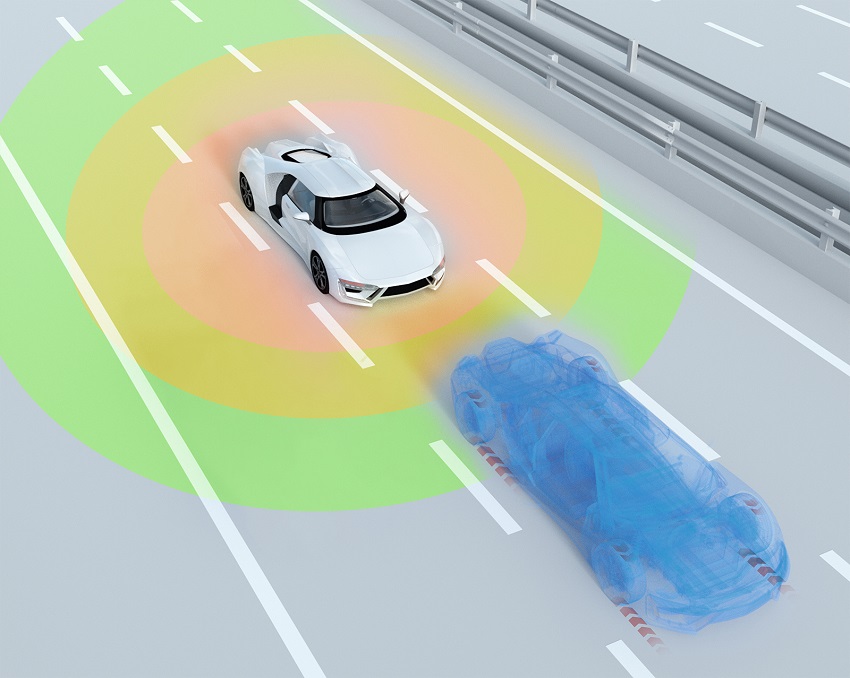

What is the main challenge for the acceptance of autonomous driving? That is ensuring the safety of road users without risking losing speed. A team of scientists recently developed a dynamic risk management system. It is part of a reference safety architecture. This gives a vehicle a better understanding of current hazards while driving.
AI capabilities are used in autonomous vehicles to analyse and take into account influencing factors. Consider, for example, the driving behaviour of other road users. With today's advanced technology, self-driving cars can be safer than human drivers. However, they may also lead to a loss of speed and comfort. And this in turn reduces the acceptance of autonomous mobility. This is according to a study by the Insurance Institute for Highway Safety. This is a US road safety organisation that regularly publishes research on autonomous driving. Pilot studies by German car manufacturers also confirm passengers' perceptions that autonomous vehicles are mostly slow and hesitant. A key challenge in bringing autonomous systems to market? Ensuring safety without limiting speed and comfort so much that acceptance disappears.
Improving autonomous driving
This is why the LOPAAS (Layers of Protection Architecture for Autonomous Systems) project was established. The project involves collaboration between Fraunhofer IESE, Fraunhofer IKS and the University of York. They are all central research institutions in the field of safety assurance of complex (software) systems. Their goal is to make autonomous vehicles faster and safer to drive. The results of the project will then be incorporated into technology transfer standards.
Referentieveiligheidsarchitectuur
The partners are combining their expertise to develop a reference safety architecture and arguments for autonomous driving and autonomous systems. Fraunhofer IESE contributes its expertise in dynamic risk management. This allows autonomous systems to assess and control the risks of their action options in a situation-specific way. ICS focuses on reliable AI-based situation detection and runtime monitoring of associated uncertainties. York University brings its expertise in systematically generating comprehensive and traceable safety reasoning.
Robotic taxis and highway drivers
The project partners are developing innovative safety concepts for the two main application areas. On the one hand, for robot taxis and robot shuttles. These are self-driving cars for one or more passengers. And on the other for highway drivers integrated into private cars. That is, software that can completely take over driving and steering functions on well-mapped motorway sections in simple weather conditions. The partners are investigating safety concepts based on specific usage scenarios of a motorway driver.
Dynamic risk management
With this digital "safety engineer", the research teams are bringing on board a system that makes automated driving more efficient for different use cases while ensuring safety. Adapted to the traffic situation, the digital safety engineer reacts individually and influences the user's driving behaviour and driving experience. In doing so, dynamic risk management using AI enables anticipatory driving, maintaining the required distance to other vehicles and avoiding hard braking.
Worst case scenarios
"Current approaches assume worst-case scenarios to ensure optimal safety. They are based partly on calculations of physical laws that determine how objects move. However, this leads to a lower vehicle speed. It is also difficult to correctly assess multiple risks that may occur simultaneously. For example, consider a pedestrian suddenly appearing to the left of the vehicle and a cyclist to the right of the vehicle." So says Dr Rasmus Adler. He is Program Manager Autonomous Systems at Fraunhofer IESE and project manager of LOPAAS. "The goal is to implement an understanding of risk in vehicles that does not calculate the worst case and therefore does not overestimate all risks."
Causal Bayesian networks
To this end, the research team uses causal Bayesian networks. The aim is to represent the joint probability distribution of all risk-relevant variables as compactly as possible, so that the system can understand the dynamic context. The researchers’ new methodology is already being applied in the field of intralogistics. A project with Hitachi focuses on safe and efficient collaboration between autonomous mobile robots and human workers in industrial warehouses. The underlying principle of the solution is to replace static worst-case assumptions with dynamic safety mechanisms. These dynamic safety mechanisms utilise knowledge about the specific current situation of a driverless transport system.
Autonomous driving and assumptions
For example, the assumption of how likely a person is to move in the intended direction of a machine can be more accurately estimated based on the current work task or previous movements of people in that location. This also allows the system to better estimate whether proactive braking is really necessary. Systems need to monitor relevant properties of themselves and their context, project these properties into the future and draw conclusions about their impact on risk. "In simple environments like warehouses, our approach to dynamic risk management works very well," he says. Hitachi plans to equip its unmanned forklifts with it. We will optimise our methodology for complex traffic situations with robotic taxis and automated drivers until the project ends in June 2024. For this, we will also use AI and data-driven models, which are essential for environment recognition and object classification," Adler said.
Photo and source: Autonomous vehicles require a paradigm shift in safety engineering. The safety of passengers and road users must be ensured without loss of speed. (Photo: Fraunhofer IESE)
See also: Autonomous electric ferry begins commercial service in Stockholm











