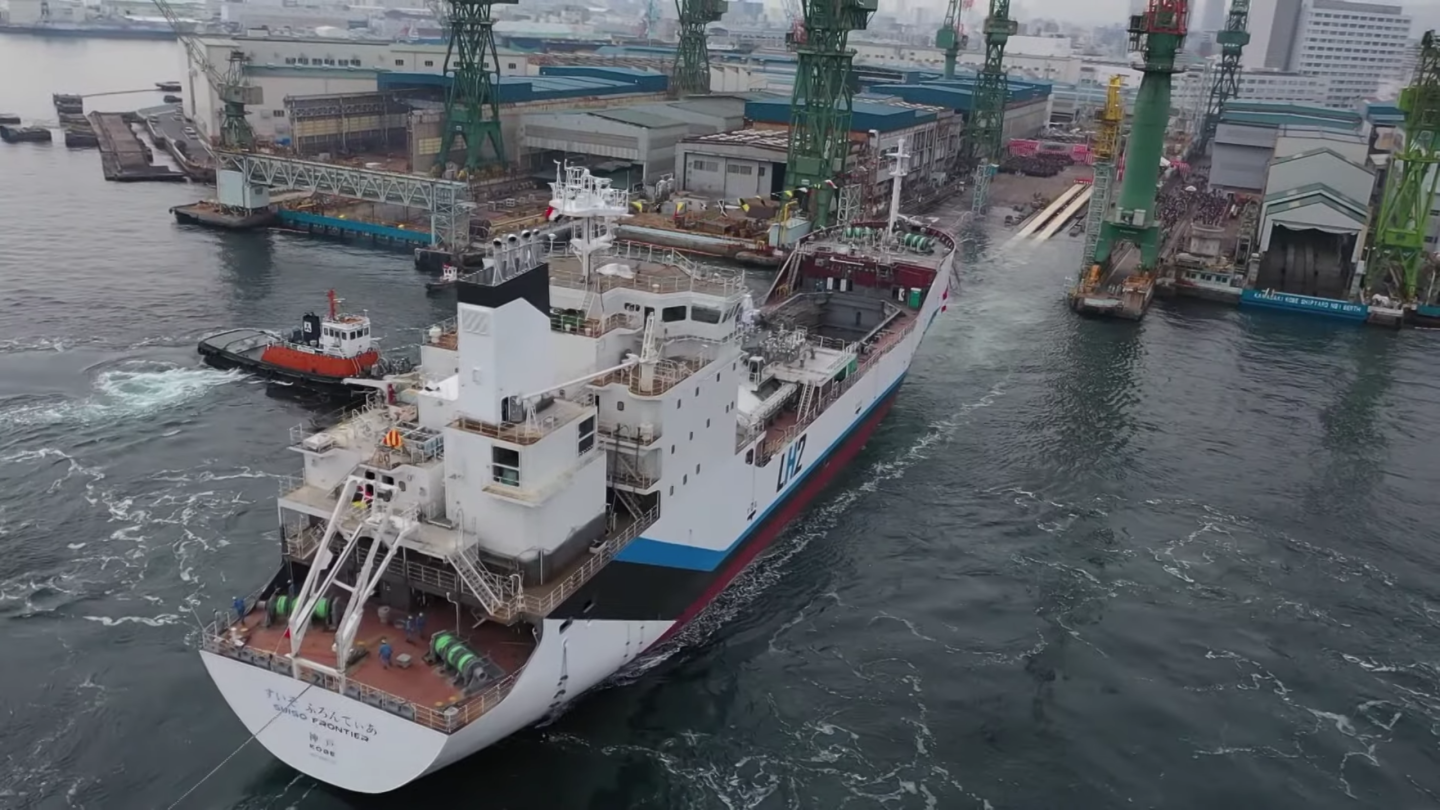

Kawasaki Heavy Industries, Iwatani Corporation, Shell Japan and J-Power have joined hands in introducing a new tanker ship specially designed to transport liquid hydrogen from the Australian south coast to Kobe, Japan. It is the first ship in that responds to the energy transition by carrying liquid hydrogen. This could mark an important step towards zero-emission transport with fuel cell-powered cars, trucks and perhaps even aircraft. Unfortunately, the tanker ship that transports liquid hydrogen still runs on diesel itself.
The Suiso Frontier is a 116-metre tanker that is being fitted with a vacuum-insulated, double-walled storage tank capable of holding 1,250 cubic metres of liquid hydrogen. The hydrogen will be compressed to 1/800th of its normal gaseous volume and cooled to –253°C to prevent it from seeping through the tank walls due to the extremely small size of the hydrogen molecules. At higher temperatures, these can literally seep through the gaps in the atomic structure of a metal container. The hydrogen itself will be produced via a gasification process in Victoria, Australia.
To produce three tonnes of hydrogen, an estimated 100 tonnes of CO₂ are emitted. This does not yet take into account the emissions from diesel transport by land and sea. Of course, hydrogen can also be produced in other ways, for example using clean, renewable energy. Solar or wind energy can be used to generate electricity, which can then be used to produce hydrogen through electrolysis.
In any case, Japan appears highly motivated to give the hydrogen economy a boost. South Korea also shares this ambition. With 1,200 hydrogen refuelling stations, 40,000 hydrogen buses, 80,000 hydrogen taxis, 30,000 hydrogen lorries and six million hydrogen fuel-cell cars, the country expects to have tackled smog by 2040.
Watch the launch of the Suiso Frontier in the video below.