
Together with its partners, ESA is developing a new exoplanet hunter: space telescope Plato. It is scheduled for launch in 2026. With it, astronomers expect to discover Earth-like planets within the habitable zone around a star. This is possible because of Plato's ability to spot smaller planets in larger orbits than current telescopes. SRON is part of the project.
SRON (Netherlands Institute for Space Research) will test Plato's cameras in a purpose-built space simulator. SRON researchers have finished testing the camera prototype. All functions work as expected.
Space simulator
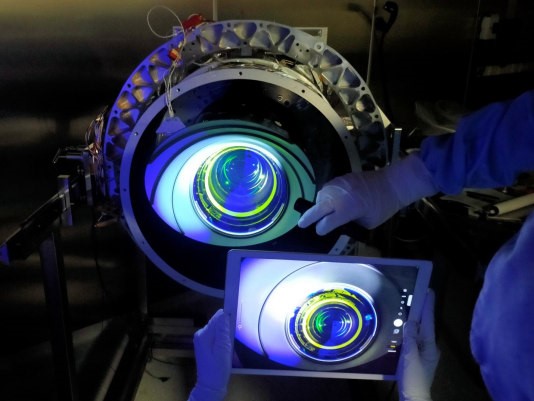
It is important to simulate the extreme conditions of space. That is why SRON scientists have built a space simulator. This is specifically geared towards testing Plato. It creates the conditions you encounter in space. Think, for instance, of incredibly low atmospheric pressure, low temperatures and artificial starlight. A mechanism that must also work in space moves the camera to use its full field of view. In doing so, the researchers measure with a precision of a millionth of a circle in which direction the camera is looking.
Intensive test programme
Plato already have a prototype camera, called the Engineering Model. This underwent an intensive testing programme for six weeks. The aim was to see if it achieved the required performance. They also had to make sure that it would not suffer from the large temperature changes you can expect outside the atmosphere. "It turns out that all functions of the Engineering Model are working as expected," says Lorenza Ferrari, the project manager. "That's good news for Plato in general. And it shows that our space simulator works extremely well."
SRON Plato team
During spring and summer, other simulators in Paris and Madrid should reproduce the test results with the same camera. Thus providing the necessary cross-calibration between the three setups. The final version of Plato is the Flight Model. This model will go into space with 26 cameras on board. There is a tight schedule to achieve the 2026 launch on schedule. Therefore, testing of each individual camera will be divided. Testing will take place in Groningen (SRON), Paris (IAS) and Madrid (INTA). SRON will receive the first of eight flight cameras in the autumn of this year. Testing of all eight will take until the end of 2023.
Vacuum chamber
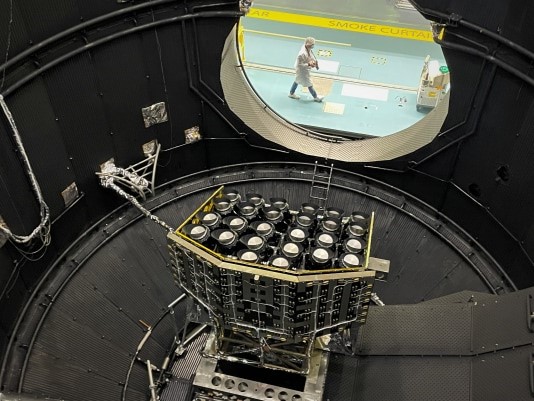
The framework to hold the 26 cameras in place is now undergoing a month-long test at ESA. It will be "soaked" in a vacuum chamber to test its durability under space conditions. The test also includes a "thermal cycling" test. In this, researchers will see how the framework holds up under the sharp temperature fluctuations associated with the transition from sunlight to complete darkness. And how these affect the operational temperature of the cameras.
Notes opening photo
Inspection of the space simulator. One of the goals is to see with a precision of a millionth of a circle in which direction the camera is looking. In this picture, a gimbal is inspected with a theodolite. This is an optical instrument that measures rotation angles. This process is done in a clean room because even the smallest particle of dust can cause deviations. A video link allows contact with the control room. Credit: SRON










