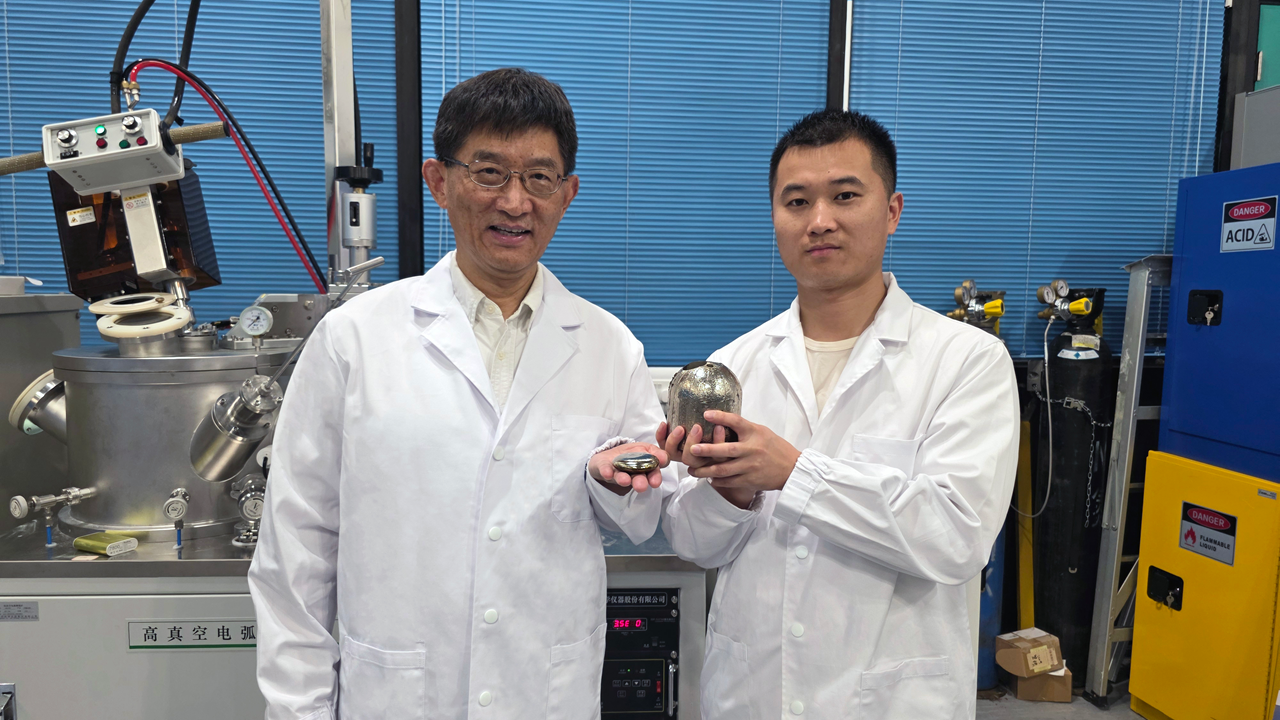

Researchers from the School of Engineering at Hong Kong University of Science and Technology (HKUST) may turn the world of heat pump technology on its head. They have developed a new elastic alloy called Ti₇₈Nb₂₂. It achieves remarkable efficiency for solid-state heat pumps. In addition, it exhibits a reversible temperature change (ΔT) 20 times greater than that of conventional metals when stretched or compressed. According to the researchers, it offers a promising green alternative to traditional vapour compression heating and cooling technologies.
Almost half of the world's energy is consumed for heating, including district heating in the building sector and process heating in various industrial sectors. Currently, global heat demand is mainly met by burning fossil fuels, which produce a large amount of greenhouse gases and consume a lot of energy. Using heat pumps based on fixed phase transitions is a more environmentally friendly approach, but their energy efficiency remains only 50-70% of the Carnot limit.[The carnot process is a thermodynamic circuit process in which all heat is supplied at a high temperature and dissipated at a low temperature]. Achieving more efficient and environmentally friendly heat pumps remains a global challenge, and requires a different approach to heat pump technology.
New heat pump technology
To address this challenge, the research team of Prof SUN Qingping of the Department of Mechanical and Aerospace Engineering (MAE) has proposed a new heat pump approach that uses heat generated by elastic deformation, known as the thermoelastic effect (TeE).
Thermoelastic effect
Although TeE was discovered in the 19th century by scientists Kelvin, Joule and Duhamel, it was long considered too weak for practical applications. Prof Sun's team is changing this. It made a new elastic alloy (Ti₇₈Nb₂₂ martensitic polycrystal) that when subjected to linear elastic deformation for heat transfer, exhibits a reversible temperature change (ΔT) that is 20 times greater (4 - 5 K) than conventional metals, which usually change only about 0.2 K. Remarkably, this alloy achieves about 90% of the Carnot efficiency limit in a heat pump cycle, making it highly competitive with refrigerants used in commercial vapour compression heat pumps.
This discovery changes the long-standing perception that the thermoelastic effect is too weak to be useful. Our research shows that linear elastic deformation can only be used for highly energy-efficient heat pumps.Prof SUN Qingping from the Department of Mechanical and Aerospace Engineering (MAE) of the School of Engineering at Hong Kong University of Science and Technology (HKUST)
Elastic alloys
Moreover, the team's research indicates that certain ferroelastic alloys could be developed with even higher thermal expansion. As a result, temperature changes of up to 22 K could be achieved. This work offers a promising opportunity for green heat pump technology and presents the first non-phase transition-based solution for environmentally friendly, high-efficiency heat supply.
Highly efficient heat pumps
Prof Sun said, "This discovery changes the long-standing perception that the thermoelastic effect is too weak to be useful. Our research shows that linear elastic deformation alone can be used for highly energy-efficient heat pumps." Dr LI Qiao, the first author of this research and Research Assistant Professor of the same department, added: "As global efforts to reduce carbon emissions increase, this technology offers a solution for replacing fossil-fuel-based heating. We are currently developing prototypes of heat pumps using the alloy for industrial applications."
Research on elastic alloy and heat pump technology
Research on the elastic alloy combined with heat pump technology was recently published in Nature Communications, in a paper titled "Large Thermoelastic Effect in Martensitic Phase of Ferroelastic Alloys for High Efficiency Heat Pumping". The research was supported by the Hong Kong Research Grants Council (RGC) through Strategic Topics Grant (STG) and General Research Fund (GRF). Several international patents have been applied for related technologies.
Source: The Hong Kong University of Science and Technology
Read also: Evonik and VoltH2 build 50 MW electrolyzer in Delfzijl
Opening photo: Prof SUN Qingping (left) and research assistant Prof LI Qiao (right), both from the Department of Mechanical and Aerospace Engineering at HKUST, demonstrate their newly developed Ti₇₈Nb₂ elastic alloy. It could be a breakthrough in heat pump technology. (Photo: HKUST)