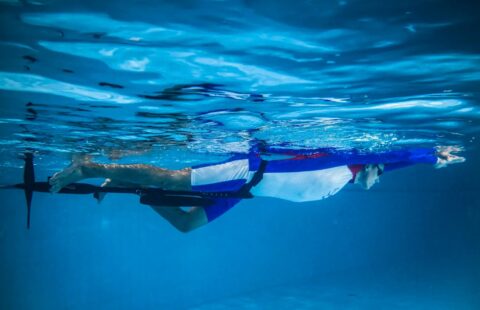
Diving is no easy task and is inextricably linked to certain dangers. Some of these are prevented by using traditional diving systems, which provide the diver with a long hose through which they can breathe. In a new Austrian variant of this system, the diver generates their own air supply. This ExoLung converts the diver’s swimming movements into air flow, ensuring a continuous air supply for as long as the diver continues to swim.
Like other surface diving systems, the ExoLung has a buoy that floats on the surface of the water and serves as both safety and air intake. A hose connects the buoy to a unit worn on the front of the torso. On the inside of the unit is a collapsible water bladder. This bladder is connected via straps to the diver's feet. As the diver pushes his or her legs away, the straps pull on the bladder, sucking in air at the surface and pushing water out. As the leg is pulled together, the straps relax and the water pushes the bladder back into the unit, compressing the air for inhalation.
Other surface-supplied breathing apparatus that bridges the gap between snorkelling and diving are limited by a battery or compressed air tanks. By using the diver themselves as the power source, the air supply only stops when the diver stops swimming. And if a diver stops swimming, it is probably because they are surfacing again.
The 5-metre-long ExoLung hose prevents the diver from diving to dangerous depths, which could carry the risk of him or her expending too much energy and being unable to return to the surface with the available air. The entire ExoLung system weighs 3.5 kg and measures 40 x 30 x 20 cm. This makes it much more portable than alternative compressor systems.
The ExoLung, for which a patent has been applied for, is still in the prototype phase, but the price of the basic version described above will be less than €300. Unlike tank-based systems, the ExoLung does not incur the additional costs of refilling and is virtually maintenance-free.
The 4.5-minute video below presents the ExoLung.