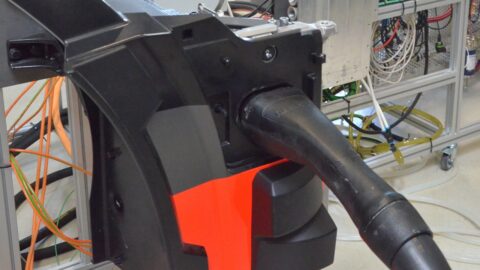
A flexible 'backstop' could help solve the grid congestion that is increasingly common in the Netherlands. It involves a small device that can automatically reduce the amount of electricity that, for example, a charging station or heat pump can draw from the grid or, conversely, solar panels can supply to the grid. The aim is to allow large industry to switch to electricity faster.
Netherlands risks failing to meet its 2030 climate targets. A key reason for this are problems around grid capacity and grid congestion. This prevents large industry from making the switch to electricity quickly. In fact, these problems are expected to increase further this decade before they eventually abate, say researchers from the TU Delft PowerWeb Institute.
TU Delft's PowerWeb Institute is a research institute focused on developing solutions for the electricity networks of the future. Its aim is to investigate how electricity networks can become more efficient, sustainable and reliable by using advanced technologies, smart grids, innovative markets and regulation. Among other things, it looks at integrating renewable energy sources, managing supply and demand, and optimising network infrastructures.
Using current capacity more efficiently
Researchers Kenneth Brunninx and Simon Tindemans handed over a Position Paper to the Lower House last week. In it, they reach out for a possible solution to the major network capacity problems that are increasingly arising in the Netherlands. It concerns the 'flexible backstop'. This allows the current capacity of the electricity grid to be used more efficiently, without compromising grid safety or reliability.
A flexible backstop is a safety mechanism that limits the amount of electricity that an electrical consumer can withdraw or supply from the grid. Think of a charging station, heat pump or PV installation. The backstop does this semi-automatically and at short notice.
Connected to or built into electrical consumer
It involves a small device connected to or built into an electrical consumer. It communicates with the distribution network operator. If acute congestion occurs on the grid, the grid operator gives a signal to limit the amount of power. This helps counter the congestion. The system activates only during periods of acute grid congestion and if all other measures have been exhausted, the researchers report.
"Upgrading the electricity grid remains essential, but in practice it will take years. So there is a need for short-term solutions that can be integrated into long-term planning. We, the members of the TU Delft PowerWeb Institute, call on the government, network operators and regulator to explore the flexible backstop as an additional grid security measure," Brunninx and Tindemans said.
Similar system in Germany
A similar system has recently been introduced in Germany for electric vehicle charging points. A legislative amendment has, since 1 January 2024, enabled regional grid operators in Germany to regulate the power consumption of residential appliances. This specifically concerns electrical appliances with a connected load of more than 4.2 kilowatts. In this way, grid operators can continue to facilitate the use of new appliances whilst at the same time preventing grid outages. In a blog post, expert Arjan Wargers from ElaadNL explores this system in greater depth.
In the Position Paper that Bruninx and Tindemans presented to the House of Representatives, they make a number of recommendations. These include developing a roadmap for the implementation of a flexible backstop. A key advantage here, according to the researchers, is that completely shutting off customers is no longer necessary in emergency situations. They also say a flexible backstop allows more new connections and finer control of available capacity, and can be implemented faster with less disruption than a physical network upgrade.
Good communication infrastructure needed
A successful flexible backstop requires a good communication infrastructure to remotely control power consumption. Some of this infrastructure is already proposed in current flexibility measures, according to the researchers, while others can be integrated into devices and energy management systems.
Bruninx and Tindemans argue that the proposed system change is necessary to accelerate and responsibly address the problem of grid congestion. They also call for a public debate to discuss the role of the flexible backstop and its implementation. Several issues should be discussed in this regard. These include: how often can it be used? How will the costs and benefits be shared? Should certain users be given priority? And how will the flexible backstop be embedded in the operational practices of system operators?
Kenneth Bruninx is associate professor at the Faculty of Engineering, Governance and Management, where he focuses on evaluating energy policy, regulation and market design using quantitative models. Simon Tindemans is associate professor in the Intelligent Electrical Power Grids group within the Faculty of Electrical Engineering, Mathematics and Computer Science. His research interests include uncertainty and risk management in power grids.
The full backstop can be found here (docx).
Author: Wouter Hoeffnagel