
According to a new UN report, more and more electronic waste is being produced worldwide, but recycling is not keeping pace. Valuable raw materials are not being recycled. This is where researchers at the Fraunhofer Institute for Factory Operation and Automation IFF want to do something about it. In the iDEAR project, they are developing solutions for the automated, non-destructive, robot-based dismantling of electronics for remanufacturing and material recycling to achieve a circular economy.
Due to technological advances, electronics have a shorter lifespan. This leads to a constantly growing demand for finite raw materials. At the same time, the mountain of e-waste is growing. By 2030, the global annual production of e-waste could rise to 74 million tonnes. Only a fraction of all electrical appliances are recycled. More than 80 per cent of e-waste ends up in landfills or incinerators. And with it the valuable raw materials, precious and rare earth metals it contains. Incineration can release hazardous chemicals and pollutants into the environment.
Manual dismantling of electronics
When electronics are not shredded, a small proportion of old devices are dismantled manually. They are stripped of harmful substances, mechanically shredded and separated into different parts using sorting processes. However, this manual dismantling involves high costs and is not very effective. Sustainable value preservation strategies to refurbish and recycle electrical appliances in the sense of a modern circular economy are still largely missing. In the iDEAR project, short for Intelligent Dismantling of Electronics for Remanufacturing and Recycling, researchers at the Fraunhofer IFF in Magdeburg combine knowledge management, measurement and robotics technology and artificial intelligence (AI) to create an intelligent system for automated and non-destructive dismantling processes to create a certifiable and closed-loop waste management system.
Data-driven methodology
"We want to revolutionise the dismantling of electronic waste. Current solutions involve high engineering costs and are limited to a specific product group. In the iDEAR project, we aim for a data-driven methodology so that as many different products as possible, from PCs and microwaves to white goods, can be dismantled with minimal engineering effort and in real time," says Dr José Saenz, group manager for assistance, service and industrial robots at Fraunhofer IFF. The researchers are initially focusing on the automated dismantling of PCs, but in the long term the process should be able to be extended to all appliances, such as washing machines.
Automation
Once the goods are delivered and separated, the process chain starts with identification and reporting. AI-based 3D camera and optical sensor systems capture labels with information about the manufacturer, product type and number. They recognise the type and position of components and check geometries and surfaces. In addition, they assess the condition of fasteners such as screws and rivets and detect deviations. "Optical measurement technology helps recognise labels and sort different components such as screws. Previously trained machine-learning algorithms and AI analyse the image data and enable real-time recognition and classification of materials, plastics and components based on sensor and spectral data," the researcher said. For example, AI recognises whether a screw is hidden or rusty. All data is stored in a digital disassembly twin. It also provides, for example, information on whether a similar product has already been disassembled.
Full or partial disassembly
In the next step, Saenz and his team use software to determine the disassembly steps. Among other things, these determine whether full or partial disassembly of the electronics should take place. For example, should only the high-quality parts be recovered or full disassembly required. Indeed, glued parts or other connections prevent non-destructive dismantling. Corroded screws, worn screw heads or deformed parts are also not up to the task. The dismantling process starts from this high-level information.
Electronics disassembly steps
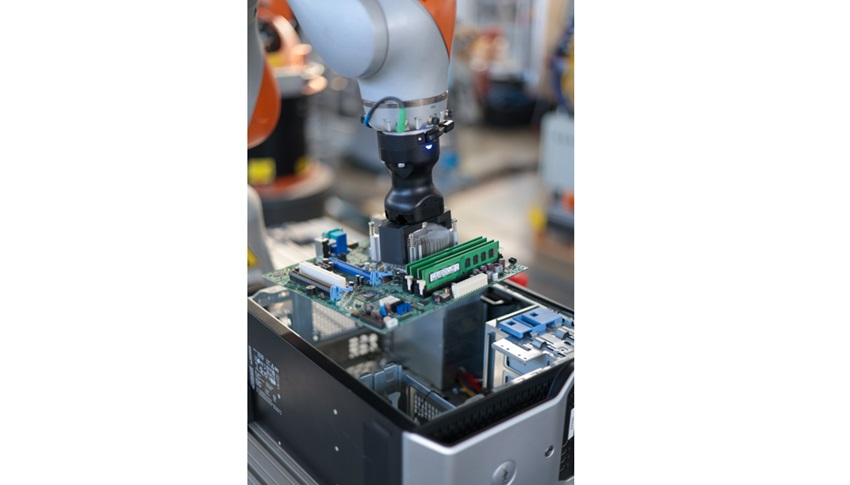
The robot receives a series of instructions and sequences to be carried out, such as "Remove two screws on the left side of the housing, open the housing, and so on. If necessary, the machine changes the required tools between individual work steps. Skills defined in the disassembly process include robotic actions such as screwing, lifting, cutting, pulling out, locating, repositioning, approaching, putting down, operating levers, bending cables, breaking and cutting. The disassembly robot can perform these tasks completely independently. In tests, the demonstrator has even managed to remove a motherboard from a PC casing. This is a highly complex task that requires a high degree of sensitivity.
Ai training
"An AI agent first trains the process solution on the simulation model and later we transfer the trained robot action to the real test rig. This is not necessary for simple skills like localisation, where we use sensor and camera data," explains Saenz.
The individual demonstrators for the sub-processes have been set up. The next step is to link the demonstrators together. The aim is to create a demonstrator that integrates all the technological developments and illustrates the interconnection of automated dismantling processes. “Recycling and refurbishment are essential for manufacturing companies to secure access to raw materials. Recovering materials not only reduces the environmental impact of electronic waste, but also provides a valuable source of raw materials for new products,” said the researcher.
Source: Fraunhofer IFF; Opening photo: The robot lifts the motherboard out of the housing. (Photo: Fraunhofer IFF)
See also: Europe on track for a 20 per cent share of global semiconductor production











