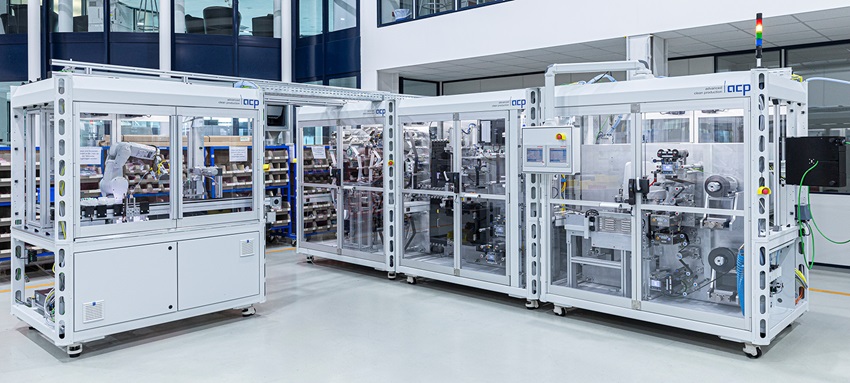

The further development of existing storage systems is a key prerequisite for the energy transition. That is why acp systems AG and the Centre for Digitised Battery Cell Production (ZDB) at the Fraunhofer Institute for Manufacturing Engineering and Automation IPA are joining forces. They have commissioned a winding system for cylindrical battery cells with flexible formats and designs. It serves as an innovative research and production platform for testing new cell formats and components in conjunction with tab designs. The winding system is the first of its kind in the world.
Batteries for electric vehicles consist of multiple modules. Each of these consists of many individual battery cells. The modules form the core of each battery. They are responsible for the lion's share of value creation. Cylindrical battery cells have become increasingly popular in the automotive industry in recent years, with a trend in favour of large cell sizes. ZDB at Fraunhofer IPA and acp systems AG worked closely on the development, construction and commissioning of a winding system for cylindrical battery cells, also called round cells. It will serve as a versatile research and production platform for rapid testing of new cell sizes and tab designs. It will also allow the application of advanced methods for improving quality and optimising processes.
Cylindrical battery cells
The new winding system completes a production line that is unique in Europe for the manufacture of cylindrical battery cells for lithium-ion batteries and future battery technologies such as sodium-ion batteries. What makes this production chain special is that all process steps are digitised and interconnected. From coating and winding to assembly, filling and forming.
Winding process
"At the ZDB, we can cover all the process steps involved in the production of a battery cell. The winding process is one of the core processes of production. The winding is the centrepiece of the battery cell. With the winding system, we have now closed a gap in the end-to-end digitised process chain. As a result, the production line is complete." So says Julian Grimm. He is leader of the research team at Fraunhofer IPA and deputy centre director of the ZDB.
Electrodes and separators coiled
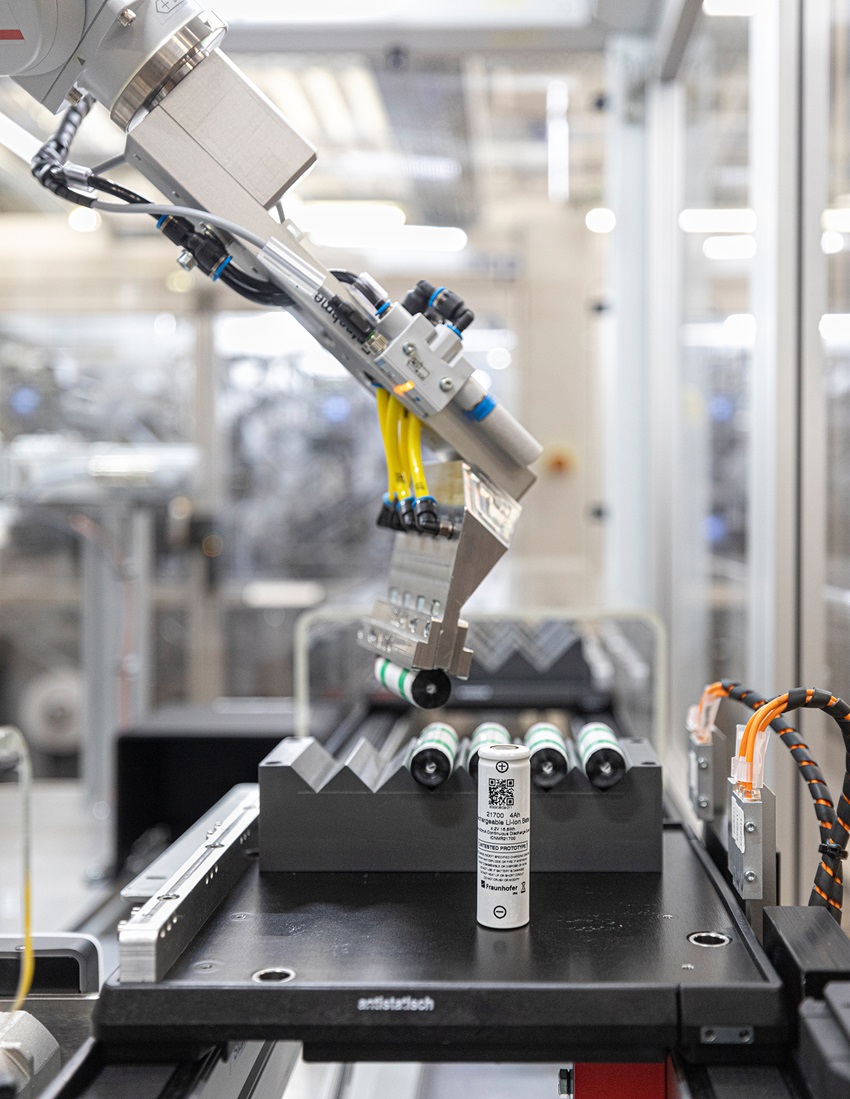
About a dozen steps are needed to make a cell ready for use. During the winding process, the positive and negative electrodes are rolled into a jelly roll together with two separators. This is followed by assembly, which involves moving and positioning the jelly roll with high precision. A rod electrode is then inserted through the central hole in the roll and used to weld the roll to the base of the cylinder.
Cylindrical battery cells
The new winding system for cylindrical battery cells is more than just a production platform for jelly rolls. It will also serve as a research platform for developing innovative cell systems and formats and testing their quality. "What makes our system unique is its flexibility. It allows us to realise different cell formats in different sizes and tab designs. For example, consider tabless designs, which do not have a tab welded to them. The tab, a narrow terminal element on the anode and cathode through which electricity must flow, is the chokepoint in large-size cells," says Grimm.
Larger cell sizes
For round cells, the trend is towards larger cell sizes, which take up more space, both in diameter and height. This means the coil and the cell itself are ultimately larger. But the problem is that the larger the cells are, the harder it is to collect the current and dissipate the heat. "We can meet this challenge with individual tab designs. For example, in a tabless design, the support foil of aluminium and copper can serve to capture current and dissipate heat, allowing both to be conducted better than with a traditional tab," Grimm explains. Innovative cell designs ensure homogeneity in cylindrical cells, allowing large cell sizes. Larger cells with more active material can be used to achieve greater energy density, which in turn increases the range of electric vehicles.
Collected data
To minimise waste and increase quality, the entire production process is digitised and networked. For this purpose, sensors collect data that converge in real time in the cloud. Traceability technologies developed by Fraunhofer IPA make it possible to assign the collected data to the battery cells produced. Each produced battery cell is available for data analysis and artificial intelligence training. This makes it possible to trace the conditions under which they were produced and how these relate to the product quality achieved. The data is used to develop services with monitoring, analysis and prediction capabilities. This makes it possible to improve the production process and eliminate error sources faster than before.
Innovative cell design and flexible production methods
"The innovative cell designs require redesign and optimisation of production processes, which can be explored in the winding facility. The combination of innovative cell design and flexible production methods is key to meeting the demands of a rapidly changing energy landscape, enabling new solutions to be brought to market faster and paving the way for sustainable, high-performance battery technologies," Grimm summarises. Manufacturers and users of electrodes, separators and cells will also have the opportunity at the facility to test their prototypes, products, cell components, materials and designs.
The Baden-Württemberg Ministry of Economics, Labour and Tourism funded the construction and installation of the winding system.
Opening photo: Innovative research and development platform: format and design flexible winding system (Photo: Fraunhofer IPA/Rainer Bez)