Next year, the Netherlands could well have its first ‘reusable’ bridge. The Economic Institute for Construction (EIB) has carried out research into reusable bridges, which shows that these could yield significant benefits for our country.
Not only are we improving in environmental terms, traffic congestion is also expected to decrease. Construction and maintenance costs will also go down. At the moment, each bridge is unique in the Netherlands. If a bridge has to be replaced, the steel and concrete may be put into blast furnaces and roads, but experts say that is not high-quality reuse.
IFD
Reusable bridges are built according to the IFD principle, which stands for industrial, flexible and demountable. Industrial means that under standard conditions an element is built (in the factory). Flexible stands for freedom of choice among the building elements (no uniformity) and demountable for building with elements with different lifespans. Bridges built JFD are sometimes called lego bridges because they can be assembled and disassembled in parts, as it were. The different building blocks fit together exactly like Lego bricks. A defective part can therefore be replaced quickly, so that the bridge is back in use faster.
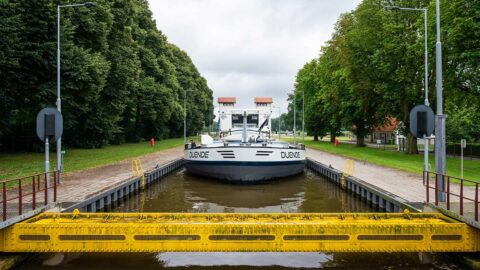
The province of North Holland is likely to get the Netherlands' first lego bridge next year. The Cruquius bridge in Heemstede will then be replaced. The province applied to take part in EIB's study, which included an examination of the costs and benefits and to what extent the bridge is realisable.
Innovative
Should reusable bridges actually find a place in our country, it will mean that bridges will no longer be unique but standardised. At most, there will be differences in size, but bridges will be built using the same building blocks. According to Paul Waarts, initiator of the project, the framework dimensions will be determined in advance (similar to the studs in Lego) but anything is possible in between. 'What shape the bridge takes doesn't matter.'
According to the EIB, many bridges in the Netherlands are due for replacement in the coming years. This needs to be handled innovatively to make the bridges as future-proof and circular as possible. The study says: 'The application of IFD principles offers a lot of perspective for this. A greater degree of prefabrication and standarisation of elements reduces the construction and maintenance costs (lifetime costs) of bridges overall by 7 to 14%. In particular, engineering costs and movement and propulsion costs can be reduced by 30 to 40%.
By: Kelly Bakker
Source: Cobouw.nl