A professor at TU Eindhoven has developed a model that should prevent 3D printed walls from collapsing or falling over. His equations could just about solve this construction problem.
3D printed materials are often still soft and flexible during printing, which can cause printed walls to collapse or topple over. Akke Suiker, professor of mechanics at TU Eindhoven, had a Eureka moment and saw the solution to this structural problem. He developed a model with which engineers can now easily determine at what dimensions and printing speed printed wall structures hold up. His equations are so elementary that they could become commonplace in the rapidly growing field of 3D printing.
Not curing
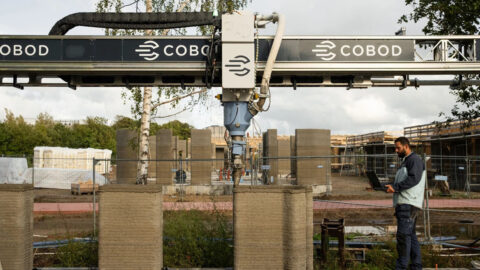
Conventional concrete, poured in formwork, is given weeks to cure. But 3D-printed concrete does not. That has no supporting formwork, and yet almost immediately gets the burden of the next layers of concrete being printed on top. Everyone senses that the stress increases as the structure gets higher. Is it already rigid and strong enough to add yet another layer on top? It is one of the key issues in the still fledgling field of 3D printing.
This issue was not actually on the plate of professor Akke Suiker, who sees his university's king-size concrete printer at work every day in passing. But on a Saturday morning last March, he did wake up with THE way to solve it. While still eating breakfast, he puts the first mathematical equations on paper. In the six months that follow, Sugar is completely entranced by it, working feverishly on the elaboration. The results appear this week in the International Journal of Mechanical Sciences1.
Predetermining
With his equations, Suiker can calculate in advance how fast he can lay layers on top of each other, at a certain curing speed of the material, and at certain dimensions of the wall structure - and of course without the structure failing. But he can also calculate how he can make that structure with as little material as possible, and what the influence of structural irregularities is. Or what happens if he makes a wall just a little thicker or lets it harden faster, or uses a different material. Or that the wall tends to fall over alone or also pulls the connecting structure with it. In the latter case, the consequential damage that occurs is obviously considerably greater. In fact, there are some 15 to 20 factors to take into account, but because Suger skilfully scaled his equations, he was ultimately left with only five, dimensionless parameters. The problem was thus tackled with a very elegant and insightful model.
When asked whether his results are going to be important for the field of 3D printing, Suiker is adamant. "They should be. The insights provided by the model create essential basics for anyone printing 3D structures. For structural engineers, engineering firms, but also, for example, for companies printing thin-walled plastic prostheses of small dimensions, because my equations apply to that as well." In any case, the initial interest is already there: he has been invited to Cambridge University to explain his work.
Suiker validated his model partly with results from tests done with TU Eindhoven's concrete printer, conducted by PhD student Rob Wolfs. At the same time as Suiker, the latter developed a computer model with which he can also calculate the structural behaviour during the printing process, but based on the finite element method2. Nice for both researchers is that results of their independently developed models confirm each other. Wolfs' model is different in scope. It works for detailed analysis of complex problems under specific printing conditions, but is not so suitable for identifying the main effects of the printing process and mapping overall trends due to its purely numerical nature and the computational time required.
By: Kelly Bakker
Source: TU/e
Photo: XtreeE