
ETpathfinder has opened in Maastricht. This state-of-the-art physics laboratory will serve as a testing ground for developing technology for future gravity wave detectors.
Gravitational waves teach us more about the universe. For example, what happened just after the Big Bang? Gravitational waves occur when two celestial bodies, such as black holes or neutron stars, collide. This force of nature creates a ripple in spacetime. However, its effect is so small that it was only measured for the first time in 2015. With that, it took about 100 years for technology to get far enough along to actually observe gravitational waves - which Albert Einstein predicted back in 1916.
Build ETpathfinder
ETpathfinder is currently being built at Maastricht University. Together with the Dutch physics institute Nikhef, the South Limburg university is the project leader. Furthermore, knowledge institutions from across Europe are involved. Professor Stefan Hild, project leader of ETpathfinder: "We started ETpathfinder with 15 partners from the Netherlands, Belgium and Germany. Universities and research institutes from France, the UK and Spain are now also contributing. It's great to see all this international expertise coming together here in our facility."
Living lab
With ETpathfinder, physicists are setting their sights on the future. Around the year 2035, a new European gravity wave detector should be ready: the Einstein Telescope. The Einstein Telescope requires an investment of around two billion euros. The telescope will be about 10 times more sensitive than current measurement setups. This should lead to hundreds of thousands or even millions of observations of gravitational waves per year. However, such a large increase in sensitivity cannot be achieved with existing technology.
Develop
The necessary technologies and techniques will therefore first be developed and tested with ETpathfinder. These include, for example, new cooling techniques, mirror coatings and lasers, which cooperating knowledge institutes and high-tech companies are developing. These innovations are also expected to find other applications in industry.
Facility
The facility itself will consist of a large dust-free hall with a stable temperature: a clean room. It is possible to set up various forms of laser interferometers in it over the next 20 to 30 years. This is a technique for measuring gravitational waves. The set-ups consist of several towers, containing all kinds of equipment, and 'arms' of vacuum tubes twenty metres long. This is not long enough to measure gravity waves, but it is long enough to develop and test all kinds of technologies and their interplay.
Opening scale model telescope
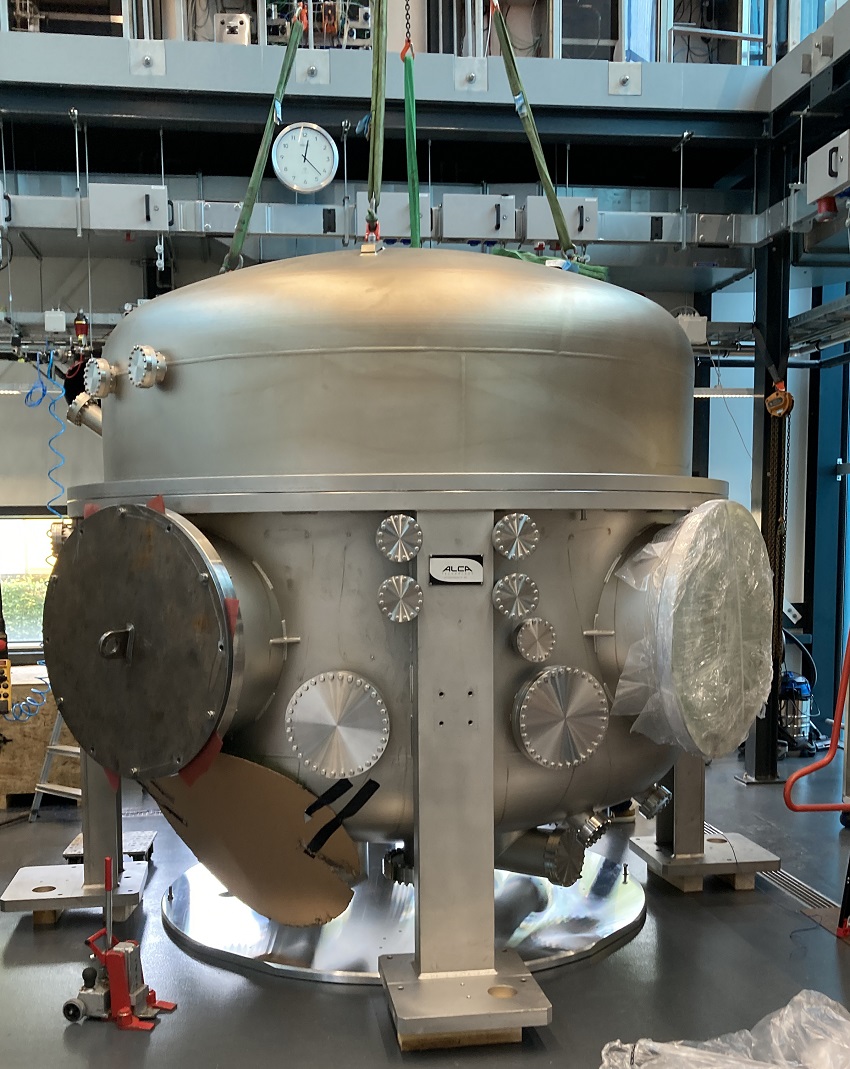
The University of Twente (UT) is also taking part in the project. It now also has a partial copy of it on campus: a scale measuring tower. This scale model serves for research into vibration-free cooling techniques.
(text continues below photo)
Unimaginable proportions
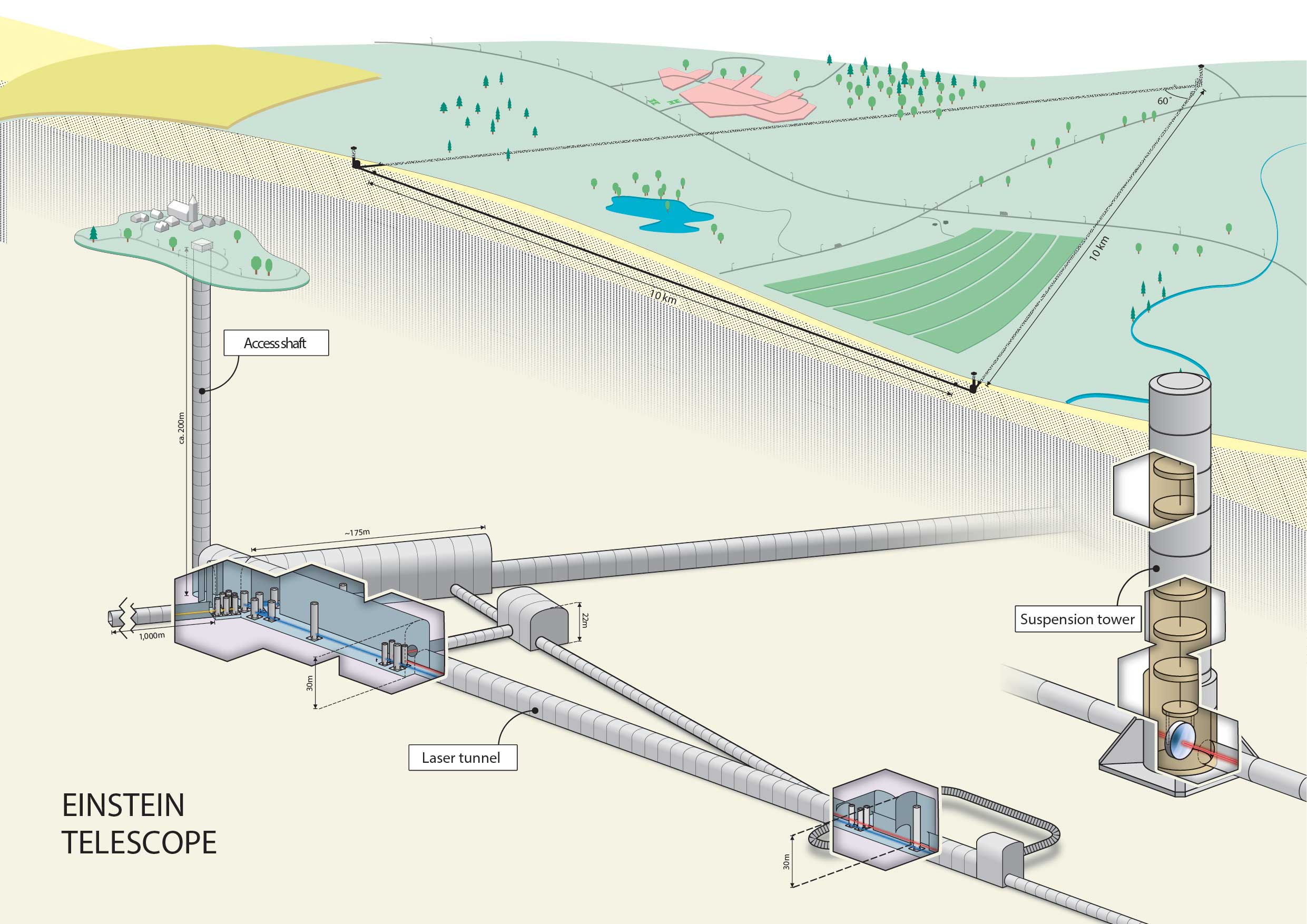
The telescope is shaped like an equilateral triangle whose sides are 10-kilometre-long tubes, 250 metres underground. At the vertices are measuring towers that emit and reflect laser beams. The slightest ripple, caused by a gravitational wave, already affects the laser beam. The precision mirrors that reflect the laser light are cooled to near absolute zero. The challenge is to use a cooling technique that does not itself cause vibration. And that's where the expertise of the Energy, Materials and Systems group, part of UT's MESA+ Institute, comes in: similar extreme requirements applied in a project for the European Space Agency, for which the group carried out research.
Scale model telescope in high-pressure lab
So on the UT campus, in the High Pressure Lab, a scale model of one of the vacuum measurement towers has been installed. It is about three metres across and 2.5 metres high. The final underground version will be at least 20 metres high to allow the mirrors to be suspended vibration-free.
Netherlands and the Einstein Telescope
It is no coincidence that ETpathfinder is springing up in Maastricht. The border region, alongside the Italian island of Sardinia, is a promising construction site for the actual Einstein Telescope. Apart from the presence of ETpathfinder, South Limburg scores high partly because of its special soil composition, which dampens disturbing subsurface vibrations. Above ground, it is also relatively quiet. For instance, there are few railway lines and wind turbines in the area. At the same time, the area offers good facilities and is home to many knowledge institutions and technology companies.
Image: Nikhef/Thijs Balder
Sources: message University of Twente and joint press release from Maastricht University and Nikhef










