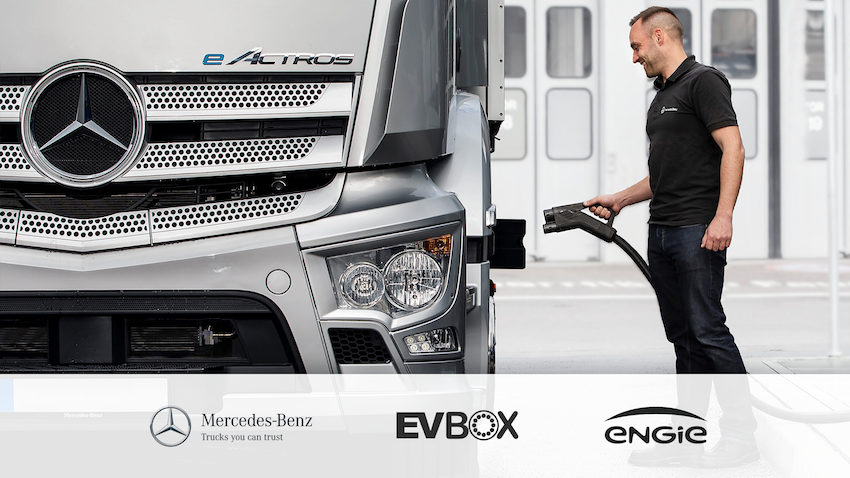

Mercedes-Benz Trucks is entering into a partnership with EVBox Group and ENGIE. Together with these parties, Mercedes-Benz Trucks aims not only to supply electric trucks, but to offer a complete ecosystem around electric transport. Including charging solutions for truck depots.
"Given the complexity of the processes surrounding electric transport, it is crucial to set the right course for the optimal use and integration of all-electric trucks. We want to properly address any concerns our customers may have in this regard while assuring them that our full-service offering covers all future needs," reports Andreas von Wallfeld, Head of Marketing, Sales and Services at Mercedes-Benz Trucks.
As part of the collaboration, interoperability between EVBox Group and ENGIE Group's products and services and Mercedes-Benz Trucks' current and future electric commercial vehicles has been tested. The eActros electric truck, for example, will be in production from this year.
Realistic user profile
Mercedes-Benz Trucks' eConsulting team creates a user profile of electric trucks based on a customer's existing routes. EVBox Group and ENGIE in turn analyse customer deposits. Based on this, they develop a customised infrastructure and energy supply. Including smart charging solutions for the specific customer. Both parties also provide maintenance to the charging stations. In addition, they provide advice and technical training.
"With more than 10 years of experience in providing integrated charging solutions for electric vehicles, we know the importance of clear guidelines, reliable products and excellent service at every stage of the customer journey. Fleet electrification will play an important role in meeting CO2 targets, especially since transport is responsible for almost a quarter of greenhouse gas emissions in Europe. I am therefore looking forward to entering into this partnership with Mercedes-Benz Trucks and ENGIE. With our expertise, EVBox Group will support Mercedes-Benz customers by delivering smart and scalable charging solutions that contribute to more sustainable transport across Europe," said Kristof Vereenooghe, CEO of EVBox Group.
eActros
Mercedes-Benz Trucks' focus on electric trucks is not new. The company has been focusing on developing these vehicles for some time. For instance, the company's all-electric eActros was already being tested in Germany and Switzerland in 2019. The company announced the second phase of the test track in August 2020. This will involve mileage tests in the Netherlands and Belgium. The vehicle's launch is scheduled for this year.
Parent company Daimler Trucks has also been experimenting with electric trucks for some time. For example, customer tests have been conducted since 2014 with the Fuso Canter E-Cell, aimed at light distribution. Meanwhile, subsidiary Mercedes-Benz Trucks has also been active with electric trucks for years.
Increasing urbanisation
Mercedes-Benz argues that increasing urbanisation worldwide requires electric trucks. Among other things, the company points to the increasing focus on improving air quality, reducing noise pollution and environmental zones. London and Paris, among others, additionally want to ban combustion engines in city centres. Electric trucks can be used in such locations to distribute goods.
The development of the eActros is supported by the German Ministry of the Environment, Nature Conservation and Reactor Safety and the Ministry of Industry and Energy. Together, the parties are making around 10 million euros available for the project. Among other things, the money will be used to research challenges surrounding the development, production and operation of electric trucks. These include the deployment of high voltages (>400 V) and powers (up to 1000 A) and battery technology. However, also consider range and energy requirements, charging infrastructure and logistics concepts. Other examples include safety requirements, suitability for use in summer and winter months and the resale of used electric trucks.
In addition to fully electric trucks, Mercedes-Benz Trucks is also working on trucks with a fuel cell. These use hydrogen-based propulsion. The manufacturer claims that both electric and hydrogen enable CO2-neutral transport. If long-distance journeys are easy to plan, the electric eActros LongHaul with a range of 500 kilometres offers the solution. However, for longer trips with more flexibility and/or more loading, the hydrogen-powered GenH2 is more suitable, according to Mercedes-Benz Trucks. The GenH2 offers a range of 1,000 kilometres.
Author: Wouter Hoeffnagel








