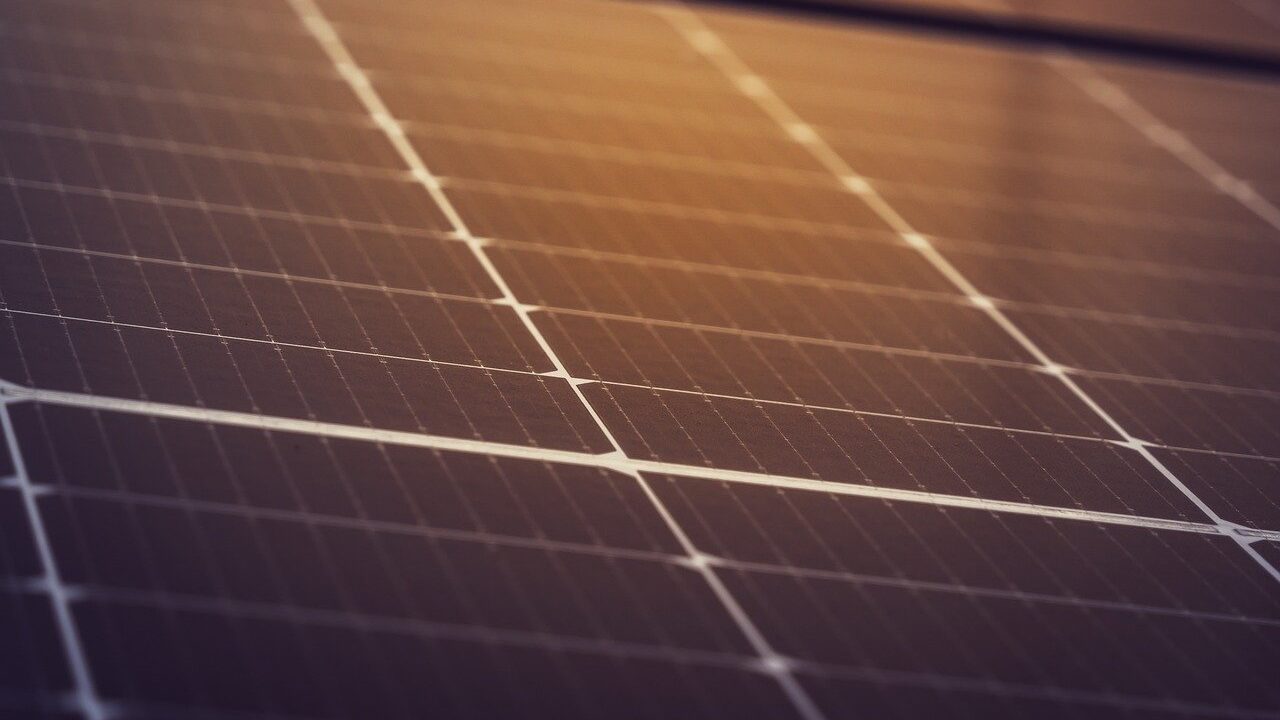

A new solar film enables generation of solar energy without the use of silicon solar panels with an energy efficiency of 27%. An important advantage as the demand for silicon is rapidly increasing due to various developments. The solar film can also be applied to a wide range of materials as a coating, theoretically allowing all kinds of objects to generate solar energy. Think cars, but also mobile phones or even backpacks.
The solar film was developed by researchers at the physics department of the UK's Oxford University. The material has been certified by Japan's National Institute of Advanced Industrial Science and Technology (AIST) for an energy efficiency of 27%. This is possible thanks to the use of a so-called 'multi-junction' approach. In this, the researchers stack multiple light-absorbing layers on top of each other in a single solar cell, which can thereby exploit a wider light spectrum. This makes it possible to generate more energy from the same amount of sunlight.
'Over time, efficiency of more than 45% should be possible'
"Over five years of experiments using our stacking or multi-junction approach, we increased energy conversion efficiency from 6 to 27%, which is close to the limits of what single-layer photovoltaic panels can achieve today," explains Dr Shuaifeng Hu, Post Doctoral Fellow at Oxford University Physics. "We think that over time this approach could enable photovoltaic devices with much higher efficiencies of up to more than 45%."
In comparison, contemporary solar panels have an energy efficiency of between 15% and 22%, meaning they convert up to 22% of the sunlight they capture into energy.
Just over a micron thick
A characteristic feature of the solar film is its thickness, which is only slightly more than one micron. By comparison, that is 150 times thinner than a silicon wafer, from which chips are made. Thanks to the thinness of the film, it can be applied to almost any material. This is in contrast to traditional photovoltaic material, which is applied mainly to silicon.
"Using new materials that can be applied as coatings shows we can replicate and surpass silicon, while also gaining flexibility. This is important as it enables more solar energy without the need for many silicon-based solar panels or solar farms," said Dr Junke Wang, Marie Skłodowska Curie Actions Postdoc Fellow at Oxford University Physics.
Reduce cost of solar energy
The researchers expect that their solar film can help further reduce the cost of solar energy. "We can imagine perovskite coatings being applied to broader types of surfaces to generate low-cost solar energy, such as the roof of cars and buildings and even the back of mobile phones. If more solar energy can be generated in this way, in the longer term we can foresee less need to use silicon panels or build more and more solar farms," Dr Wang said.
The researchers are part of a larger group of researchers working on photovoltaic materials led by Professor of Renewable Energy Henry Snaith of the Oxford University Physics Department. Through the spin-off Oxford PV, the researchers aim to bring the material to market. Mass production of perovskite solar cells recently started at a plant in Brandenburg-an-der-Havel, Germany. Germany was chosen because of incentives made available by the German government.
A perovskite solar cell features an absorption layer, which consists of a material with a crystal structure that absorbs sunlight and partially converts it into a flow of electric charges. The layer is coated on both the top and bottom with a transport material that allows electrons (negatively charged) or holes (positively charged) to pass through. TNO, amongst others, is also working on perovskite solar cells.
More parties working on solar film
Oxford University is not the only organisation working on solar film, however; various other organisations are also developing rollable solar cells. One example is Hyet Solar, which began mass production of the material several years ago. Vopak, amongst others, is using the material at its terminals in Laurenshaven, Rotterdam. TNO Solar Research is also working on solar film.
Author: Wouter Hoeffnagel
Image: Michael Pointner via Pixabay











