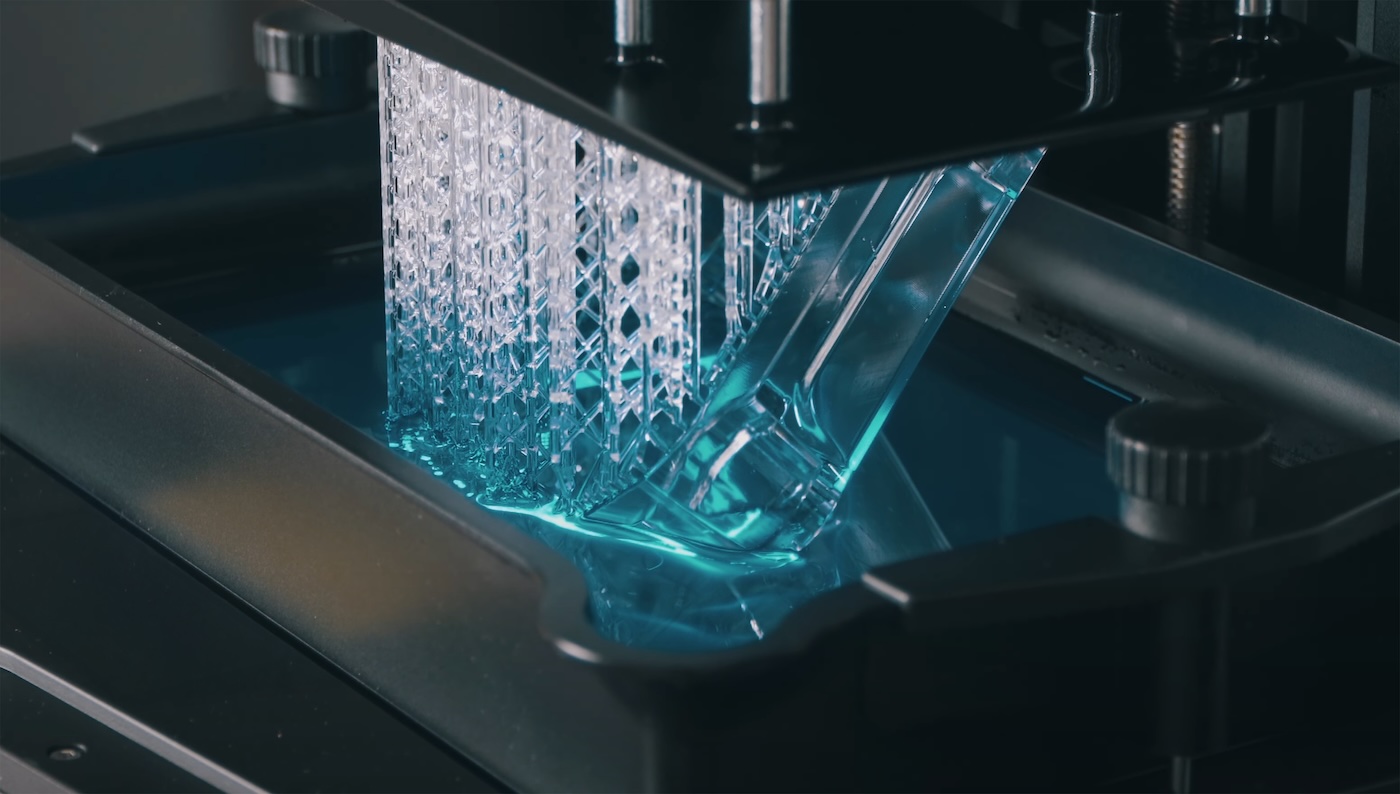

A new 3D printing method allows flexible and hard materials to be combined in one print. To do this, the method uses different colours of light, causing the material to cure differently.
The 3D printing method was developed by researchers at the University of Texas at Austin. The method was inspired by the way nature combines hardness and flexibility, including in the structure of bones and cartilage. The researchers expect that their development could enable advanced prosthetics, flexible medical devices and stretchable electronics, among other things. These products should be able to move with the human body thanks to the printing method, in a way similar to a human joint or ligament.
Zak Page, assistant professor of chemistry at the University of Texas at Austin and lead author of the paper: "What has really motivated me and my research group is looking at materials in nature. Nature does this in an organic way, combining hard and soft materials smoothly at the interface. We wanted to replicate that."
Problems at the interface
One of the biggest challenges in creating objects with very different physical properties is that materials tend to fail at the interface: the location where the two materials come into contact. As an example, the researchers point to shoes, where the rubber sole of over time can separate from the rest of the shoe's material.
By printing both materials from the same material despite their different physical properties, the researchers counteract this. To make this possible, the researchers use a customised liquid resin. The material cures differently during the printing process thanks to different chemical reactions. The researchers activate these different reactions by adjusting the colour of the light they use to cure the material. Using violet light, the resin hardens into a stretchy, rubbery material. Using higher-energy ultraviolet light causes the material to become rigid and strong.
Creating stronger joints
Researcher Keldy Mason: "We built a molecule with both reactive groups so that our two hardening reactions could 'communicate' with each other at the interface. That gives us a much stronger connection between the soft and hard parts, and there can be a gradual transition if we want to."
"This approach can make additive manufacturing more competitive for higher-volume production compared to traditional processes such as injection moulding. Just as importantly, it opens up new design opportunities. This gives engineers, designers and makers more freedom to create," Page said.
'Surprised how well it worked the first time'
The assistant professor added: "Honestly, what surprised me the most was how well it worked the first time. That almost never happens with 3D-printed resins. We were also surprised at how different the properties were. The soft parts stretched like a rubber band and sprung back. The hard parts were as strong as plastics used in consumer products."
The researchers see wide applications for their development. They report that the printing process is faster and with better resolution than previous approaches. The printer setup is also relatively simple and affordable, which could make the technology accessible to researchers, hospitals and educational institutions. Page: "It could be used to prototype surgical models, wearable sensors or even soft robots. There is so much potential here."
The researchers share more information about their development in a paper published in Nature Materials. In addition, the researchers share a paper in ACS Central Science.









