
Thermoelectric materials can convert temperature differences into electrical voltage and vice versa. They can be used for power generation, cooling and heating, among other things. However, producing thermoelectric materials is often costly. A new 3D printing technology developed by researchers at the Institute of Science and Technology Austria (ISTA) makes it possible to significantly reduce these costs.
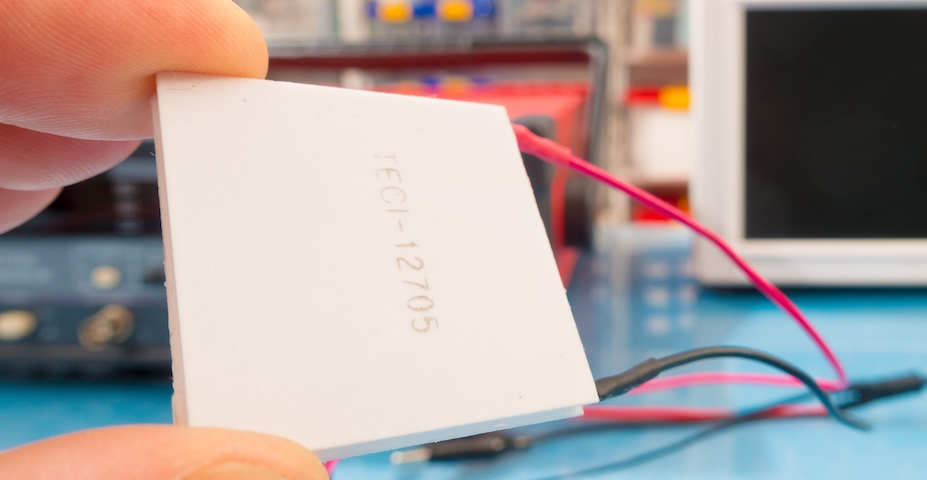
Thermoelectric coolers can be used for local cooling, among other things. The coolers make use of the Peltier element, an electrical component that can be used to move heat from a cold to a heat spot or to generate power from temperature difference. In doing so, the units have a long service life, are highly resistant to leaks, are adaptable in shape and size, and contain no moving parts. This makes them ideally suited for a variety of cooling applications, such as in electronics.
Expensive production process with high material losses
Thermoelectric coolers are not new. In practice, coolers are manufactured from metal. The manufacturing process is not only expensive, but also leads to a lot of material loss. At the same time, the performance of the coolers is limited in practice.
A technology developed by Maria Ibáñez, Verbund professor of Energy Sciences and head of the Werner Siemens Thermoelectric Laboratory, and postdoc Shengduo Xu at ISTA offers a solution. The technique allows high-performance thermoelectric materials to be printed using a 3D printer to realise a thermoelectric cooler.
Higher efficiency and lower costs
"Our innovative integration of 3D printing into the production of thermoelectric coolers significantly improves production efficiency and reduces costs," says Xu. Unlike previous attempts to 3D-print thermoelectric materials, the method developed by ISTA yields materials with much higher performance. Professor Ibáñez added: "With a commercial level of performance, our work has the potential to reach beyond academia and find relevant applications in industry."
Ibáñez: "With a commercial level of performance, our work has the potential to reach beyond academia and find relevant applications in industry."
Degenerated semiconductors
The researchers point out that all materials exhibit some degree of thermoelectric effect. However, this effect is often too small to be useful in practice. Many materials that do offer sufficient thermoelectric effect are usually so-called 'degenerate semiconductors'. These are semiconductors to which impurities have been deliberately added to make them behave as conductors.
Current advanced thermoelectric coolers are produced using ingot-based techniques. These are costly and, in addition, energy-intensive production processes. These methods require extensive machining processes after production, during which a lot of material is lost.
Printing the required shape
"Our work allows us to 3D-print exactly the required shape of thermoelectric materials. Moreover, the resulting devices exhibit a net cooling effect of 50 degrees in air. This means that our 3D-printed materials perform comparably to materials that are significantly more expensive to manufacture," Xu explains.
The team expects their 3D printing technology to offer a scalable and cost-efficient production method that is less energy-intensive and also saves time.
Special inks
The team uses specially developed ink. Once the solvent in this ink evaporates, strong atomic bonds are formed between the particles. This creates a material network with solid chemical bonds, which improves charge transfer between particles. The bonds help with improving thermoelectric performance.
"We used an extrusion-based 3D printing technique and formulated the ink in such a way as to keep the structure of the printed material intact and strengthen the bond between the particles. This enabled us, for the first time, to produce thermoelectric coolers from printed materials with performance comparable to ingot-based devices, while saving material and energy," says Ibáñez.
Adjusting ink composition
The team reports that the composition of the ink can be adapted for other materials, for example for high-temperature thermoelectric generators. These are devices that can generate electricity from temperature differences. The researchers thus hope to increase the applicability of thermoelectric generators in energy recovery.
"We have successfully completed a full cycle, from optimising the thermoelectric performance of raw materials to manufacturing a stable and high-quality end product," says Ibáñez. Xu adds, "Our work provides a pioneering solution for the production of thermoelectric devices and marks the beginning of a new era of efficient and sustainable thermoelectric technologies."
Author: Wouter Hoeffnagel











