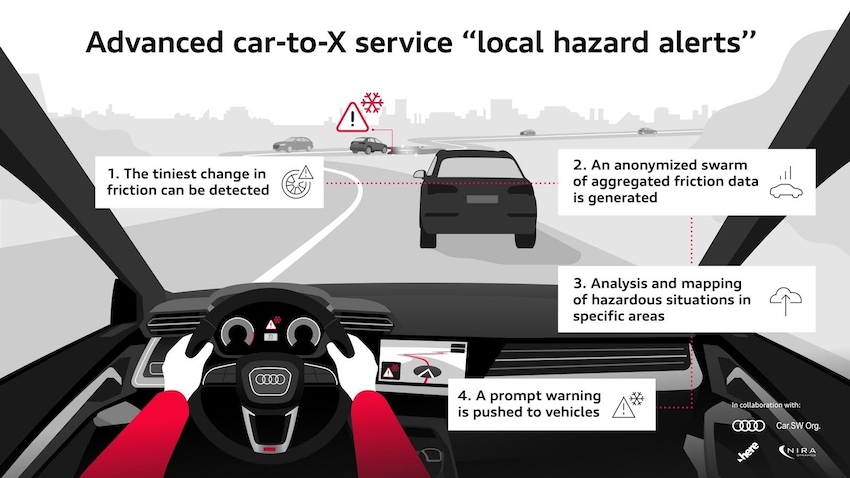

Audi is going to use a new system to give customers near real-time warning of dangerous road conditions, such as slippery roads. It involves a car-to-car service, where vehicles inform each other.
Car-to-car services are not entirely new for Audi. Models from the German carmaker have been able to give each other alerts since 2017. These include for accidents and cars stationary by the roadside with breakdowns, but also for traffic jams, black ice on the road or limited visibility. This service is called 'local hazard alerts'.
This existing service bases its alerts on data collected by Audi's from other customers. These include electronic stabilisation control (ESC) activity, rain and light sensors, windscreen wipers, headlights, emergency calls and airbag deployment.
Faster and more accurate
The new service Audi is now making available warns of danger faster and more precisely than the existing 'local hazard alerts'. It uses "highly accurate swarm data" to do so. Audi developed the service in collaboration with the organisation Car.Software and HERE Technologies.
The service is based on a solution from Swedish company NIRA Dynamics. With its 'Road Perception' service, the company provides information on road conditions. Information such as the friction of the wheels on the road, the exact location of speed bumps or the presence of potholes in the road makes journeys safer and more efficient, according to the company. NIRA Dynamics is also targeting the service at autonomous vehicles, which need such information for autonomous driving.
A hazard warning system based on this solution has been developed in collaboration with Car.Software and HERE Technologies. Based on the degree of wheel slip, the system estimates the coefficient of friction between the tyres and the road surface. This estimate is based partly on suspension technology data, such as wheel rotation speed and acceleration values. The data collected is processed locally in the vehicle, as well as in NIRA Dynamics' cloud. Audi stresses that all data is processed anonymously.
Combining with metadata
Data is combined with metadata, such as current weather information. The collected data is transmitted to the HERE location platform. This platform focuses on telematics, geocoding, route planning and traffic information, among other things. The road network is displayed on HERE platform as a three-dimensional model. Finally, the HERE servers transmit the alert information to cars driving in the relevant area or arriving here soon. The information is displayed in the vehicles on the virtual cockpit or the optional head-up display.
According to Audi, the system offers benefits to several parties. For example, driver assistance systems can do their job more accurately, something that benefits motorists. Navigation systems can give a better estimation of travel time based on road conditions. However, consider also municipalities, which can use the information to more accurately grit, clear snow and have road maintenance carried out.
Swarm intelligence
Audi describes the technology as 'swarm intelligence'. The technology is not limited to Audi, but is also available on new models from other parts of the Volkswagen group. Specifically, this includes new models from Audi, Volkswagen, SEAT, ŠKODA, Porsche, Bentley and Lamborghini. More than 1.7 million Volkswagen Group cars are expected to deliver swarm intelligence data this year. This number should rise to more than 3 million units by 2022.
Volkswagen also partnered with MobileEye around swarm data in 2017. The Israeli company's camera-based mapping and localisation technology Road Experience Management (REM) will be deployed in Volkswagen models for self-driving functions. In collaboration with Intel, the parties announced an autonomous taxi service in Israel in late 2018. The service should be operational from 2022.
Author: Wouter Hoeffnagel
Source photo: Audi








