
A new approach to beam forming will soon make additive manufacturing more flexible and efficient. Fraunhofer ILT has developed a new platform. This makes it possible to individually optimise laser powder bed fusion (LPBF) processes. Customised beam profiles offer many advantages. They improve component quality, reduce material losses and make it possible to scale the build-up speed of the single-beam process. This was previously impossible.
Various studies have already impressively demonstrated that beam shaping in laser powder bed fusion (LPBF) can improve the efficiency and productivity of this additive manufacturing process. The Fraunhofer Institute for Laser Technology ILT and the Chair of Technology of Optical Systems (TOS) at RWTH Aachen University are collaborating on a state-of-the-art test system. This enables them to investigate laser beam profiles in power classes up to 2 kW. This innovation can be used to develop bespoke solutions for industrial partners. The platform is designed to integrate LPBF processes more efficiently and robustly into industrial production, enabling them to meet growing demand.
Laser power in LPBF processes
Currently, laser powers of around 300 to 400 watts are common in many LPBF processes. However, the standard laser beam used in this process has significant drawbacks. The high concentration of power in the centre of the beam leads to local overheating. And it leads to unwanted material evaporation and process instability. The consequence? They can affect component quality through splashing and poring. These problems significantly limit process scalability. This means that the laser power available in LPBF systems - often up to 1 kW - cannot be used for most materials.
Accelerating the process
"One way to speed up the process is to use multiple lasers and optical systems in parallel." So says Marvin Kippels, PhD candidate in the Laser Powder Bed Fusion department at Fraunhofer ILT. "However, the costs are at least proportional to the number of systems installed." Moreover, these systems cannot always be used homogeneously in real applications. As a result, productivity cannot be increased proportionally to the increase in power. A promising approach is to increase the productivity of the single blasting process. This can then be transferred to multi-beam systems."
New opportunities through bundling
The potential of more complex bundle forming has so far remained largely unexplored due to the lack of the necessary system technology. This is now changing thanks to the extensive studies that researchers at Fraunhofer ILT have begun.
Targeted optimisation
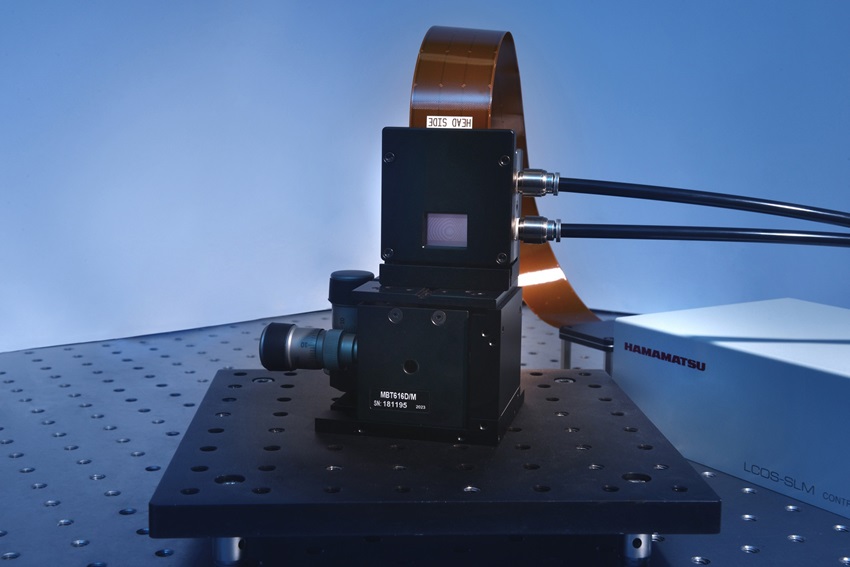
"The interaction between laser beam and material in the process is very complex because of its dynamics. Daardor simulations can only give indications of the actual melt pool behaviour," Kippels explains. He is currently setting up a new type of system that uses LCoS-SLMs (Liquid Crystal on Silicon - Spatial Light Modulator). This allows researchers to examine almost any beam profile in the LPBF process. Because it has a laser power of up to 2 kW, the innovative system is a platform for testing new beam shapes at very high power levels in the LPBF process. This makes it possible to identify the appropriate system technology for an individual LPBF task. "We can specifically optimise the LPBF process," Kippels explains. He refers specifically to less material evaporation, less spatter, less melt pool dynamics, a smoother melt path surface and higher process efficiency by adjusting the melt path geometry.
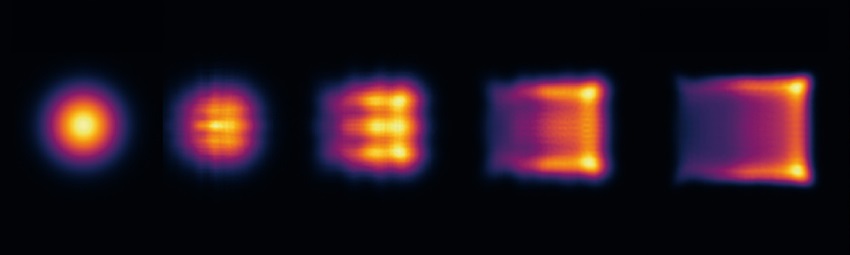
Flexible profiles for specific requirements
Currently, system technology is often touted as one that can produce specific beam shapes such as ring or hat profiles. However, the choice of these beam shapes is not based on a deep understanding of the underlying process mechanisms. Only through a fundamental understanding of the processes can research specifically determine which modifications achieve a particular goal, such as a particular melt trajectory geometry.
Huge potential LPBF
This means that there is a need to develop and optimise a bundle shape for the application, which a company can implement without the need for LCoS-SLM technology. Thanks to this research platform, industrial customers and project partners of Fraunhofer ILT can already benefit from unprecedented flexibility in laser beam research.
"We are still at the very beginning. Yet we are already seeing the enormous potential that beam shaping can offer for the LPBF process," says Marvin Kippels. "There is no one perfect beam shape. Every application has its own requirements. Thanks to our flexible beam shaping, we can find the ideal distribution for each process, the best process parameters for the task at hand." To achieve this goal, several departments at the Aachen institute support the work of Kippels and his team.
Featured image: With the system currently under construction, LCoS-SLMs can be used to generate almost any desired beam profile in the LPBF process. Photo: Fraunhofer ILT, Aachen, Germany
See also: 3D printing with multiple surface textures and colour gradients without changing materials











