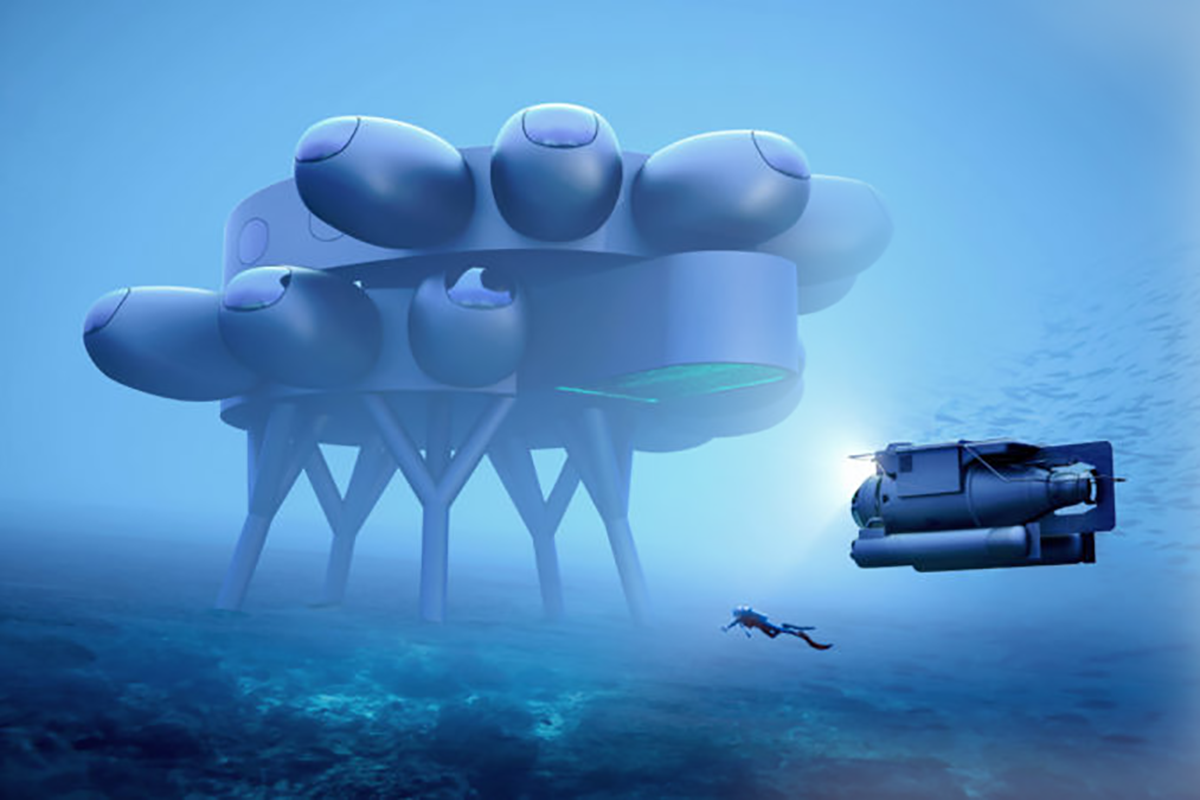

Proteus - the son of Poseidon - is the name of the world's most advanced underwater research station. The Underwater Centre is an initiative of Fabien Cousteau whose grandfather is Jacques Cousteau, the oceanographer made famous by numerous popular and influential books, films and TV programmes.
Underwater Laboratory
The 'young' Fabien, now 52 years old, has kept the family business thriving. Since learning to dive at the age of four, he has become one of the leading ocean conservationists and documentary makers of his generation. They are now taking the next step with industrial designer Yves Behar with the plan to build the largest underwater laboratory on the planet. His grandfather, of course, had a few cracks at the idea himself. Jacques Cousteau's Conshelf 1, 2 and 3 were underwater enclosures or 'habitats' that were also used to conduct research po the seabed.
Sustainable and striking
Fabien Cousteau's ambitious project Proteus will be more than three times the size of a previous attempt and can house up to 12 people at a time. It is a spiralling double-decker design on stilts that adjust to the shifting seabed. The centre is powered entirely by wind and solar energy from the surface and thermal energy from the ocean.
Spherical forms protruding from the main space will serve as bedrooms, laboratories, medical rooms, enclosures for systems and storage areas. The largest of these pods will be the "wet porch" - a large downward-facing hole that acts as a dock for underwater vehicles, allowing divers to enter the station. There will also be the world's first underwater garden and facilities for video production.
If all goes well - funding is not yet in place - the Proteus habitat will be some 20 metres below the surface of the coast of Curaçao. Divers and researchers will be able to stay there for weeks, benefiting from being able to work day in and day out without having to go through the long process of decompression every time.
Like an undersea international space station, Cousteau hopes to do regular live streams and release virtual reality and augmented reality images to convey the importance of the research.