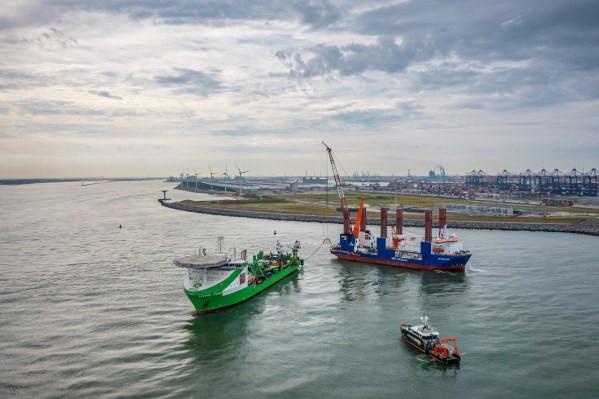

To connect wind farms north of the Maasvlakte, TenneT is using an underwater robot. This unmanned robot drives over the seabed and pulls a deep trench in it for the cables.
North of the Maasvlakte, TenneT is developing the offshore grid Hollandse Kust (south) for the connection of new wind farms. They are located about 22 kilometres off the coast of the Dutch province of South Holland. For this project, four offshore cables will be buried in the bottom of the North Sea. For the first ten kilometres of the offshore cable route, it is necessary to sink these cables 5.5 metres into the seabed so that it can cross the busy Rotterdam "Maasmond" without any problems. The installation of the first two cables already took place in September 2020.
Preparations completed
The Van Oord - Hellenic Cables consortium is installing the two cables to the Beta platform. The interlinking cable, which connects the two offshore platforms, had previously been successfully installed at the Alpha and Beta jackets. The preparatory work was completed in the past few days. The cable that will be installed at the Beta jacket has been pulled ashore to the new onshore high-voltage substation on the Maasvlakte. Now the consortium combination will lay this cable with a total length of 34 kilometres to the Hollandse Kust (south) wind area. Laying cables under water is not easy. Especially for this project, Van Oord therefore developed the Deep Dig-It, a gigantic remote-controlled underwater trencher.
Laying cables
Van Oord's Deep Dig-It is a Tracked Remotely Operated Vehicle (TROV). It drives unmanned over the seabed and creates a deep trench for the cables by liquefying the seabed. At the same time, the underwater trencher lays the cables in the trench and reseals it. The trencher is one of the very largest and most powerful of its kind and can bury the cables to a depth of more than 5.5 metres in very hard soil. Control of the underwater robot is done from an installation vessel. This vessel is also equipped with a crane that releases and retrieves the underwater robot into the water.
Weight of cables
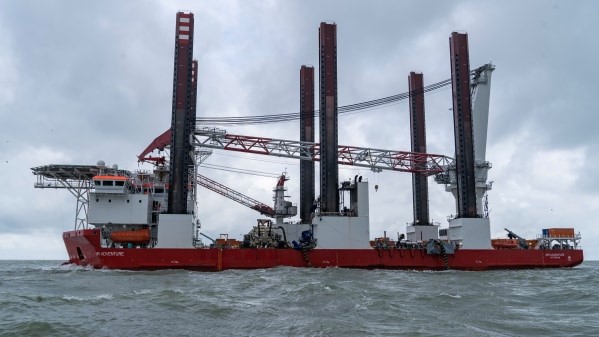
Beta cables weigh about 100 kilograms per metre and consist of three cores. These cores are made of aluminium. The cables have a diameter of 30 centimetres. Both cables were loaded onto spools in the cable ship 'Living Stone'. This cable ship runs on liquefied gas (LNG), which after all results in fewer emissions. Installation of the 34-kilometre cable route will take about four weeks. The work is expected to be completed by mid-September.
Topside
At the end of this year, the topside, the transformer station (socket) itself, will be lifted onto the Alpha jacket. The topside of the Beta jacket is expected to follow early next year. Once the topsides are hoisted onto the jackets, it will be possible to connect, test and commission the final systems. The wind farm is expected to be fully operational by 2023.
Hollandse Kust (south)
The grid connection for Hollandse Kust (south) is located 22 kilometres off the coast of the Dutch province of South Holland. Therefore, the whole has two transformer stations at sea, each with two 220 kV AC cables. These cables allow transmission of the sustainably generated electricity to land. TenneT has built a new 380 kV high-voltage substation and is expanding the high-voltage substation 'Maasvlakte 380 kV'. From this high-voltage substation, offshore wind energy is fed into TenneT's Randstad 380 kV Ring South. The wind energy goes through the national high-voltage grid to electricity consumers in the country.
Connection offshore wind energy until 2030
In the period up to and including 2023, TenneT will realise 3.5 GW of offshore grid connections for wind farms at sea. For these wind farms, TenneT uses five times the same type of 700 MW transformer platform located close to a wind farm and five times the same type of 220kV cable connection to the coast. This standardisation allows TenneT to build these projects more efficiently, faster and cheaper.
6.1 GW offshore wind farms
According to the Wind at Sea Roadmap, a further 6.1 GW of offshore wind farms will be developed between 2024 and 2030. This concerns wind farms in the wind energy areas Hollandse Kust (west), TenneT is again betting on three standardised 700 MW platforms (2.1 GW) for the first two areas. Efficient connection of wind energy areas further into the North Sea, such as IJmuiden Ver (4 GW), will require other technologies based on direct current instead of alternating current. At least two offshore connections of 2 GW each will be developed for IJmuiden Ver. In addition, a third connection of 2 GW for IJmuiden Ver is being studied in parallel with the other IJmuiden Ver projects.
Offshore grid connections Germany
In the German part of the North Sea, TenneT has already surpassed the German government's 2020 target a year earlier and 7.1 GW of offshore wind is now in operation in Germany. Until 2030, TenneT's offshore grid connection capacity in Germany will be expanded to about 17 GW.











