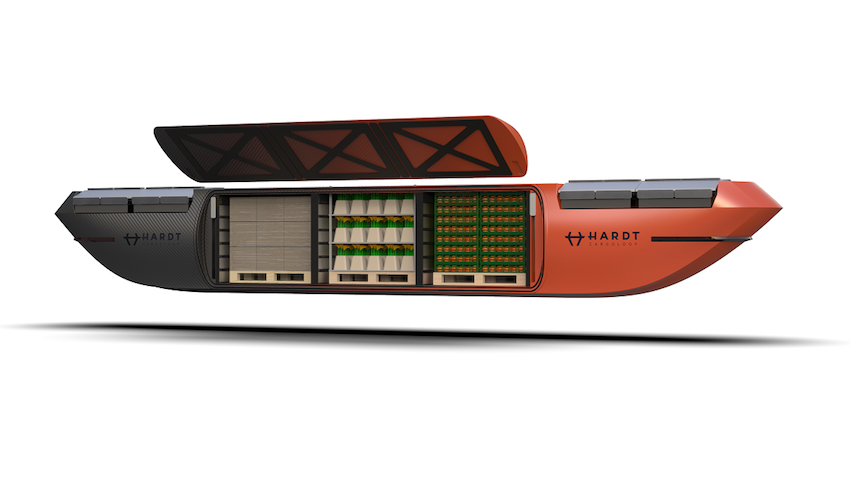

It is possible that valuable low-weight goods such as medicines or flowers in the Randstad will be transported via the hyperloop in the future. Among others, the municipalities of Haarlemmermeer, Rotterdam and Westland have signed a covenant with the company Hardt Hyperloop for this purpose.
The hyperloop is a means of transport that travels through a vacuum tube. This vacuum creates low resistance, allowing the vehicle to reach a high speed with relatively little energy. With a top speed of about 1,200 kilometres per hour, a journey from Amsterdam to Paris should be possible in about 30 minutes.
Flowers and medicines
The research that has now been announced focuses on using the hyperloop concept for of goods. This specifically involves freight of limited weight and high value, such as flowers or medicines. An initial trace between the Rotterdam and Amsterdam regions is being investigated. The research should identify challenges also faced by other urban areas in Europe and find solutions for them. This should pave the way for investment in hyperloop infrastructure across the continent.
Hardt Hyperloop speaks of a pilot route that is a first step in creating a pan-European emission-free hyperloop network. The network should reduce the transport of goods across Europe to hours and worldwide to days. The hyperloop should also reduce maintenance costs on existing infrastructure and combat congestion. And by reducing CO2 emissions, it should be able to improve air quality.
A large number of parties are involved in the study. Besides the municipality of Haarlemmermeer, Rotterdam and Westland, they include Agora Flores Holland, Air Cargo Netherlands, Amsterdam Airport Area, Amsterdam Logistics Board, APMT(Maersk), Baas, Berg Roses, BestFreshGroup, De Wintertuin, Dümmen Orange, Dutch Flower Group, Europool Systems, evofenedex, Greenport Duin- en Bollenstreek, The Greenery, GroentEnFruithuis, InnovationQuarter, Port of Amsterdam, North Holland province, South Holland province, SADC, Royal Schiphol Group, TLN and Groningen province.
Hyperloop Development Program
The parties are joining forces under the banner of the Hyperloop Development Programme (HDP), a public-private partnership for the development of the Hyperloop that was announced at the end of 2020. The HDP focuses on developing the Hyperloop as a sustainable means of transport, for both passengers and goods. The Ministry of Economic Affairs and Climate Policy (EZK) and the Ministry of Infrastructure and Water Management (I&W) are among those involved, as are the province of Groningen, industry partners and knowledge and research institutes.
"This cooperation is an important step in the development of this new modality, which will soon enable us to deliver more often, fresher and faster at a lower rate. We can start transporting goods at speeds that are very competitive with trucks, with more frequent and smaller shipments. Because the system operates autonomously and integrally, platooning allows for quick and easy capacity adjustments. Of course, this does not only apply to Dutch business, many other markets, such as ecommerce and pharma worldwide, also benefit from such a network," says Rik Roeske, cargo hyperloop project leader.
Marja Ruigrok, alderman for economy & innovation at the municipality of Haarlemmermeer: "As alderman for economy & innovation, I naturally like to stay connected to these developments. It is of course fantastic if products reach their destination faster and the number of truck kilometres by road can be reduced."
'Gamechanger for transport'
Walther Ploos van Amstel, economist and urban logistics lecturer at the Hogeschool van Amsterdam: "The Hyperloop is a 'gamechanger' for the transport sector, just like the container from the 1960s. The competitiveness of regions will change. As Europe's logistics mainport, the Netherlands must respond to this now."
Who will eventually run the network and how fine-meshed the network can become is all still part of the study. The first results of the study are expected during 2022.
Author: Wouter Hoeffnagel











