
A new navigation system for drones and robots is inspired by the behaviour of honey bees. Bee-Nav enables small robots to independently cover long distances and return safely to their starting point, using a neural memory of just 42 kilobytes.
The system was developed by scientists from TU Delft, in collaboration with biologists from Wageningen University and Carl von Ossietzky University in Oldenburg. The results of the underlying research have been published in the scientific journal Nature.
Heavy, expensive and energy-intensive
Most current navigation systems for robots use detailed maps and in practice require a lot of computing power and memory. This makes the systems heavy, expensive and energy-intensive. This limits applicability for small, lightweight drones.
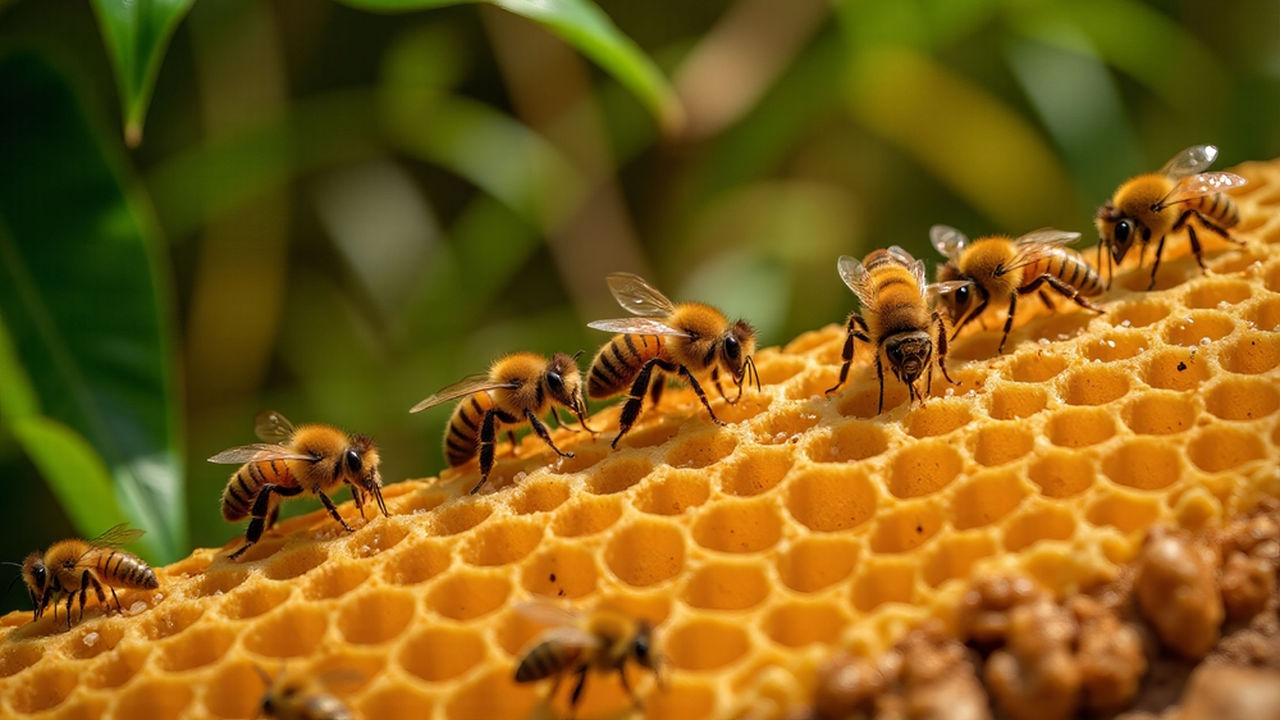
Honey bees, however, show that more efficient solutions exist. Although they have small brains, bees are able to cover long distances and successfully find their way back home. They do this through odometry, where they estimate distance and direction based on visual movement signals, and visual memory, where they memorise the environment around key locations.
Neural network
The research team translated these principles to Bee-Nav. During a short learning flight near its home base, the drone captures panoramic images of its surroundings. A small neural network learns to process these images to estimate the direction and distance home. This enables the drone to return even if the home base is not visible.
The neural network is trained using odometric estimates, which become less accurate over time. Despite this limitation, odometry proved sufficient for the drone to successfully return to its home base.
Suitable for both indoor and outdoor use
During tests in large indoor spaces, the system performed excellently. Also outdoors, at the drone research field lab Unmanned Valley in Valkenburg, the drone successfully returned to its starting point, even over distances of more than 600 metres.
Wind proved to have a significant impact on the system's performance. For instance, in windy outdoor conditions, the success rate dropped to 70 per cent, mainly due to the impact of wind on image quality. Wind caused tilt of the drone, making the images less useful for navigation.
The researchers point to several practical applications of Bee-Nav, such as monitoring greenhouses. For instance, lightweight drones can be used to inspect crops and detect diseases or pests at an early stage. The navigation system can thus help growers increase their yields and reduce wastage.
The team stresses that the system still needs to become more robust in real-world conditions. However, the scientists call the results promising.