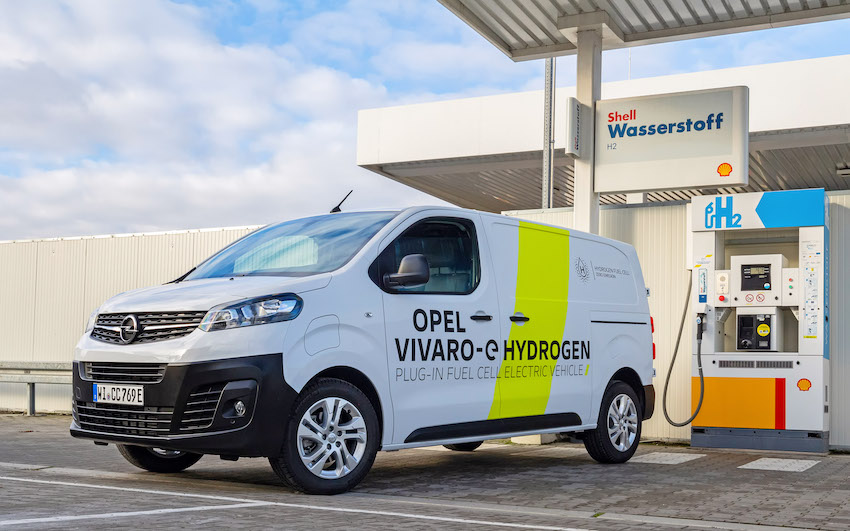

The first Opel Vivaro-e HYDROGEN has rolled off the factory production line at Opel. The hydrogen-powered van has been produced for Miele, manufacturer of household appliances. The German company will deploy the van daily in the Rhine-Main region.
Stellantis, parent company of Peugeot, Opel, Citroën and Fiat, announced in April its commitment to hydrogen-powered vans. Existing models of vans from these brands will be adapted for hydrogen driving by Stellantis. Specifically, the Citroën ë-Jumpy, Opel Vivaro-e and Peugeot e-Expert are the basis for this. The electric drive of these vehicles is supplemented by a fuel cell. This fuel cell produces electricity from hydrogen using a chemical process.
Range of more than 400 km
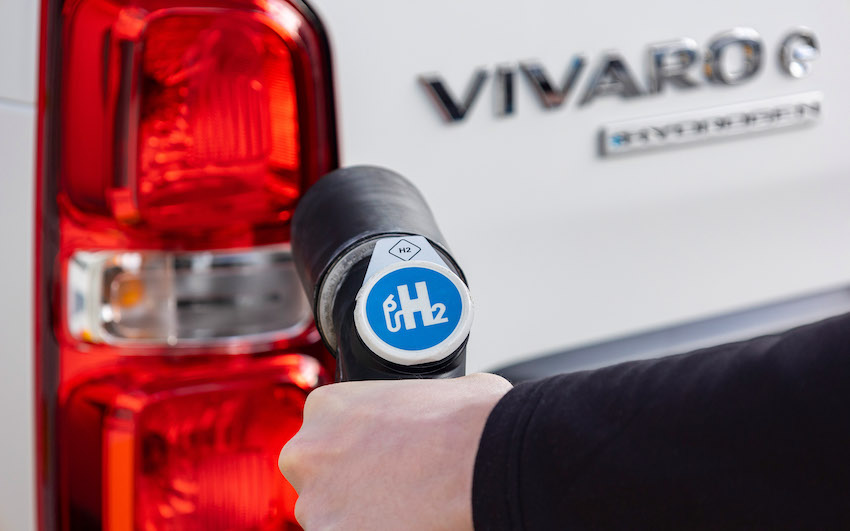
The Opel Vivaro-e HYDROGEN that has now rolled off the production line offers - with full hydrogen tanks - a range of over 400 kilometres WLTP. The vehicle is equipped with a 45 kW fuel cell, which generates enough power to cover long distances on motorways. The hydrogen tank can be filled up in just three minutes, which is comparable to refuelling a conventional diesel or petrol tank.
The vehicle is also equipped with a 10.5 kWh lithium-ion battery. This battery provides peak dynamic power. This can be used, for example, during take-off and acceleration. Stellantis reports that the battery storage serves as a reserve in such situations and ensures that the fuel cell can always operate under optimal conditions. In addition, the brand deploys the battery to store energy generated using regenerative braking. It is also possible to charge the battery using a plug, for example at a charging station. This can increase the vehicle's range by 50 km. The Vivaro-e HYDROGEN comes standard with an 11kW three-phase on-board charger and a charging cable.
No concessions on cargo volume
Stellantis stressed that despite the presence of a fuel cell, it does not compromise on cargo volume. The Vivaro-e HYDROGEN is available with a load volume of 5.3 to 6.1 m3 and available in length M and L, which are 4.95 and 5.30 metres long respectively. The payload is up to 1,000 kg.
In terms of safety, the hydrogen-powered van features several systems. These include a reversing camera with 180-degree vision, Blind Spot Alert and Park Pilot front and rear. Also present is the Multimedia Navi Pro infotainment system, which can be operated via voice or colour touchscreen. This system also offers support for Apple CarPlay and Android Auto.
Driving long distances emission-free
Opel CEO Uwe Hochgeschurtz and Head of Development Marcus Lott were present at the production launch in Rüsselheim. Hochgeschurtz: "With the new Opel Vivaro-e HYDROGEN, we are starting the next chapter of our sustainable mobility offering. The clever concept combines the advantages of hydrogen propulsion with the versatility and features of our best-selling light commercial vehicle."
Lott added: "The new Opel Vivaro-e HYDROGEN perfectly meets the requirements of fleet operators. The hydrogen-powered van is the ideal solution for travelling long distances emission-free without losing time recharging batteries. The Opel Vivaro-e HYDROGEN brings emission-free mobility to the future, especially for business use."
Volkswagen Crafter HyMotion
Stellantis not the only brand betting on hydrogen-powered vans. In 2018, for instance, Volkswagen already announced the Crafter HyMotion, a Volkswagen Crafter with hydrogen fuel cell. This is a 4.2-tonne van with a range of over 500 kilometres. The Crafter owes this range in part to its hydrogen tanks with a capacity of 7.5 kg of hydrogen. The Crafter HyMotion consumes 1.4 kg of hydrogen per 100 km. A refuelling stop takes just 4 minutes.
Like the Vivaro-e HYDROGEN, the Crafter is equipped with a lithium-ion battery. In this case, it is a 13.1 kWh one. The 30 kW fuel cell acts as a range extender. The Crafter HyMotion features the same 100 kW electric motor and transmission as the e-Crafter.
Renault also opts for hydrogen
Another example is Renault, which together with partner Symbio already introduced two light commercial vehicles with a hydrogen range extender in 2019. At the time, these were the KANGOO and MASTER Z.E. Hydrogen. However, both models eventually never appeared on the market.
Renault entered into a new partnership with Plug Power in early 2021. This collaboration led to the creation of HYVIA. This company is now launching a trio of hydrogen-powered light commercial vehicles. These include a van, a chassis cab and a small city bus. HYVIA also supplies hydrogen refuelling systems to entrepreneurs in support of these vehicles.
Three models
The Renault Master Van H2-TECH features a 30 kW fuel cell and 33 kWh battery. The tanks offer capacity for 6 kg of hydrogen. The vehicle has a cargo volume of 12 m3 and a range of up to 500 km.
The Renault Master Chassis Cab H2-TECH is tailor-made for conversions. The 19 m3 van is aimed at, among other things, large goods and parcel transports, with a payload of up to 1,000 kg. The vehicle is equipped with a 30 kW fuel cell and 33 kWh battery. The hydrogen tanks hold 3kg of hydrogen. The range is around 250 km.
The Renault Master city bus H2-TECH accommodates up to 15 passengers. The vehicle is equipped with nine seats and six stacking seats. The vehicle is equipped with a 30 kW fuel cell combined with a 33 kWh battery. The tanks accommodate 4.5 kg of hydrogen. This gives the vehicle a range of about 300 km.
Author: Wouter Hoeffnagel











