
The biggest challenge for offshore hydrogen production appears to be not the electrolyser or the technology itself, but the integration of engineering, infrastructure and regulations, as well as coordination between the parties involved. That is the main conclusion from the final report of the PosHYdon project.
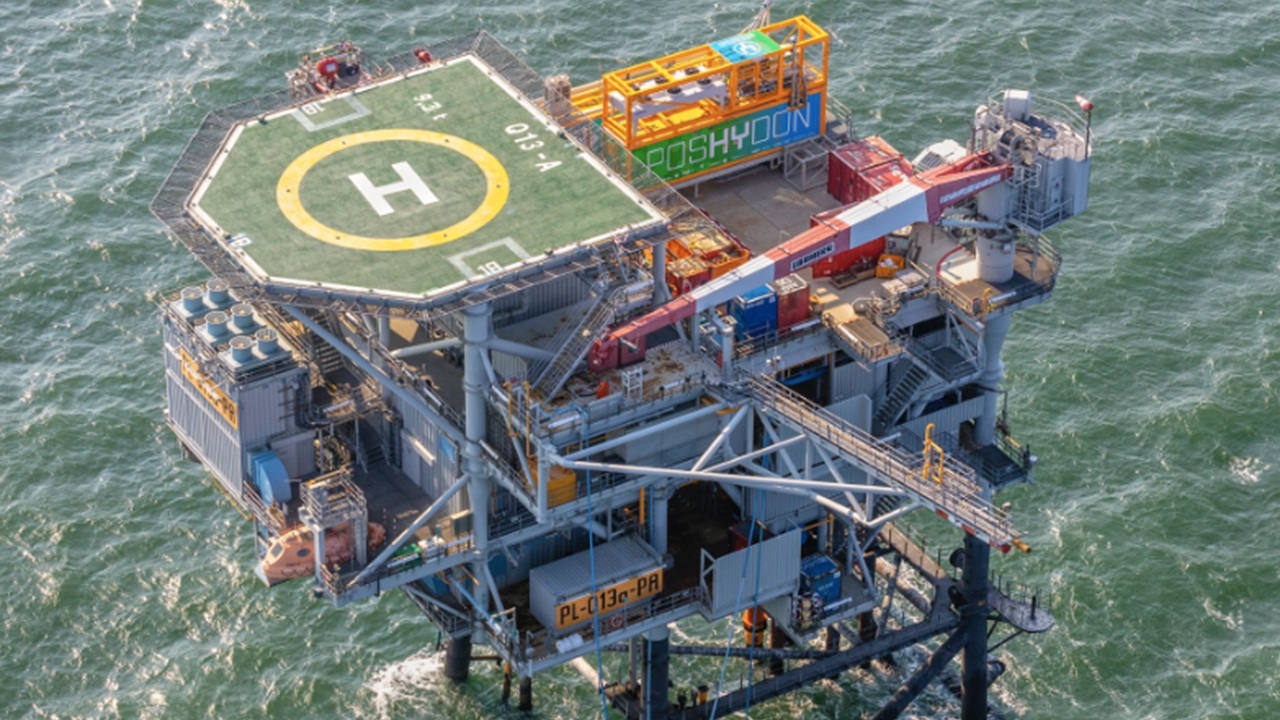
Fifteen public and private partners gained practical experience in the PosHYdon project with the production of green hydrogen from seawater using green electricity from offshore wind on the Q13a-A platform, approximately thirteen kilometres off the coast of Scheveningen. Offshore wind energy, seawater desalination, electrolysis and existing offshore infrastructure were tested in a single integrated system. This made PosHYdon the world’s first offshore project for hydrogen production and transport on an operational production platform. It also provided insights into what is needed to enable the larger-scale application of offshore hydrogen in the future.
Key lesson from PosHYdon
“Many people think the big question is whether we can produce hydrogen offshore. In PosHYdon, we were able to answer that question in the affirmative. But the real lesson is that successful offshore hydrogen projects stand or fall on system integration. You have to approach technology, infrastructure, permits, safety and market players as a single entity from day one. That is precisely why pilots such as PosHYdon are so vital; in a controlled environment, we discover what is needed to actually realise new energy systems. This is how we turn plans from paper into reality. “The lessons and insights we have gained in the process make this pilot particularly valuable,” says René Peters, Business Director for Energy Infrastructure at TNO.
Appoint a system manager
A key recommendation from the final report is to appoint a single, clear system manager in future projects. Such a party can ensure coherence between all technical, operational and organisational aspects of a project and prevent risks arising at the interfaces between different organisations and systems. This is an essential starting point for the far-reaching integration of energy systems.
A foundation on which to build
Minister Stientje van Veldhoven-van der Meer, Minister for Climate and Green Growth: “Technology is only half the story. PosHYdon demonstrates how important it is to work together on permits, regulations and practical challenges. Pilot projects provide the evidence needed to make informed decisions. The results and lessons learnt from PosHYdon give others a foundation on which to build. Let’s use that knowledge to continue working towards a reliable energy system.”
Practical implementation is proving to be more complex than the technology alone
During the project, it became clear that many challenges lie at the interfaces between different disciplines and organisations. These challenges concerned not only the performance of the electrolyser, but also issues such as operational procedures, licensing processes, regulations, infrastructure and the division of responsibilities between the parties involved. Among other things, PosHYdon investigated the technical, operational and organisational conditions required to make responsible use of existing infrastructure (such as existing gas pipelines) within future hydrogen systems.
Hydrogen blending
A concrete example is the authorisation to blend more hydrogen into the existing regional natural gas network. The permitted concentration had to be increased from 0.02 to 0.5 per cent by volume. To obtain this authorisation, it had to be demonstrated that the higher hydrogen concentration would not have any adverse effects on, amongst other things, the infrastructure, gas quality and metering systems. Following technical investigations, risk analyses and consultations with, amongst others, the Ministry of Economic Affairs and Climate Policy and network operators, authorisation was granted. This experience demonstrates that it is not only the technical aspects that matter, but above all the timely alignment of regulations, interests and perceptions of risk.
Key lessons for the North Sea of the future
Permits, safety analyses and coordination with regulators must be addressed at an early stage of a project. These key factors help determine how quickly innovative energy projects can be taken from concept to reality. The final report of the PosHYdon project brings together technical, operational and regulatory lessons learnt from several years of practical experience. The knowledge gathered can be utilised by industry, public authorities, infrastructure operators, investors and developers of future offshore energy projects. It thus provides a knowledge base for the further development of hydrogen production in the North Sea.
Consortium
The project was realised with the support of a broad consortium of public and private organisations: DEME, EBN, Emerson, Eneco, Eni, Gasunie, Hatenboer Water, Investa Expertise Centre, IV Engineering, Nel, Nexstep, NGT, Nogat, TAQA Energy and TNO.
Source and image: PosHYdon
Read also: Government invests 450 million euros in underground hydrogen storage