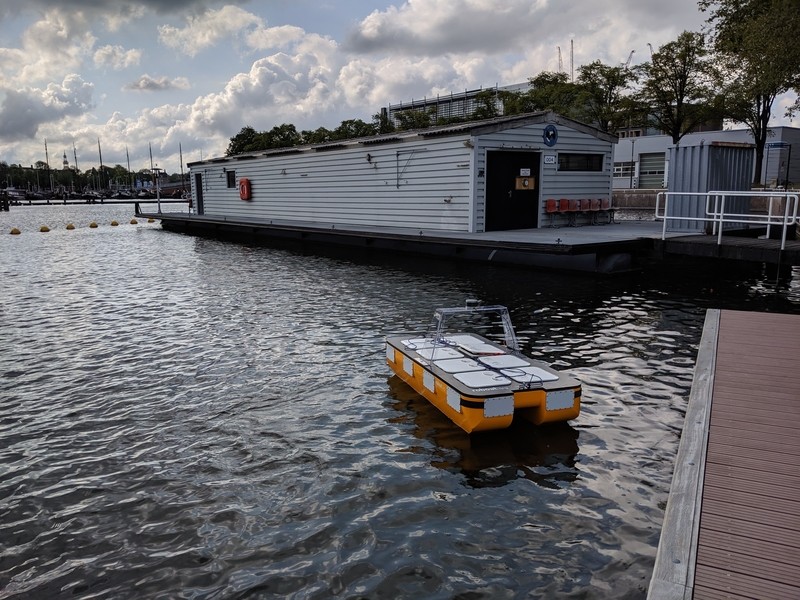

The world's first fleet of autonomous boats is growing - literally. After years of testing and upgrading, MIT's self-propelled Roboat is now twice the size allowing it to carry two people at once. The boats are also more intelligent and can now move in coordinated groups.
The Roboat project began in 2016 as a series of floating platforms that could sail autonomously, carrying passengers and cargo, monitoring the environment or making connections for temporary bridges or stages. In 2018, they were upgraded to become smarter and more agile, and in 2019 they were given the ability to be merged into different arrangements.
Passenger transport
A new upgrade was recently carried out. Whereas previous models had a maximum length of 1 m, the new Roboat II has a length of 2 m, finally making it big enough to carry passengers. Two researchers demonstrated this by climbing into the boat in pairs and then running the boat.
Roboat II is now also much smarter thanks to a new 'Simultaneous Localisation and Mapping' (SLAM) algorithm that helps the craft find the fastest and most direct route to its destination. Something that requires constantly updating the plan while the algorithm detects its surroundings with lidar (a kind of laser rangefinder), GPS and an inertial measurement unit (IMU).
Uber service
Eventually, the team wants to come up with a kind of Uber service for on water. When a customer places a request, a system controller assigns the nearest Roboat to pick up the customer. The boat will then make its way autonomously using the SLAM algorithm. During tests, the team steered the Roboat II through the canals of Amsterdam and the boat was able to complete a three-hour round trip with a margin of error of just 17 cm.
The development of an autonomous boat capable of accurately mapping its location, robustness and human transport is a crucial step towards implementing the system in the full Roboat. The research team hopes it will eventually be implemented in other boats to make them as autonomous as well.
The Roboats do not work in isolation so the team has also equipped them with a new system that allows them to interconnect and move together as a kind of swarm. One Roboat is designated as the leader and this boat receives the destination instructions. There is no direct communication between the leader and the followers - instead, the followers estimate where the leader is going and try to keep up with him.
Current collaboration algorithms rarely consider dynamic systems on water. When a team of water vehicles work together to transport people or goods, it presents unique challenges not encountered in air or road transport. For example, inertia and load on the vehicles become more important factors that make the system more difficult to control.
The team tested groups of three Roboats connected at both ends or side by side and showed that they could navigate well to determine destinations in both configurations.
Watch Roboat II in action in the video below.