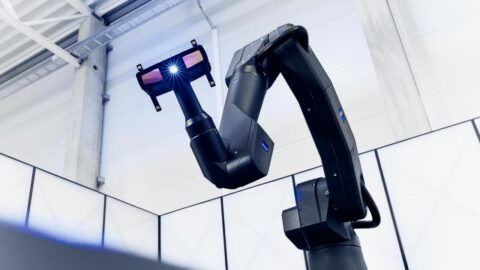
The automotive industry is increasingly using collaborative robots: robots that can safely work closely with humans. Volkswagen, for example, announced in late 2016 that it had developed its own collaborative robot, and BMW employees have been working closely with robots since 2013. But as production workers, how do you teach your employees to interact with these kinds of robots? Smart Robotics is setting up a robot academy for this purpose with support from both the government and universities, where 30,000 people a year can be trained to use collaborative robots.
Collaborative robots are a quantum leap from traditional industrial robots. Unlike their big industrial brothers, collaborative robots are equipped with sensors that detect the presence of humans and adjust their behaviour accordingly. If the robot does unexpectedly come into contact with a human, this collision is detected, preventing serious injury. This 'awareness' ensures that, unlike industrial robots, collaborative robots do not need to be placed in safety cages.
Working safely with humans
A key feature of collaborative robots is therefore their ability to work closely with humans. For example, the robots can perform repetitive tasks for humans and thus relieve humans. Smart Robotics is an employment agency for these types of robots, helping companies flexibly adjust their production capacity with them. "We supply robots that can be easily learned, creating flexibility for our customers. Those who purchase or hire a robot are thus not tied to one specific task, but can also train the robot for other tasks. This makes our robots a tool that customers can use to perform different activities," says Heico Sandee, one of the founders of Smart Robotics. The robots are therefore equipped with smart software, which allows the robots to be programmed for a new task without the intervention of a robot programmer.
"Repetitive tasks such as packing boxes at the end of a production line will increasingly be taken over by robots. This is inevitable given the relatively high cost of labour in the Netherlands. As companies in the Netherlands grow, automation in factories will also increase. However, a robot remains a fairly simple machine that still very much needs human creativity," Sandee said. The co-founder of Smart Robotics therefore does not expect humans to disappear from production environments any time soon. "Where an employee now packs boxes at the end of the line, for example, in the future the same employee will control several robots that have taken over this task. So those who learn to deal with robots now need not fear losing their jobs in the future."
Theory and practice
This is why Smart Robotics is now establishing a robot academy, where production managers can go to train their employees on how to use the robots. Per year, 30,000 employees can attend training at the academy. This training teaches them how to handle the robots and sets out their capabilities. "The training consists partly of theory and partly of practice. The theory part focuses on the use of collaborative robots in general, the use of new forms of automation and smart industry. The practical part involves practising using the collaborative robots we supply ourselves," concludes Sandee.
It is not known when the robot academy will open its doors.
By: Wouter Hoeffnagel
Source: Volkswagen
Source: Smart robotics
Photo: Shutterstock