The Nederlandse Aardolie Maatschappij (NAM) recently experienced a major breakthrough. The NAM-designed RoBorg robotic crane was deployed offshore for the first time, where it managed to insert a camera cable into a gas well, among other things.
Together with Shell, NAM manages 44 natural gas wells in the North Sea. Many of these gas fields are getting empty, making gas extraction more costly. To bring down operational costs, many platforms have been simplified in recent years. Facilities such as gas treatment plants, accommodation areas, helicopter decks and lifting cranes have therefore been removed.
The RoBorg
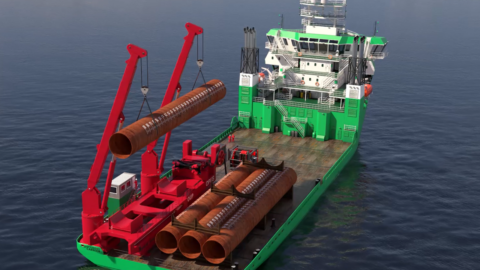
To continue inspecting and maintaining these simplified wells with the so-called sickline technique (a steel cable that hoists tools down), the KroonBorg was already introduced two years ago. This vessel, equipped with an innovative wave-compensating system, sails past platforms and safely deposits people and equipment on them. After a test on land in Groningen in the summer of 2016, the RoBorg was loaded onto this vessel in early February and then dropped off on the UK platform Leman Alpha.
Under the watchful eye of production technologist Robbert Kroes and well services engineer Wessel de Hollander, the inventors of the robotic crane, the RoBorg was loaded from the KroonBorg onto the platform. Kroes: "After our test on land, we knew the concept would work on its own. The challenge was that the Kroonborg could get close enough and put everything down exactly where needed. When that succeeded, the relief was great. From there, the situation was basically the same as on land; a routine job for NAM."

Work
The RoBorg's first job was to insert a camera cable into this well. "The production of Leman Alpha was declining recently so we wanted to do two things: firstly, to see what the pressure was of the gas reservoir at a depth of 4 kilometres and, secondly, to take a sample from the obstruction we encountered in the well. We will then send that to the lab after which we can possibly plan an intervention to (re)optimise production." Other work the RoBorg can carry out includes exchanging safety valves or putting a barrier in the well.
Efficient
The use of the robotic crane will make maintenance and optimisation of well production affordable again, according to NAM's Willem Rogge. "For NAM, this is a major breakthrough because we are now able to maintain and inspect multiple wells in an efficient way. So it was interesting to see how unloading from the KroonBorg would go. But this was done in no time."
The robotic crane is not fully automated; a number of technicians are still needed. But, says Robbert Kroes, these are far fewer than normal. "Using large working platforms required around 30 men. The same work can now be done with 3 technicians. We think NAM will benefit a lot from the RoBorg."
By: Kelly Bakker
Source: NAM