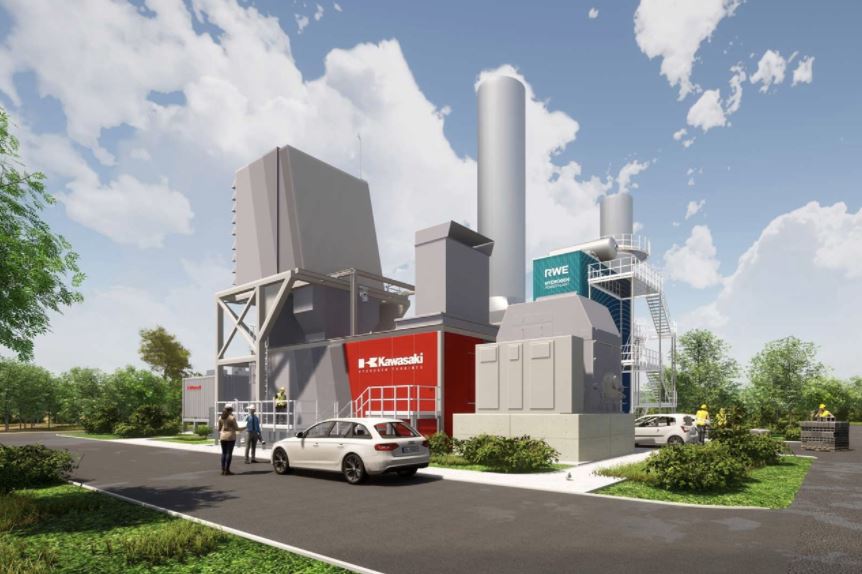

Turbine manufacturer Kawasaki Heavy Industries and energy company RWE are to build a hydrogen-powered gas turbine in Lingen, Germany. The companies will use the gas turbine to test the conversion of hydrogen into electricity.
As part of its “Growing Green” strategy, RWE made an announcement in November. The company plans to add at least 2 gigawatts (GW) of gas-fired power station capacity. This is to support the energy transition with flexible power supply. These new plants will have a clear decarbonisation pathway. For existing facilities, RWE is developing a roadmap to prepare them for clean operations.
100% hydrogen
Now comes the next step. Together with Kawasaki, RWE Generation SE (RWE) will build a hydrogen-powered gas turbine in Lingen, Germany. The project is one of the first in the world to use a gas turbine to convert 100 per cent hydrogen into electricity on an industrial scale. The power station, with a capacity of 34 megawatts (MW), is expected to be operational by mid-2024.
Combination of hydrogen and natural gas possible
Kawasaki's gas turbine offers maximum fuel flexibility. It can operate with 100 per cent hydrogen, 100 per cent natural gas and, moreover, any combination of the two. This is important because the amount of green gas available during the upswing in the hydrogen economy will often fluctuate before continuous green gas availability.
Fluctuations
During the pilot project, the intention is to test the turbine in different ranges. Think of percentages ranging between 30 and 100 per cent. This has everything to do with typical load curves of gas turbines inherent to a power grid with an increasing share of renewables. These are subject to fluctuations due to weather conditions.
Combustion systems
During the course of the project, it plans to use two combustion systems developed by Kawasaki. Both have already been tested in 1 MW variants in a demonstration project in Kobe, Japan. In Lingen, these technology principles would be scaled up to industrial scale for the first time.
All options under one roof
When it comes to the topic of hydrogen, RWE says it has all the options under one roof. Think green power generation and the know-how to produce and store green hydrogen. The company also has experience with regard to energy trading. It can supply fuel to industrial customers as required. RWE is already active in more than 30 hydrogen projects.
Lingen gets key role
The Lingen site plays a key role in RWE's hydrogen strategy: as part of the GET H2 project, the company plans to build the first 100 MW electrolysis plant there by 2024, which will produce green hydrogen with offshore wind energy from the North Sea. The capacity of this plant is to be expanded to 300 MW by 2026 and 2 GW by 2030. Indeed, the goal of the GET H2 project is to work with national and European partners to create the critical mass needed to develop a supra-regional European hydrogen infrastructure and develop a strong European hydrogen market.
Source and image: RWE











