
Engine or hydraulic oil sometimes enters the aircraft cabin via drained air. This is called a 'smoke event'. During a flight, it is not possible to determine whether this air pollution negatively affects air quality on board. This is where researchers have now found something.
Using the Bleed Air Contamination Simulator, BACS for short, researchers at the Fraunhofer Institute for Building Physics (IBP) can artificially simulate air contamination or smoke events on the ground. They do this by deliberately contaminating the air in the test facility with oils and de-icing agents. After this, they analyse the contaminated air. Based on the results, it is possible to draw conclusions about possible health risks.
Air contamination
Most aircraft directly vent the engine to supply and pressurise the passenger cabin. Under adverse and rare conditions, this bleed air contains engine and hydraulic oil or de-icing agents that can enter the aircraft cabin. They can affect the cabin air quality and cause unusual odours. This is known as smoke and odour nuisance. What quantities of degradation products accumulate in cabin air? What measures can be taken to minimise possible health risks? This has not yet been clarified. The rare smoke events are unpredictable, so it is not possible to identify and quantify associated pollutants in cabin air on regular flights.
Simulate
Researchers at Fraunhofer IBP are investigating whether cabin air contaminated with engine oil can harm the health of cabin crew and passengers. They are also investigating how this can be prevented and how risks can be detected in time to take action. With their Bleed Air Contamination Simulator (BACS), they can simulate pressure and temperature conditions in the air supply and deliberately contaminate the air with oil and de-icing fluids. Certain amounts of engine oil are added to hot compressed air to mimic the degradation processes that take place in bleed air. This allows detailed analysis of the products of these reactions, which can enter the cabin and cockpit when conditions are unfavourable.
Smoke events are rare
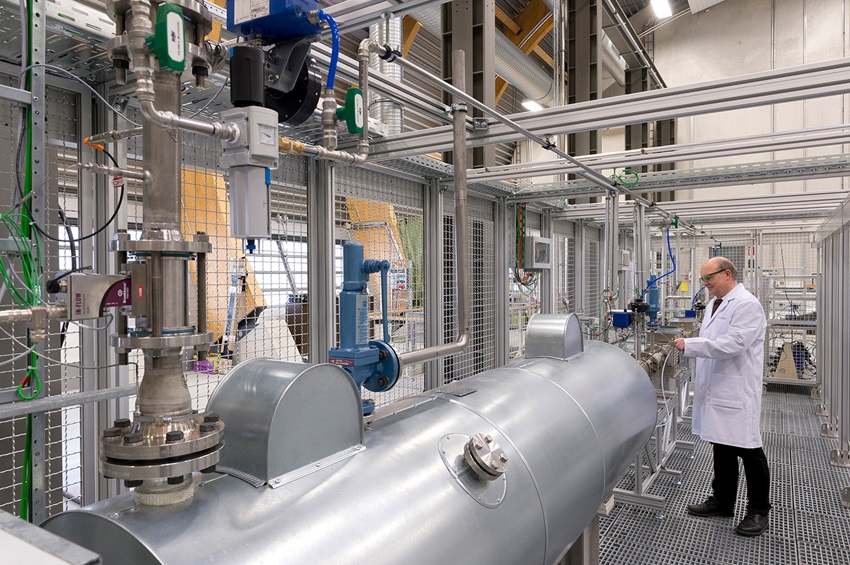
"Smoke events are rare and unexpected, so they cannot be captured with a predetermined number of test flights. With our test unit, we can perform these important investigations on the ground and repeat them as often as desired. This saves aircraft fuel and avoids unnecessary emissions and costs," says Dr Christian Scherer, head of the Environment, Hygiene and Sensor Technology Department at Fraunhofer IBP. The simulator is 20 metres long, 2 metres wide and 2 metres high. There are 40 connections where samples can be taken for online analysis and laboratory tests. The air flow rate is up to 300 kg/h, a fifth of the air flow rate in a long-haul aircraft.
Effects of air pollution
"So far, our tests have not confirmed the suspicion that substances generated during engine oil degradation, including organic acids such as valeric acid and trace organophosphates such as tricresyl phosphate, could have neurotoxic effects," says Dr Florian Mayer, a colleague of Scherer. The amounts of PM10 and PM2.5 particles generated are also negligible. However, there is a sharp increase in ultrafine particles less than 0.1 µm in diameter. The researchers also found no increase in CO or CO2. Detailed results, however, are still pending. They are expected sometime in 2025.
A unique test unit
To perform the analyses, ambient air is first drawn into a compressor. An air heater heats the air to a temperature of up to 590 °C, depending on requirements. Various concentrations of liquid contaminants are then fed into the hot air, which is compressed to up to 8 bar. Once the mixture of oil and air has passed through a mixer, decompressed to 3 bar and cooled in the first of two heat exchangers, researchers can take the first samples. The air then flows to the second heat exchanger, where it is further cooled and decompressed to ambient conditions until the air is at room temperature. At this stage, samples can be taken, for example for particulate matter (PM). A 300-litre vessel at the end of the line simulates the aircraft cabin.
Broad scope of application
"Our system is unique of its kind and has a wide range of applications. We do not only simulate the degradation of operating fluids in aircraft. Instead, the simulator offers us and potential customers a way to test the effectiveness of various air treatment technologies used in aircraft," says Scherer. The contaminated air can also be used to study the effectiveness of air purification systems such as filters, catalysts and converters. Sensors can additionally be studied to see how well they respond to pollutants. "Our measurements are accurate and close to reality, as we have demonstrated in several ways," says Mayer.
Featured image: Dr Florian Mayer prepares to carry out measurements on the Bleed Air Contamination Simulator (photo: Fraunhofer IBP)
Read also: Additive manufacturing can make the aerospace sector greener











