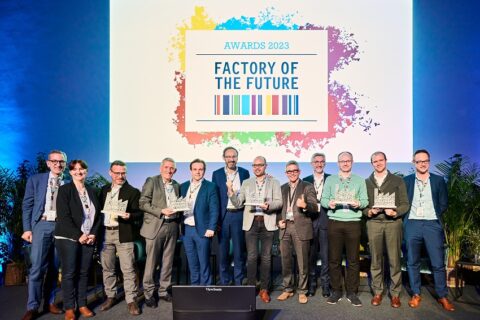
Choosing low-sugar or gluten-free? The app SmartWithFood gives personal advice on which product is preferred. The company, a subsidiary of the Colruyt Group, is betting on tailor-made nutrition with the app.
SmartWithFood developed a supermarket app that scans products to see if they match food intolerances or plans to eat less sugar. The app should help consumers make more conscious food choices and smoothly find the products they want or need for their health. By scanning product barcodes, customers can see at a glance whether the scanned product matches one or more personal nutrition profiles and also suggest alternatives.
The app recognises almost all products in Colruyt, Bio-Planet, OKay shops and also the Colruyt Group range at affiliated Spar shops. Consumers can also use the app at home.
The Belgian supermarket organisation participates with SmartWithFood in the international Personalized Nutrition and Health consortium. In this consortium, Colruyt investigates the role of sensors and trackers as well as blood and DNA analyses with partners in different disciplines . The aim is to formulate targeted nutritional advice for consumers via individual biological data.
App as lifestyle assistant
SmartWithFood serves as a practical lifestyle assistant on which the user enters his food profile once, and possibly also the profiles of family members or friends. He can also indicate whether the app should take into account intolerances or a vegetarian, vegan or alcohol-free lifestyle. In addition, he can specify more than 200 ingredient preferences or requirements.
After scanning the barcode, the app immediately shows whether the product fits the entered profiles. It also provides info on the nutritional values of the product and the equivalent physical activity (cycling, jogging) of the portion. The user can also request suitable alternative products. The SmartWithFood app then suggests all alternative solutions in the different Colruyt Group shops.
Pioneering in customised digital nutritional information
With SmartWithFood, Colruyt Group is initially focusing on a number of food profiles in need of reliable nutritional information. The app can make life easier for people with an intolerance to gluten or lactose, for example. The app is also a handy tool for people who want to eat vegetarian or want quick and accurate information on ingredients and nutritional values. Consumers may eventually be able to further add to their profile with personal preferences such as less saturated fats or a Mediterranean or low-sugar diet.
"We are convinced of the app's added value for the target group. Improving data quality is a continuous process in which we aspire to further refine the solid basis that is now in place together with our suppliers," states Business Unit Manager Ignace De Nollin of SmartWithFood.
"On the one hand, we live in busy times with an oversupply of information. Consumers can no longer see the wood for the trees. On the other hand, more and more people want or need to eat consciously, out of necessity or conviction, for their own well-being or for a better world. That is why we want to give consumers even easier access to transparent and reliable product information. Moreover, we now make it easier than ever to make the exact choices that fit into their individual diet."
In international consortium
SmartWithFood innovates in customised nutrition through the international Personalised Nutrition and Health consortium, which brings together food and technology companies. The public-private partnership, with an annual budget of some 3 million euros, is led by knowledge institution TNO and Wageningen University & Research. The consortium also includes names from the food and retail sector such as dairy group FrieslandCampina and supermarket chain Jumbo, as well as electronics group Philips, which participates with sensor technology.
"In the consortium, we can work multidisciplinary with partners in different studies to get a holistic picture. This includes the role of sensors and trackers as well as blood and DNA analyses to arrive at targeted nutritional advice based on individual biological data. In this way, we especially want to get a feel for possible scenarios that could come onto the market," says SmartWithFood's De Nollin.