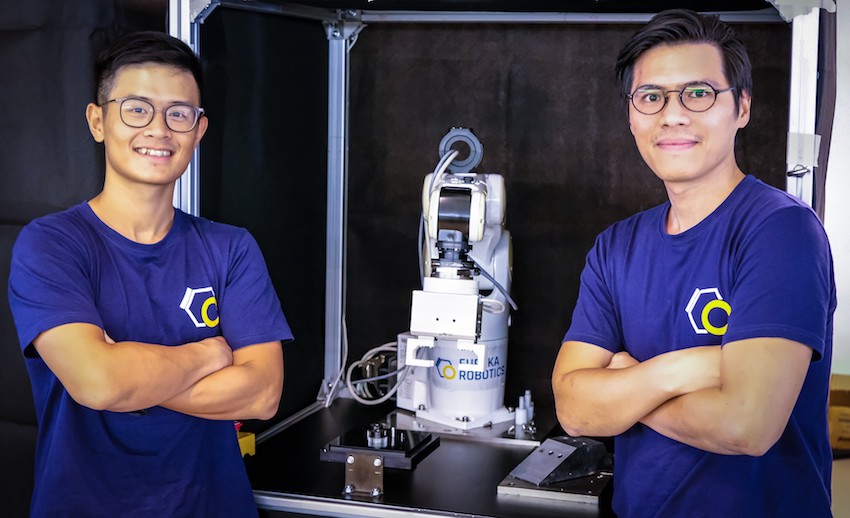

A new technology gives robotic arms almost the same sensitivity as a human hand. The technology has been developed by Singapore's Eureka Robotics, a spin-off from Singapore's Nanyang Technological University.
The technology is called Dynamis. It allows robotic arms to manipulate objects only a few millimetres large or thick. This without causing damage. Think of lenses, electronics components and very small gears.
Ikea Bot
Dynamis is a force feedback technology that has been in development for some time. The Eureka Robotics researchers first published about their technology in Science in 2018. At the time, they deployed it as part of the 'Ikea Bot'. This robot assembles an Ikea chair in just 20 minutes.
The technology has since been further developed. Thus, Eureka Robotics aims to make the technology suitable for a wider range of applications. The company is now making the technology available for various industrial robots from Denso Wave. This is a manufacturer of industrial robots and part of Toyota Group.
Integrated into robots from Denso Wave
In practice, this integration means that Denso Wave customers can now integrate Dynamis technology into their robots. This technology is part of the force controller. Using a force sensor on the robot's joint, this system detects what force is being applied to an object. Based on this measurement, the robot adjusts its force to the desired level.
Applying the right pressure is important. If too little force is applied, it may result in parts not being assembled correctly. However, if too much force is applied, the object may actually be damaged.
AI algorithm
Under the bonnet, Dynamis is a complex artificial intelligence (AI) algorithm developed by Associate Professor Pham Quang Cuong. He is Deputy Director of the Robotics Research Centre at NTU's School of Mechanical and Aerospace Engineering. For this, the professor collaborated Dr Hung Pham, one of his former students and now co-founder and CTO of Eureka Robotics. This company focuses on developing custom-made robots.
One example is Archimedes. This robot is focused on manipulating sensitive optical lenses and mirrors. Here too, the robot employs human-like dexterity. Archimedes is already in practical use by several companies worldwide.
Pythagoras
Another example is Pythagoras. This robot is aimed at manipulating 5G telecom lenses for inspection and cleaning purposes. Here, Pythagoras combines an accuracy of 0.2mm with high flexibility. Thus, up to 1,000 lenses can be placed randomly in a bin. The lenses can be interleaved and placed in any orientation.
A third example is Deep Visual Servoing for the electronics industry. Using technology, robots can position connectors. Here, the robot combines an accuracy of less than 0.2mm with the flexibility to place multiple types of connectors, among other things.
Further information on robots from Eureka Robotics is available here.
Holy grail
Eureka Robotics claims that many contemporary robots offer either high accuracy and low flexibility, or low accuracy and high flexibility. With Dynamis, the company aims to enable robots with high accuracy and high flexibility.
Professor Pham Quang Cuong calls sensitivity to touch and dexterity like human hands the "holy grail" for robotics. Among other things, the professor points to the complexity of programming the force controller. Perfecting a robot's grip for a specific task is very time-consuming.
Programming touch-sensitive tasks
"Dynamis today makes it easy for anyone to programme touch-sensitive tasks typically performed by humans. Examples include assembly, precise manipulations, polishing and sanding," says the professor. "These tasks share a characteristic: the ability to maintain consistent contact with a surface. If our human hands are stripped of our touch sensitivity - for example, by wearing a thick glove - we may find assembling small Lego blocks very difficult. Let alone assembling the tiny components of a car engine or a camera for use in our mobile phones."
Hiroyasu Baba, FA/Robotics Business Unit Product Planning Department, Manager at Denso Wave, points out that NTU Singapore and Eureka Robotics have been using DENSO robots for some time. "Thanks to this relationship, joint development started naturally. And we were able to launch this product smoothly. This technology, installed in DENSO robots, is a force feedback technology. This is becoming increasingly important in the practical use of robots. Thanks to Eureka Robotics' development, the system is advanced, yet easy to use and light enough for integration into our standard robot controllers."
Author: Wouter Hoeffnagel










