

Hexagon develops digital reality solutions. The company recently introduced the Leica Blk Arc and the Leica Blk2Fly. They are two fully autonomous reality capture measurement solutions, the latest innovations in Hexagon's portfolio of accessible and easy-to-use laser scanners.
The Leica Blk Arc is a laser scanner. Its purpose is to improve the navigation of robots and other platforms to create fully autonomous, mobile laser scanning. When combined with a robot, the laser scanner is fast, accurate and flexible. It thus responds to the growing need for autonomous solutions. For example, with minimal user intervention, the laser scanners can create accurate 3D point clouds and/or images of changing environments in a safe and easily repeatable way.
Autonomous flying laser scanning device
The Blk2Fly is the first fully integrated, autonomous flying laser scanning device. With a few simple taps on a tablet, users can quickly, easily and accurately scan objects and environments from the air. Aerial scanning is an interesting option for various industries that need accurate data of inaccessible or hard-to-reach areas. Aerial recordings make it possible to realise a complete and accurate picture of the characteristics and dimensions of an object's exterior.
Visualisation platform
The Leica Blk Arc and Blk2Fly are directly connected to HxDR, Hexagon's cloud-based visualisation platform. There, scan data from the field can be uploaded and stored. AI applications process the data so that everyone can instantly see customised digital reality images.
The future of autonomous devices
"The Blk2Fly and Blk Arc show that Hexagon is working hard to realise a future with autonomous and smart capabilities for digital reality capture," said Ola Rollén, CEO of Hexagon. "The integrated software systems for the scanning devices have been custom developed. We aim for more autonomous and faster workflows for reality capture. Robots, sensors and software work together to execute reality capture projects as dynamically as possible ear a whole range of applications. Whether that is documentation of existing structures or monitoring and reconnaissance of remote and hazardous environments such as mines, factories, off-shore installations or fires."
Boston Dynamics Spot
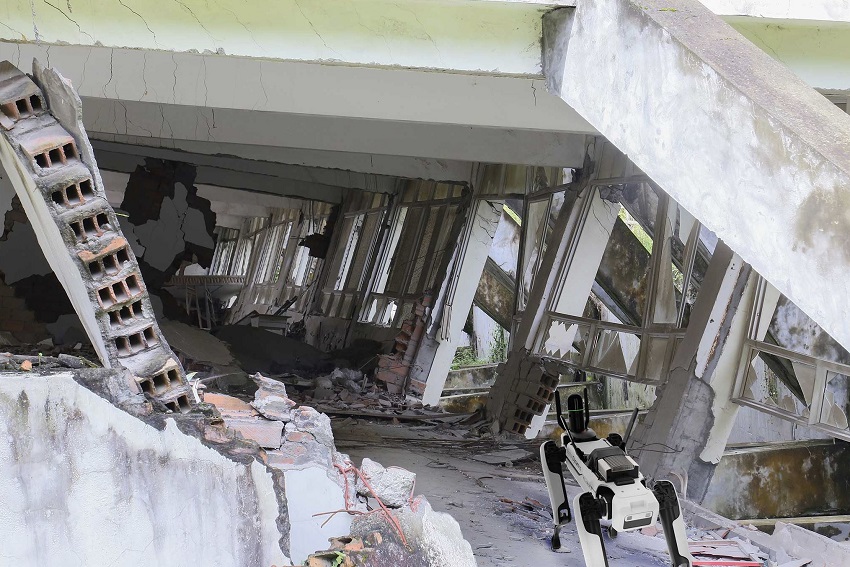
The first integration of the Blk Arc with robots was developed for the Boston Dynamics Spot. It is also suitable for other autonomous robotic platforms. For the first time, the integration of the Blk Arc with the Spot provided opportunities for fully autonomous, mobile laser scanning using a robot. The Spot carries the scanning device through the environment. At the same time, the scanning device enhances the robot's navigation using the acquired 3D data. The combination gives the Spot extended autonomy. This results in accurate laser scanning and navigation anywhere the robot can move. This greatly improves safe 3D modelling of hard-to-reach or inaccessible areas.
Safe autonomous flight paths
The Blk2Fly offers a whole new level of flight safety with advanced technology for autonomous obstacle avoidance. A combination of LiDAR, radar, cameras and GNSS ensure optimal and safe flight paths. Users can easily combine data from the Blk2Fly with interior scans of buildings and objects. These are acquired with the Leica Blk2Go, Hexagon's handheld 3D scanner. The coloured 3D point clouds and other construction site documentation provide an excellent basis for Building Information Modelling (BIM).
Image: Hexagon











