It has already passed in various general media. In Limburg and North Brabant, there will be a provisional stop for new companies and bodies that want a connection to the electricity grid, both for purchase and generation of electricity. There is also no more room for existing companies that want a heavier connection. But how to proceed now? TenneT explains what they will be investing in in the coming period.
The high-voltage grid in Limburg and North Brabant is almost at maximum capacity. This is due to the rapidly growing demand for electricity. Think of industrial electrification, large-scale battery systems and making mobility (charging stations) and the built environment (heat pumps) more sustainable.
Two billion euros
National grid operator TenneT will invest two billion euros over the next ten years to structurally increase the capacity of the grid. At the same time, the grid operator is launching a study. It wants to find out what possibilities there are to use other solutions to create more connection space more quickly. TenneT has formally notified ACM, the energy market regulator, about this.
Making choices
MaartenAbbenhuis, COO TenneT: "Economic developments and sustainability are continuing at a rapid pace. This is demanding more and more from the electricity grids, which were not originally designed for this. That is why we are expanding the grids substantially in the coming years. However, we cannot do everything at once and will have to make choices, together with the national and provincial governments, about where to prioritise. We are also deploying smart solutions to create additional space at an accelerated pace, for instance by making agreements with customers to relieve the grid when capacity is scarce."
Fast-growing demand for capacity
The rapid development of heat pumps, charging stations, new businesses and industry's sustainability initiatives is leading to an explosion in demand for electricity grid capacity. Over 800 megawatts of new requests have been added in recent months in North Brabant and Limburg. This is comparable to four times the capacity of the city of 's Hertogenbosch. Grid expansion is in full swing. But this is taking a long time. This is partly because of the search for suitable sites and long permit procedures. Another pain point is that there are only a limited number of staff to prepare and carry out all the work.
Consequences for society
This development is now causing bottlenecks in both provinces' high-voltage grids. This is the reason for announcing a provisional stop for companies seeking a new connection. This applies to both off-take and generation of electricity. As a result, applications from large business customers for a new or heavier connection to the electricity grid will be put on the waiting list. Connection is not possible until additional grid capacity is added.
No impact on small consumers and residential construction
For small consumers (such as residential customers) and residential construction, there are no consequences. Calculations around grid capacity take into account growth in current off-take. This includes newly built houses, or private individuals who want a heavier connection. Private individuals who want to install solar panels can also continue to do so. Transmission restrictions for generators only apply to large-scale solar or wind projects.
Investments in North Brabant
To increase capacity on the grid, TenneT is investing around two billion euros in both provinces over the next ten years. For instance, the existing 380kV connection (electricity highway) between Geertruidenberg and Maasbracht will be reinforced to transmit more electricity. In North Brabant, work is underway on new high-voltage substations in Halsteren, Boxmeer and Tilburg, among others.
Investments in Limburg
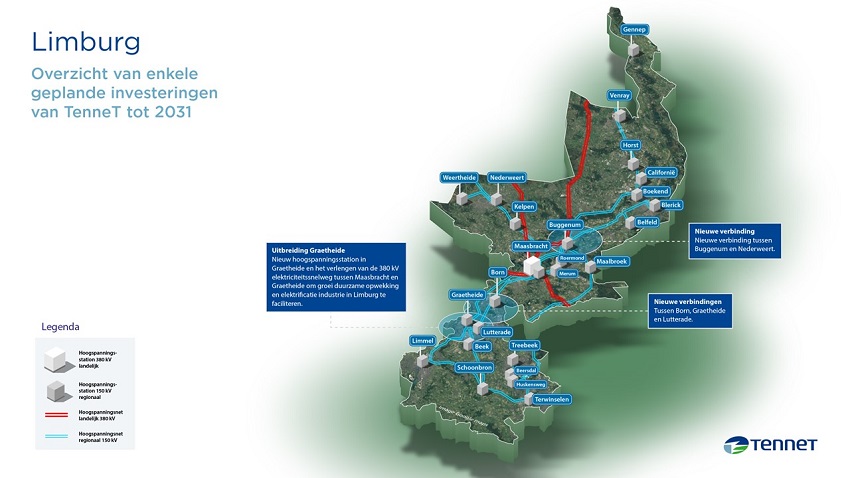
In Limburg, grid reinforcements are being worked on in the Graetheide, Born and Lutterade region, among others. These expansions are in preparation. They will be realised in the coming years and commissioned in phases. Meanwhile, Enexis Netbeheer will also continue to invest in the coming years to prepare the lower-lying network sections for the energy system of the future.
Congestion management
TenneT is also pushing for other solutions to use the existing grid more intensively and create additional capacity faster. One possibility is to deploy congestion management. This is a market mechanism in which connected parties make less use of the electricity grid against payment. This in turn creates additional capacity. TenneT is investigating this in the coming period. The results of the already ongoing study on feed-in are expected in September. The study on offtake at the end of this year.