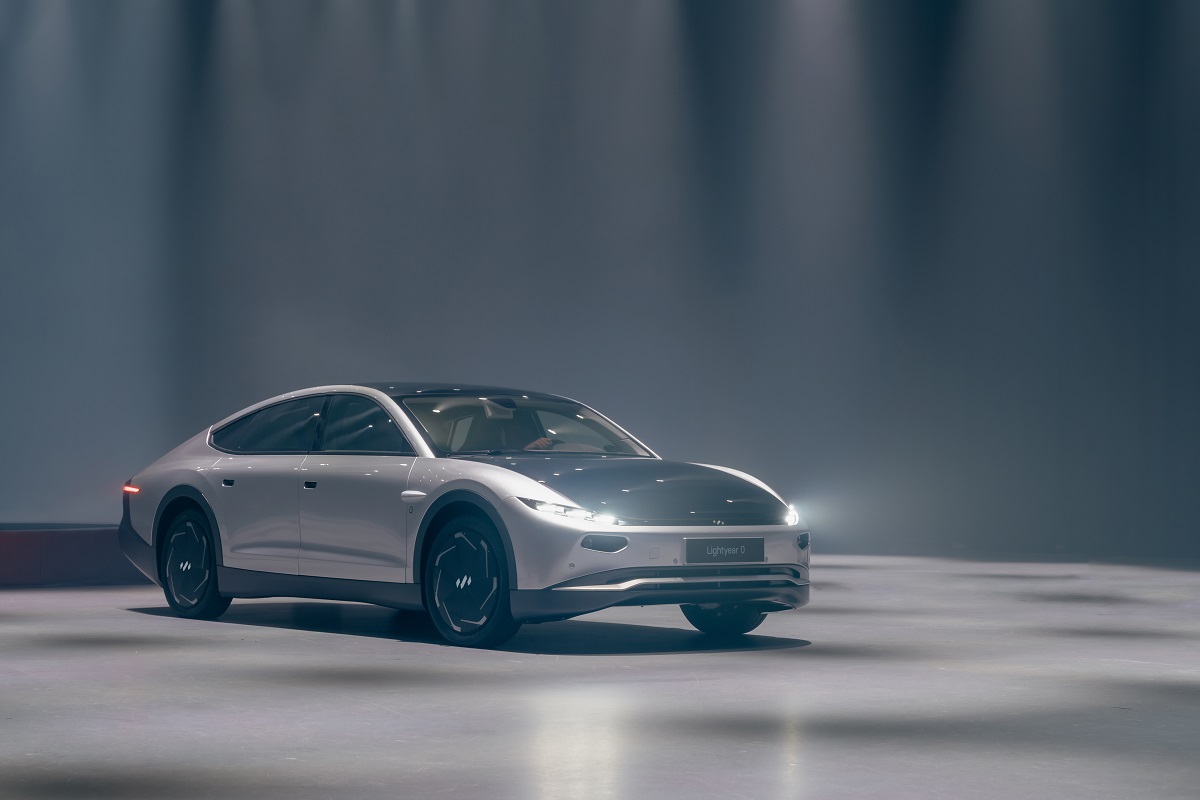

Lightyear has presented its production car Lightyear 0. After six years of research and development, designing, engineering, prototyping and testing, this solar car will go into production this autumn.
With Lightyear 0, the company offers a new future. A future for motorists who want to combine the freedom of mobility with the reassurance of renewable energy. Lightyear co-founder and CEO Lex Hoefsloot: "In 2016, we only had an idea. Three years later, we had a prototype. Now, after six years of testing, iterating, (re)designing and countless obstacles, Lightyear 0 is proof that the impossible is actually possible."
Double curved solar panels
The Lightyear 0 is equipped with five square metres of patented, double-curved solar panels. This allows the vehicle to charge itself while commuting. Or when the car is simply parked outside. In optimal conditions, the Lightyear 0 can thus power itself with a range of 70 kilometres per day. This is on top of the estimated 625 kilometres of range through the battery.
Months without a charger
Yielding up to 11,000 solar kilometres per year, motorists using the Lightyear 0 for their daily commute (35 kilometres) can drive for months in summer before needing to connect to a charger or power socket. In the Netherlands, that would be two months and in sunny countries like Spain or Portugal as long as seven months.
New architecture
Lightyear 0 reinvents the wheel when it comes to electric car architecture. Its four in-wheel motors make it the most efficient electric powertrain available today. With an energy consumption of 10.5 kWh per 100 kilometres (at 110 km/h), it is the most efficient electric car. Its drag coefficient is less than 0.19. This makes it the most aerodynamic family car to date.
Weight
Besides aerodynamics, the weight of the car also affects its efficiency. Lightyear 0 is a five-metre-long electric car but weighs only 1,575 kilograms in total. The strength of the holistic design becomes clear in practice. At motorway speeds (110 km/h), the Lightyear 0 can travel 560 kilometres in a row.
Minimalism, sustainability and comfort
From its origins, Lightyear has strived to develop a car that eliminates pressure on the planet and on the motorist. That is why every design detail has taken minimalism, sustainability and comfort into account. The streamlined dashboard has a 10.1-inch touchscreen infotainment system. It allows cloud-based updates. The interior is composed entirely of vegan and natural materials. These include ecological microfibre suede seats and rattan palm detailing.
Production starts this autumn
Production of the Lightyear 0 will begin this autumn. The first car will be delivered in November. Lightyear is preparing to put the first solar cars on the road. It has therefore chosen to officially unveil its first car with a name that reflects this journey. Lightyear 0: the car that is paving the way for a new era of clean mobility.
250,000 euros
A maximum of 946 Lightyear 0s will be produced, each priced at 250,000 euros. This will enable this new form of mobility to be effectively introduced to the market. Lightyear will then launch its next model. This will be designed for mass production with a price tag starting at 30,000 euros. Production is scheduled for late 2024 or early 2025.
Photo and source: Lightyear











